



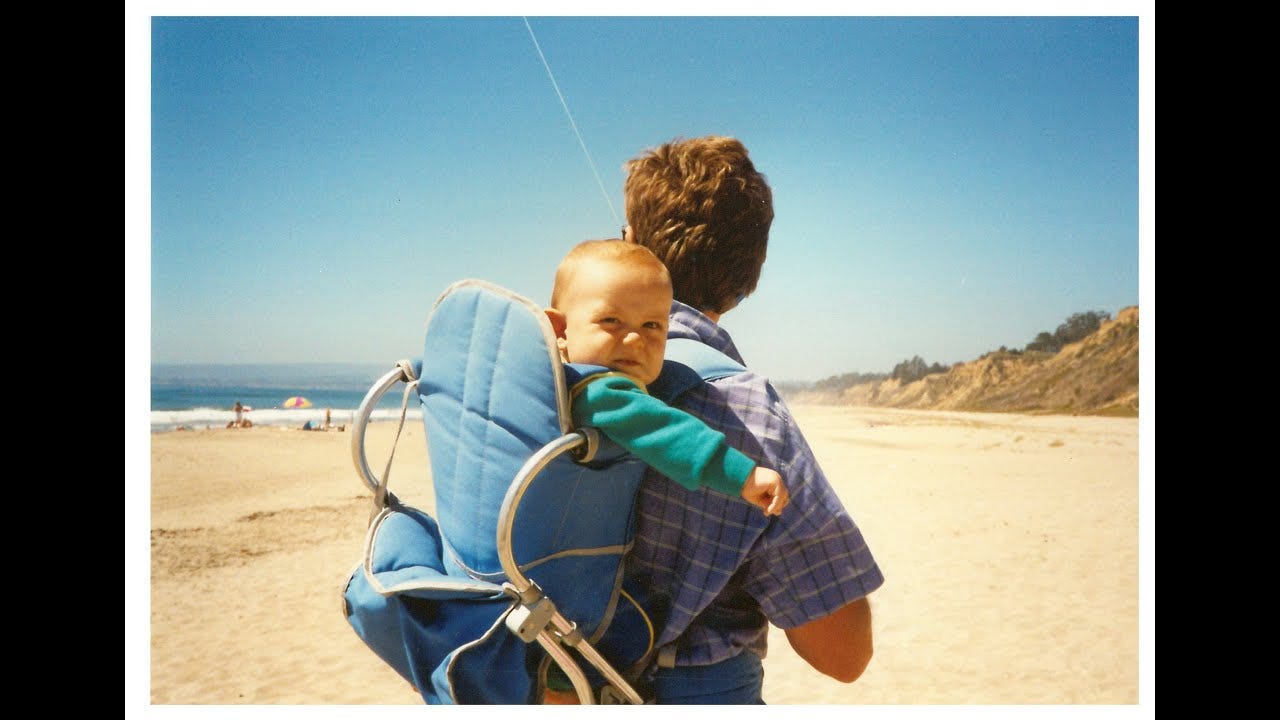
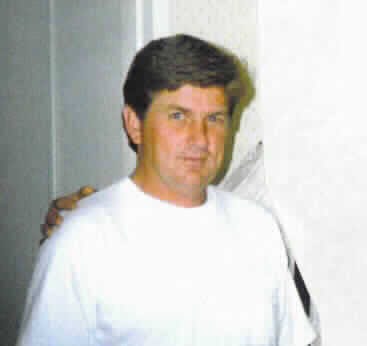
The last confirmed photograph of John Curely Hartenfeld shows a man built for the outdoors — six feet tall, around 200 pounds, with brown hair and hazel eyes. His friends remember him first as a surfer. His wife remembers how much he loved his children. His son, James, remembers the feeling of looking under beds and in closets, waiting for his father to jump out and say it was all a prank.
It wasn’t a prank.
On the morning of Saturday, August 2, 1996, John Hartenfeld, 46, stopped at High Desert Angler, a fly fishing shop in Santa Fe, New Mexico. He was heading out for a weekend solo trip — a chance to get away, to be alone with the water, to breathe. He climbed into his 1996 beige and gray Toyota 4-Runner, New Mexico plate 724 HYX, and drove north toward the mountains.
He was never seen again.
Nearly thirty years later, his son James — a Portland-based stand-up comedian who has spent most of his adult life carrying the weight of this unanswered question — is making a documentary series about it. The project is called My Little Cold Case. And in a development that stopped James in his tracks just weeks before this interview, New Mexico cold case investigators recently called to say they had found remains in the area where his father disappeared, and that they needed his DNA.
The Last Trip
In the summer of 1996, John Hartenfeld was living in Santa Fe, working as a project manager for a bank that had hired him to oversee suburban construction and development projects across New Mexico and into Colorado. It was not the work he had imagined for himself. John was a builder at heart — the kind of man who wanted to make coffee tables, custom homes, things that were one-of-a-kind. The corporate development work paid the bills, but it caused friction.
He and his wife were at odds about where the family was living, and what their life in New Mexico looked like. The argument that preceded his final fishing trip was part of a longer disagreement about all of it.
The arrangement they reached was straightforward: John would take a solo fly fishing trip into the mountains of northern New Mexico, and his wife would take the children up to Northern California to visit her family. Two separate trips, both of them a breather from the tension at home. John had spots picked out. He knew the water up near Valle Vidal, a sprawling wilderness area tucked into the Sangre de Cristo Mountains close to the Colorado border. He had also reportedly considered heading toward Conejos County in southern Colorado, west of Trinidad.
He stopped at High Desert Angler before he left — a last gear check, a hello to the people who knew him as a regular. That stop was the last confirmed sighting.
A day or two passed. His wife noticed she hadn’t heard from him. The family drove home from Northern California without making much of it at first. But when they got back, John wasn’t there. He was supposed to already be home.
“I remember looking for him in the house,” James recalled in an interview. “And that’s a hard memory to be like, oh, well, dad’s funny — he’s probably pranking us. I remember just looking under beds and in closets like a kid. And then I remember the feelings intensifying, and it got snowballing pretty quickly.”
A Credit Card, a Chainsaw, and a Wiped-Down Truck
What followed the disappearance is a sequence of details that, individually, might be explained away. Together, they form something darker.
The first alarm was the credit card. Four days after John left for his fishing trip — on August 6, 1996 — one of his cards was used at a gas station in Taos, New Mexico. But the purchase was unusual in a way that has stayed with James ever since. It wasn’t a tank of gasoline. It was a small amount — the kind of quantity consistent with two-stroke fuel, the specialized gas used for equipment like chainsaws and weed trimmers.
“It was like something that’s used for a chainsaw or something like that,” James said. “So it was weird, like my dad wouldn’t buy that much gas. Super weird. And then where it gets gnarly is using phrases like dismemberment and stuff like that — that’s coming up in the investigation and correspondence, where it’s like, is this being used for a machine to dismember a body?”
James paused. He noted, with a generosity toward his father’s memory that speaks to who John was, that he could also picture his dad buying a stranger a few dollars’ worth of fuel out of simple kindness. But the investigators didn’t frame it that way.
Then came the vehicle.
On October 19, 1996 — more than two months after John disappeared — hunters found his Toyota 4-Runner sitting on the Rio Costilla Livestock Cooperative, a remote stretch of privately held ranch land in the Amalia-Costilla area near the New Mexico-Colorado border. The discovery should have cracked the case open. Instead, when investigators processed the truck, they found that it had been wiped. Completely. Every surface that might have held a fingerprint had been cleaned.
“I find that incredibly strange,” James said. “Did police have any theories as to, I guess, just people covering their tracks?”
The answer, he said, was essentially no — not in any definitive sense. Investigators considered two possibilities: that whoever moved the truck simply didn’t want to be connected to it, or that they had done something to John and were trying to eliminate evidence. Neither explanation was ever attached to a name or a prosecution. And there was a further complication — James revealed in the interview that among the loose collection of people investigators considered as possible persons of interest, everyone who was asked to take a polygraph refused.
“Someone’s Messing with My Car”
Perhaps the most chilling detail to emerge from James’s account is one that didn’t appear in any newspaper at the time.
Before John Hartenfeld vanished, he spoke with one of his closest friends — a man James referred to affectionately as Muggsy, whose real name was Mike Yap. It was one of the last conversations John had.
“One of the last conversations Muggsy had with my dad was my dad saying, ‘Hey, it’s weird out here. Someone’s fucking with my car,’” James said. “And that is a really alarming thing to hear.”
It suggests that John Hartenfeld was aware, in the final hours or days of his life, that something was wrong. That he was not alone out there in the way he had planned to be. That whatever happened to him may not have been sudden — someone had been near his vehicle before the confrontation, whatever that confrontation ultimately was.
James let the silence sit on that for a moment before continuing. “So, who was that? And why?”
The Land and the Tension
The area where John Hartenfeld was fishing — the remote mountains and valleys of far northern New Mexico, close to the Colorado border — is not simply wilderness. It is country with a complicated human history, where questions of land use, access, and belonging carry real weight.
James raised a dimension of the investigation that he described as difficult to talk about, but important.
“They thought that the biggest motive was that he was fishing in an area where he shouldn’t have been,” James said. “He was on reservations, and in New Mexico at the time, there was a huge problem where they were like, a lot of white people are moving here, and this is causing a lot of tension in communities and in certain areas.”
This was, he said, probably the theory that came up more than any other in the early investigation. It’s not a comfortable framing — it raises sensitive questions about land rights, territorial disputes, and who bore responsibility for what happened — but James said it would be dishonest to ignore it. “That’s hard to bring up into the case. But it was also something that was probably brought up more than anything.”
He also raised a second line of speculation: whether John’s work in suburban development had put him in contact with people who weren’t trustworthy, or whether there were labor or union disputes connected to his construction projects. James was careful to call this speculation rather than theory. “I feel like that’s even too firm of a term to use,” he said. “People were wondering — was he wrapped up in working with some people that weren’t great? Were those unions weird or something like that?”
No firm line of investigation in that direction ever produced a named suspect.
The Search That Found Nothing
New Mexico State Police organized a major search-and-rescue operation after the vehicle was located. A ten-member team, a helicopter, and cadaver dogs descended on the terrain near Amalia. They covered the area thoroughly. The cadaver dogs tracked a scent from the spot where the truck had been found to a nearby road — and stopped.
“The search team has concluded its search and turned up nothing,” Sgt. Ted Branch told the Albuquerque Journal in early November 1996. “The cadaver dogs went to the spot where the vehicle had been found and then went to a road nearby and stopped. That’s where the trail ended.”
Investigators said they would look at whether John’s credit cards had been used further. Nothing publicly came of that inquiry. The case was officially entered as a missing persons file out of the Raton State Police.
A listing appeared in the Social Security Death Index for a J.C. Hartenfeld — born July 2, 1950, death listed as August 1996, Social Security number originally issued in California in 1966 — but no body had been officially identified, and no obituary was ever located. Whether the entry reflected an administrative presumption, a legal declaration, or something else has never been publicly clarified.
Then, in November 1997, hunters in rural Taos County discovered a human skull. State Police compared it against two names: John Hartenfeld and Ralph Herrera, another missing local man. Herrera had actually been found deceased in 1992 from natural causes — a record-keeping confusion that muddied the investigation. The NamUs case file for the unidentified skull recorded a conclusion both simple and devastating: “Unknown information about John Hartenfeld. No other follow up in case file.”
James has tried to have the skull compared against his father’s dental records. So far, he has hit a wall. The dental records from 1996 have proven nearly impossible to locate. “That’s a dead end for me right now,” he said. “I’m not giving up on the possibility of getting them, but I don’t know what those steps look like right now.”
New Remains, a Phone Call, and a DNA Test
The most significant development in this case in years came just weeks before James sat down for this interview.
New Mexico cold case investigators called him. They told him that remains had been found in the area where his father disappeared. They needed his DNA.
“I can’t believe it,” James said. “I’m probably three weeks ago now from the call from the cold case unit in New Mexico, and they were like, ‘We found some remains in the area your dad disappeared.’ And I’m now in this database because of friends who have been helping with my project.”
James’s first instinct was the logic of the modern era. He asked if they were going to mail him a tube to spit into. They told him that’s not how this works — Portland police would come to his home, and the process would be done properly, in person.
“That makes sense,” James said. “Everything needs to be as direct as possible.”
The visit hasn’t happened yet as of this writing. The investigators told him it could be weeks, possibly months. But the call itself represented something James had been waiting a long time to receive: an indication that the case was actively moving, that there were people on the other side working it.
“You wait so long for someone to help you with anything,” he said. “And especially with law enforcement.”
He was quick to add that even if the DNA test comes back and the remains don’t belong to his father, he intends to help connect the case to other families who might be searching. “If I’m not a match, I’m going to help other people who might be.”
Who Was John Hartenfeld?
James doesn’t talk about his father the way people talk about case files. He talks about him the way people talk about someone they miss.
John Hartenfeld was known, above everything else, as a surfer. His friends from Santa Cruz in the 1970s still bring it up decades later — the way he moved in the water, the level he’d reached, what a natural he was. He was a phenomenal swimmer in high school and middle school, and that translated into the kind of surfing that makes an impression. Even now, in conversations about what happened to him, his friends reach for the surfing first.
He was also a builder — not a developer, though that’s what the work had become by the end. He was someone who wanted to make things by hand. Custom furniture. One-of-a-kind pieces. Homes designed to be lived in rather than sold. He made gifts for people, handmade and considered, and people kept them.
“He was known for being really funny, but also could be very blunt with people,” James said. “He was very charismatic and social, but he was also very private, and needed to do things alone a lot as well.”
That duality — the man who filled a room and the man who needed to disappear into the mountains to hear himself think — is part of what makes the fishing trips so characteristic. John wasn’t going to Valle Vidal as an escape from himself. He was going to be himself.
His wife most often described him, James said, by talking about how much John loved his children.
James lost his father when he was a boy. He has spent his adult life in a creative career — stand-up comedy, acting, screenwriting — and there is something in that path that echoes his father. John was creative in ways the job didn’t always let him express. James has built a life on exactly that expression. He wraps up shows sometimes and thinks, that one felt right. That one was the kind of thing his dad would have appreciated.
“Sometimes I’ll leave a show and be like, I think he would have really liked that, or thought that was fun,” James said. “He really liked unique things that were kind of one-of-one.”
My Little Cold Case
The documentary series James is building around his father’s disappearance is called My Little Cold Case. It is a six-episode project, produced with friends in Portland, and it is explicitly not the kind of cold case content that most people are used to consuming.
“Such a high percentage of cold case projects are made because they’re called, but they have some closure to them,” James observed. “We get a lot more attention on cold cases that are relatively complete, and we don’t get to watch or experience a lot of cold case projects that are about things that are totally unsolved or more open.”
My Little Cold Case is for the other families. The ones who are still in it, still waiting, still waking up without resolution. James wants people who are living with open cases to watch the series and feel seen — to recognize themselves in what he’s going through, and to feel less alone in it.
The format he’s pursuing pushes against the conventions of the genre. It won’t be a standard documentary. It’s designed to be something that makes audiences both laugh and cry — exactly as the people making it have done throughout production. James is a comedian by trade, and he isn’t abandoning that to make something somber. He’s using it. Grief and comedy have always lived next to each other for him.
“My Little Cold Case is a project that reflects the importance of healing through both play and grief,” James said. “It’s ideally something that people who have unsolved cold cases are living with — hopefully it’s something they’re able to relate to and see themselves in.”
The project began conceptually in 2009, when James was a student at Humboldt State University and was simultaneously showing up in online forums, teaching himself how to pull public records so he could study what had happened to his father. It took fifteen years to become a production. Every step forward, James said, is invaluable.
What Remains
John Curely Hartenfeld is listed in NamUs as case MP127934 — missing from Raton, New Mexico, last contact August 2, 1996. He is also in the New Mexico Missing Persons database. Both entries were added recently, secured through the efforts of advocates outside the family who believed the case deserved renewed attention.
The DNA samples collected during the original investigation have never been tested.
The person who used John’s credit card on August 6, 1996, to purchase a small amount of two-stroke fuel in Taos has never been publicly named.
The Toyota 4-Runner, found with its surfaces wiped clean on private ranch land, has never been connected to a prosecuted suspect.
Every potential person of interest who was asked to take a polygraph refused.
Investigators — both law enforcement and private detectives hired by the family — concluded that foul play was the most probable explanation for John’s disappearance. No one has been held accountable.
And now, somewhere in a New Mexico evidence facility, there are remains that may or may not belong to a 46-year-old man who told his friend the week he died that someone was messing with his car — and who then drove into the mountains and didn’t come back.
The DNA test is pending. The call to Portland has been made. James Hartenfeld is waiting.
What You Can Do
Anyone with information about the disappearance of John Curely Hartenfeld is asked to contact the New Mexico State Police Cold Case Unit at (505) 841-9256.
The case is listed at NamUs case MP127934 at namus.nij.ojp.gov.
To follow or support James Hartenfeld’s documentary series, visit MyLittleColdCase.com.
Note: This article draws on publicly available newspaper archives from the Albuquerque Journal and the Santa Fe New Mexican (1996), documentation from the National Missing and Unidentified Persons System (NamUs), the New Mexico Missing Persons database, the Websleuths case forum, content published at MyLittleColdCase.com, and a first-person interview with James Hartenfeld. Some investigative details remain undisclosed by law enforcement. This article does not allege the guilt of any named or unnamed individual.


