


True Crime Has Been Popular Throughout Time
There is a persistent myth that true crime is a modern indulgence — a symptom of binge culture, streaming algorithms, and a society that has grown bored by ordinary entertainment. People who half-jokingly confess to spending weekends down podcast rabbit holes or refreshing Reddit threads about cold cases often speak as though they are admitting to something new, something historically unprecedented in its morbidity. They are wrong. The compulsion to consume, dissect, and moralize about real violence is not a 21st-century affliction. It is an American inheritance — woven into the fabric of this nation from its very first decades, present in every medium before that medium even had a name, and driven by forces so deep in human psychology that they have outlasted every technology that has tried to carry them.
This is the story of how true crime became America, and why America has never wanted it to stop.
The Puritan Scaffold: Where It All Begins
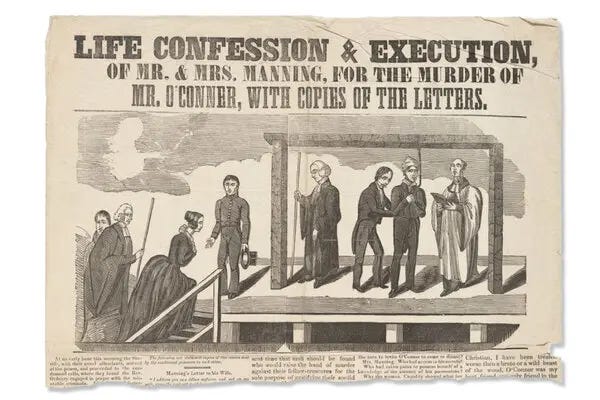
Before there was Serial, before there was Making a Murderer, before there was even a country, there were execution sermons.
In the Puritan settlements of New England — the communities that would eventually become the bones of the United States — crime was not merely a legal matter. It was a theological event. When a man or woman committed murder or some other grievous sin and was condemned to hang, the community gathered in extraordinary numbers to witness not just the death, but the narrative that accompanied it. Ministers delivered lengthy sermons at the gallows, and those sermons were printed and distributed throughout the colonies. These were the first true crime texts on American soil.
The earliest printed execution sermon can be traced to the 1670s as the earliest literary reaction to crime on American soil. Attendance at these events was enormous. Wayne C. Minnick suggests that audiences for execution sermons ranged between 550 and 850 people, adding that the pews were usually jammed and additional auditors stood about the walls and windows, not counting the further numbers that assembled around the gallows.
What is remarkable about this — what connects these Puritan crowds to the millions who downloaded Serial in 2014 — is the fundamental human need underneath it. Crime disrupts the social order. It asks terrifying questions about free will, evil, and what lurks inside the people we live beside. The execution sermon was the Puritan way of working through those questions publicly. The criminal was given a moment to confess, repent, and be restored to God’s grace — and the community gathered to watch that restoration, to process their collective fear, and to reaffirm the moral boundaries of their world.
What we would call true crime had its origins in early American writings that sought to understand the relationship between juridical and divine law, providential design and free will, and the sinner and the criminal.
The content has changed across three and a half centuries. The medium has been reinvented dozens of times. But the impulse — to gather around the story of a real crime and try to understand it — has never wavered.
The Penny Press and the Birth of Crime as Entertainment
By the 1830s, the theological scaffolding had come down. The young American republic was urbanizing rapidly, immigration was swelling the cities, and a new class of working people had money enough for a newspaper but not for the expensive broadsheets that catered to the merchant class. Enter the penny press — cheap, mass-produced papers that sold for a single cent and survived on the appetite of ordinary readers.
Penny papers emerged as a cheap source of news with coverage of crime, tragedy, adventure, and gossip. This was a deliberate editorial choice. Crime, human interest stories, local events, and sensationalized accounts of accidents or scandals became staple fare. Day appreciated the value of impudence and mockery and so newspapers no longer relied on intellectual political commentary but instead began to capitalize on sensational news like divorce, seduction, crimes of violence, crimes of passion, and personal gossip.
The penny press also invented a new kind of journalist: the crime reporter. Crime reporting proved essential in developing another penny press innovation — professional reporters. Elite newspapers relied on in-house editorials and correspondence from external contributors, but penny newspapers required staff members to visit courts and police stations to gather information firsthand rather than awaiting its delivery to editorial offices.
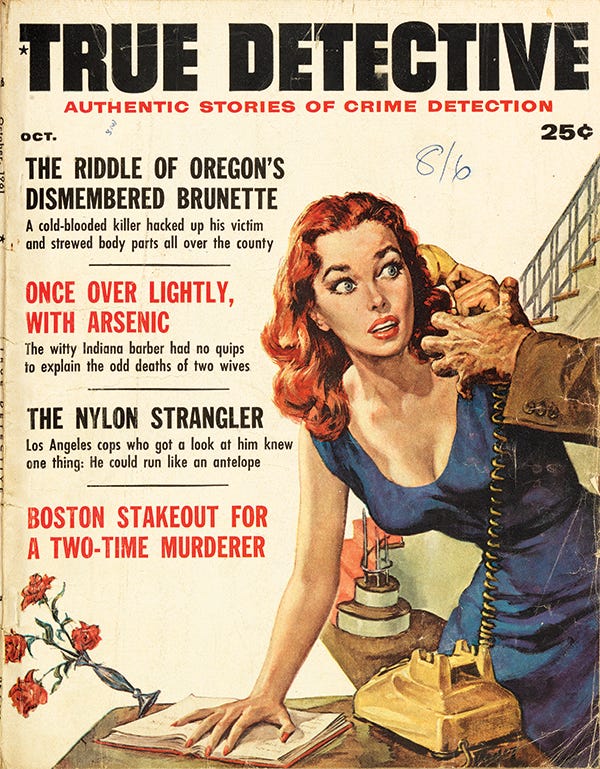
The first great tabloid crime sensation of the American penny press era was the 1836 murder of Helen Jewett, a New York City sex worker found hacked to death in a brothel. The lurid case drew much coverage in U.S. newspapers. The case had everything a penny press editor could want: a beautiful victim, a wealthy young suspect from a respectable family, and a courtroom drama that ended in acquittal despite overwhelming evidence. It sold papers in quantities previously unimaginable. America had discovered that crime was not merely newsworthy — it was irresistible.
By the end of the century, the formula was to blend stories of murder, catastrophe, and love with elements of pathos to produce the human side of news. Pulitzer and Hearst built their publishing empires using this model decades later. The resulting era of “yellow journalism” — named for the rivalry between Joseph Pulitzer’s New York World and William Randolph Hearst’s New York Journal — elevated crime coverage to a near-operatic register. With yellow journalism at its height, the press during this era was eager to cover murder trials, especially ones with bizarre facts, gory details, or sympathetic defendants.
Hearst went further still. Hearst had turned his focus to stories of political corruption, sexual deviance, and criminal activities, founding the Murder Squad, a team of investigative reporters assigned to solve crimes before the police could do so. The Murder Squad was, in every meaningful sense, the 19th-century predecessor of the true crime podcast — a team of committed civilians using journalism to investigate real cases, with the public watching along in real time.
Lizzie Borden and the Trial of the Century
No account of true crime in 19th-century America is complete without Lizzie Borden, whose 1892 case in Fall River, Massachusetts became the prototype for every “trial of the century” that followed.
On August 4, 1892, Andrew Borden and his wife, Abby, were hacked to death in their home in Fall River, Massachusetts. Andrew’s daughter, Lizzie, a church-going, temperance-supporting spinster, allegedly swung the axe. The sheer breadth of literature and art produced in its wake speaks to an enduring fascination with a story that was, in its day, nothing short of a media phenomenon.
Lizzie’s arrest and prosecution led to the original “trial of the century” and garnered as much, if not more, press than O.J.’s proceedings a century later.
What made Borden so compelling — and what makes her still compelling — was the fundamental mystery at the heart of it. The forensic science of 1892 could not definitively settle the question, and the jury acquitted her. The case lived on in newspapers, pamphlets, poems, and that famous children’s rhyme precisely because the question of guilt was never resolved. She was America’s first cold case celebrity.
The coverage of the Fall River murders demonstrates that, even as true crime evolves throughout the centuries, it continuously engages with the culture that surrounds it. Lizzie Borden was not merely a murder suspect. She was a referendum on gender, class, respectability, and the limits of forensic knowledge — all questions that her era was struggling to answer.
Pulp, Print, and the First True Crime Magazines
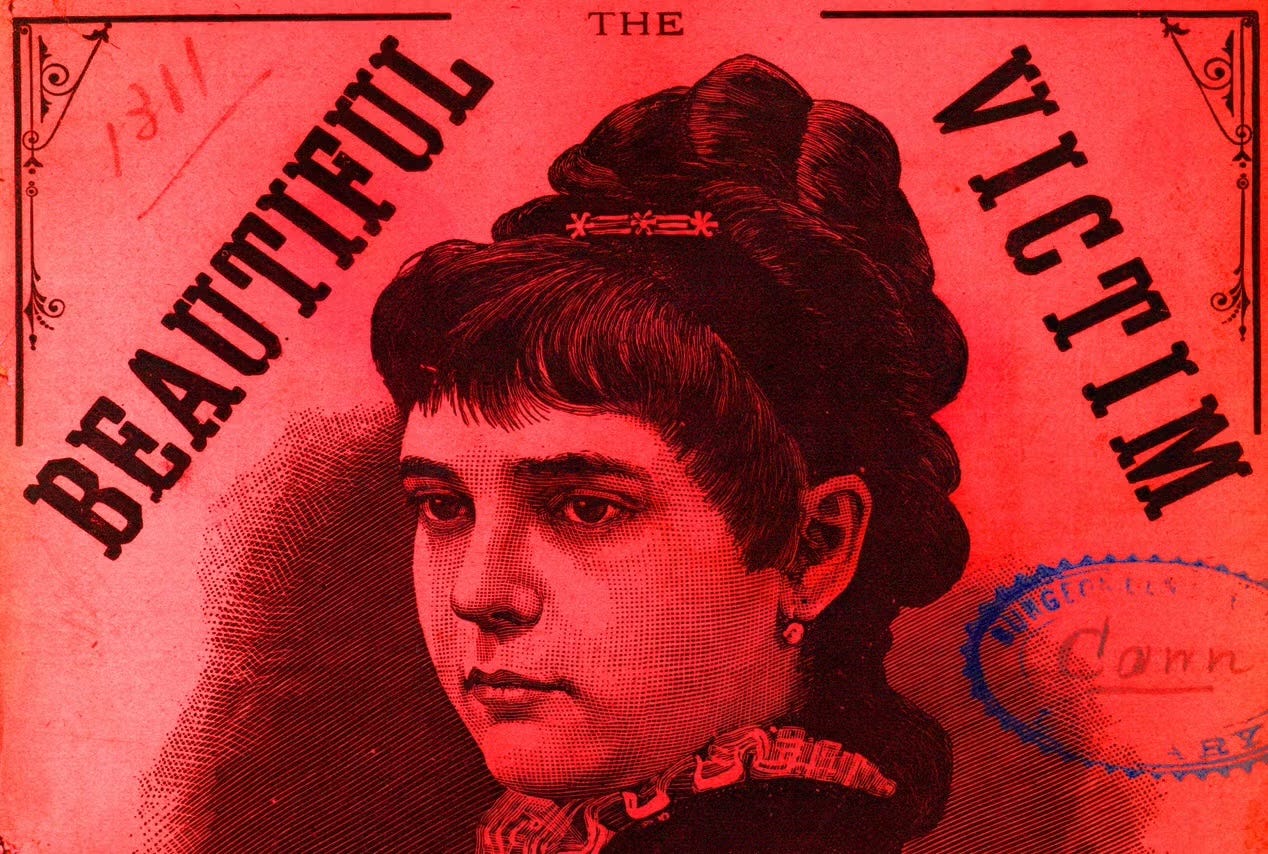
As the 20th century opened, true crime found its first dedicated home in the magazine format. The pulp era brought with it not merely fiction featuring detectives and murderers, but nonfiction publications devoted entirely to real crimes.
In the first forty years of its existence, the American true crime magazine soaked up the styles of tabloid journalism, film noir, New York street photography, Surrealism, American urban realist painting, revolutionary montage, and innumerable other currents crisscrossing American culture between 1920 and 1960. True crime magazines reassembled these styles within dynamic juxtapositions of image and text.
An American pioneer of the genre was Edmund Pearson, who was influenced in his style of writing about crime by De Quincey. Pearson published a series of books of this type starting with Studies in Murder in 1924 and concluding with More Studies in Murder in 1936.
The true crime magazine occupied a peculiar cultural position — widely read, widely purchased, and widely condescended to. The true-crime magazines have yet to see their day with popular culture and literary critics, and they are largely ignored in scholarly treatments of pulp magazines. Yet their influence was enormous. During the 1950s and 1960s, True Detective magazine developed a new way of narrating and understanding murder. It was more sensitive to context, gave more psychologically sophisticated accounts, and was more willing to make conjectures about the unknown thoughts and motivations of killers than others had been before.
This is where a crucial transformation occurs. The execution sermon had focused on the spiritual condition of the condemned. The penny press had focused on the spectacle of crime. The true crime magazine began to probe something harder and stranger: the psychology of the killer. Americans were no longer satisfied with the facts of a murder. They wanted to understand the mind that committed it.
Hollywood Discovers Real Crime: The 1930s and the Screen
By the time the Great Depression settled over America like a gray shroud, the nation’s appetite for crime narratives had a powerful new delivery system: motion pictures. And the 1930s became, by any measure, the decade when Hollywood discovered that real crime — or at least crime thinly drawn from real headlines — could make an extraordinary amount of money.
The economic devastation of the Depression is essential context. As economic despair gripped the American public, Hollywood sought to resonate with their disillusionment by producing films that portrayed the lives of gangsters and the corrupt social structures surrounding them. Iconic films like Little Caesar, The Public Enemy, and Scarface featured anti-heroes who, despite their violent and illegal pursuits, often embodied aspirations for wealth and status in a society struggling to maintain its ideals.
These films were not invented from nothing. The first film in this new genre, Little Caesar, depicted the rise of a small-town mobster to the upper echelons of organized crime. Appearing in 1930, it starred Edward G. Robinson as Caesar Enrico Bandello. The movie was so successful that Hollywood made more than 50 gangster movies the following year.
In the early 1930s, several real-life criminals became celebrities. Two in particular captured the American imagination: Al Capone and John Dillinger. Gangsters like Capone had transformed the perception of entire towns. Dillinger became so famous — and so romanticized — that the FBI’s pursuit of him was itself a national drama. As the newly formed FBI increased in power, there was a shift to favour the stories of the FBI agents hunting the criminals, instead of focusing on the criminal characters. In 1935, at the height of the hunt for Dillinger, the Production Code office issued an order that no film should be made about Dillinger, for fear of further glamorizing his character.
Get That Man (1935): Crime on the Margins
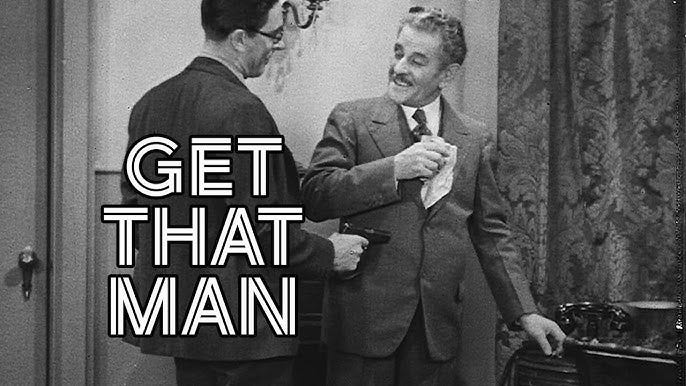
Released on July 11, 1935, Get That Man is a fascinating artifact of this era — a film that illustrates how thoroughly crime had colonized American screen culture, even in its lower-budget, independent corners.
Get That Man is a 1935 American drama film directed by Spencer Gordon Bennet, from a screenplay by Betty Burbridge. It stars Wallace Ford as Jack Kirkland, a taxi driver who discovers he closely resembles a murdered heir to a fortune.
When taxi driver Jack Kirkland is forced to drive two escaping bank robbers, all three are captured by police and placed in a lineup, where private investigator Jay Malone mistakes Jack for John Prescott, the missing heir of a millionaire who recently passed away. The real John Prescott sees a newspaper ad placed by Malone and telephones him from an automobile camp a hundred miles out of town. They plan to meet the next day, but before then John is killed in a fight with Don Clayton and Fay Prescott, Don’s hardened blonde accomplice whom John unfortunately married.
The film is a product of its moment in every particular. The police lineup — then a relatively new investigative technique — features prominently. The threat of wrongful conviction for a crime the protagonist did not commit was a anxiety very much alive in Depression-era America, when ordinary people felt buffeted by systems beyond their control. The murdered heir, the blackmailing lawyer, the femme fatale — these were not abstract archetypes. They were drawn from the headlines that Americans had been devouring for years.
Get That Man did not achieve the cultural prominence of Scarface or The Public Enemy. Due to a failure to renew copyright, it is now in the public domain. But its very ordinariness is revealing. By 1935, crime dramas built on real criminal anxieties — wrongful conviction, police corruption, the violent underworld — were not prestige productions. They were bread-and-butter Hollywood, the everyday output of an industry that had internalized, completely and without deliberation, the American obsession with crime.
The same year, G-Men appeared with James Cagney, making the FBI agent the hero of the crime story rather than the criminal. To give the film a documentary-like quality, G-Men shows pictures of the Justice Department building, microscopic shots of bullets and fingerprints, and the FBI firing ranges. Hollywood was already reaching for the tools of documentary realism — the forensic detail, the institutional backdrop — to make crime stories feel more authentic and more urgent. The audience wanted to believe they were seeing something real.
The decade’s obsession with crime on screen was not lost on censors and moralists. In 1933, the National Committee for the Study of Social Values published a study on crime. One of the findings claimed that gangster movies had given convicted criminals their early education. The argument that consuming crime narratives causes crime is, of course, at least as old as the penny press, and the 1930s version is no more convincing than the 21st-century version. What the panic does reveal is how deeply embedded crime storytelling had become in American culture — deeply enough to frighten the guardians of public morality.
In Cold Blood and the Literary Legitimization
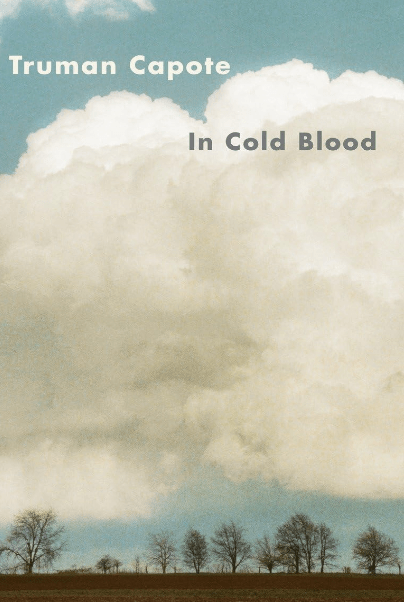
For all its cultural reach, true crime spent much of the 20th century as the despised stepchild of American letters — something people consumed without admitting to it. Although it occasionally aims for respectability, true crime is usually relegated to the bin of “trash” culture, a term that denotes cheaply produced, simplistic materials catering to the uncritical masses.
That changed — or at least became more complicated — with Truman Capote’s In Cold Blood, published in 1966. Capote spent six years reporting on the 1959 murders of the Clutter family in Holcomb, Kansas, conducted extensive interviews with the killers Richard Hickock and Perry Smith, and produced a book that forced the American literary establishment to confront true crime as a legitimate art form. In Cold Blood was serialized in The New Yorker, was a bestseller, and is still in print today.
What Capote did was not to invent true crime. He legitimized it by applying to it every tool of literary craft — character psychology, narrative tension, moral ambiguity — and refusing to let his readers look away from the complexity of what they were consuming. The killers were not monsters. They were comprehensible human beings who had done a monstrous thing. That was harder to process, and far more interesting, than a simple cautionary tale.
Norman Mailer followed with The Executioner’s Song in 1979, another Pulitzer Prize winner based on real killings. The literary establishment had, somewhat reluctantly, acknowledged that true crime could rise above its pulpy origins.
Television, Forensics, and a Nation of Amateur Detectives
By the 1980s and 1990s, true crime had discovered a new and extraordinarily powerful home: the television screen. Shows like Unsolved Mysteries, which debuted in 1987, and America’s Most Wanted, which launched in 1988, transformed true crime from a private reading habit into a communal, interactive experience. Viewers called tip lines. Fugitives were captured. Cold cases were solved.
Court TV launched in 1991, bringing actual trials — in real time — into living rooms across the country. The O.J. Simpson trial of 1994-1995 became the defining media event of the decade, watched by an estimated 150 million Americans on the day of the verdict. Every element that makes true crime compelling — celebrity, race, gender, wealth, legal complexity, and genuine uncertainty about guilt — was present, amplified to an almost unbearable degree.
The Forensic Files era that followed built an entirely new kind of true crime consumer. In the 1980s and 1990s, true crime taught pop culture consumers about forensics, profiling, and highly technical aspects of criminology. We have thus now become a nation of experts, with many ordinary people able to speak intelligently about blood-spatter patterns and organized versus disorganized serial killers.
This democratization of forensic knowledge is one of the most consequential developments in the history of true crime consumption. The audience had shifted from passive spectator to active analyst. Americans were not just watching crime. They were evaluating the evidence, forming opinions about guilt and innocence, and — increasingly — expecting to be involved in the outcome.
The Podcast Revolution and the Serial Earthquake
The internet changed everything for true crime, as it changed everything for everything else. Message boards and forums allowed amateur investigators to pool their research. Websites devoted to cold cases proliferated. The blogosphere gave victims’ advocates a platform that traditional media had never provided.
But the event that remade the landscape was a podcast.
The 2014 podcast Serial offered a detailed reexamination of the case and is widely credited with sparking the modern true crime podcast boom. With around 300 million downloads, it became the first podcast to receive a Peabody Award.
Serial was a game-changer for the true crime genre. It was the first piece of work in the medium that achieved mainstream success without using a sensationalized or dramatized approach.
More than 40 million listeners tuned in. They followed reporter Sarah Koenig week by week as she investigated the 1999 murder of Hae Min Lee and the conviction of her ex-boyfriend Adnan Syed — not to deliver a verdict, but to think out loud about the case, to share her uncertainty, to invite the audience into the process of investigation rather than just the conclusion.
The effect was seismic. A Pew Research Center study indicates true crime is the most common podcast topic, and 24 percent of the 451 top-ranked podcasts in the United States across Apple Podcasts and Spotify are about true crime.
The Serial model also demonstrated something that the Puritan execution sermon had understood three centuries earlier: Americans want to be part of the story. They want the opportunity to deliberate, to weigh evidence, to arrive at a moral judgment. The podcast simply gave them the most intimate and portable version of that experience yet invented.
The flaws in the conviction brought to light by the series ultimately contributed to a lower court vacating Syed’s conviction, and he was fully cleared of all charges in 2022. True crime had done something that courtrooms failed to do. An audience of millions had effectively functioned as a force for justice.
The Psychology of the Obsession
Why do we do this? Why, across three and a half centuries and a dozen different media, do Americans return again and again to the most disturbing stories their culture can produce?
Researchers have developed several interlocking explanations. The most basic is simple curiosity about death and violence — an evolutionary adaptation that once helped our ancestors survive by paying attention to dangerous situations. But true crime consumption is also deeply purposeful.
The most popular and commonly accepted explanation for why women love true crime is because they feel, consciously or subconsciously, that they might learn something from it. Women often see themselves, quite literally, in true crime stories.
A 2022 YouGov poll found that around 50 percent of Americans enjoy true crime media, with women making up 58 percent of that audience.
There is also a cognitive and emotional element that is harder to articulate but impossible to ignore. True crime content interests and appeals to a very wide audience seeking thrills or a greater understanding of the motivations behind human behavior, combining a taste for thrillers with the rise of nonfiction in the 20th century.
Clinical psychologist Michael Mantell has framed it this way: watching crime allows us to feel compassion — for victims, and sometimes even for perpetrators — and it helps us feel secure by placing violence at a narrative distance. We experience the fear without the danger. We grieve without the loss. And we participate in the moral reasoning that a civil society requires without having to sit on an actual jury.
True crime is also the site of a dramatic confrontation with the concept of evil, and one of the few places in American public discourse where moral terms are used without any irony, and notions and definitions of evil are presented without ambiguity.
In a culture that has grown suspicious of certainty in almost every domain — political, religious, scientific — true crime offers the rare pleasure of a clear moral universe. There are victims. There are perpetrators. Justice is either served or it is not. These are ancient satisfactions, as old as the gallows sermon, as new as this morning’s podcast drop.
The Ethics and the Shadows
It would be dishonest to celebrate America’s true crime tradition without acknowledging its costs. The genre has always had a shadow side.
Victims’ families are frequently re-traumatized by true crime productions made without their consent. Real people’s worst moments become entertainment products consumed by strangers. The focus on sensational cases — usually involving white, middle-class victims — distorts the public’s understanding of how crime actually operates in American society. True crime often wants to illustrate the most insane and shocking stories, when so often crime, particularly crime that impacts minorities or the people who are most impacted by a crime, isn’t shocking.
There are also questions about what true crime does to the audience’s perception of the justice system. These podcasts say they are giving you a look behind the curtain at what happens in courts. So, by being heralded as investigatory journalism, they can actually influence cultural perceptions of criminal cases.
In a 2022 poll, half of Americans said they enjoy the genre of true crime, including 13 percent who call it their favorite genre. That level of cultural saturation carries real responsibility. The line between investigation and entertainment, between advocacy and voyeurism, is one that practitioners of true crime — whether they work in podcasts, documentaries, books, or websites like this one — are obligated to navigate carefully.
The Cold Cases and the Unfinished Business
There is a final dimension of America’s relationship with true crime that deserves particular attention: the obsession with the unsolved.
One potential uptick for true crime podcasts today is the fact that the murder clearance rate — the number of cases solved by law enforcement — is at an all-time low. More Americans today are affected by unsolved crimes than ever before. Many of those affected are the ones who start podcasts in search of helping others find peace.
The cold case is the true crime narrative stripped to its philosophical core. There is no trial, no verdict, no resolution — only the question. Who did this? Why? And why has no one been held accountable? Cold cases are the stories that refuse to end, and for that reason they exert a particular gravitational pull on the American imagination. They are not entertainment. They are unfinished moral business.
One of those people is Sarah Turney, whose podcast Voices for Justice helped solve the disappearance of her sister Alissa. Turney mobilized the public through social media and by way of her podcast, leading authorities to arrest her father twenty years after her sister mysteriously vanished.
This is where the lineage that runs from the Puritan execution sermon to the digital age becomes most clear. Americans have always believed that the community has a role in justice. The sermon was a community ritual. The penny press trial coverage was a community discussion. The podcast is a community investigation. The form changes. The impulse does not.
An Unbroken Thread
More than 350 years of American history argue against the idea that true crime is a trend. It is a tradition — one of the oldest and most persistent in this culture.
It began with Puritan congregations packed into churches to hear the confession of a condemned man, then assembling outside to watch him die. It continued through execution pamphlets, penny newspapers, yellow journalism, pulp magazines, Hollywood gangster pictures, prestige literary journalism, network television, cable crime channels, and the infinite scroll of the podcast era. At every stage, the medium was new. The appetite was not.
The 1935 film Get That Man — made during the most fertile period of American crime cinema, when real-life criminals like John Dillinger were national celebrities and the FBI was learning to use film for its own public relations — is a small but telling piece of this tradition. It is not a landmark. It is precisely the opposite: an ordinary product of a culture so thoroughly saturated with real crime narratives that they had become the default vocabulary of popular entertainment.
Since the early modern murder pamphlet, true crime has asked us to consider how we, as a society, both contribute to and learn from the most shocking acts of our age.
That has not changed. And it will not change, because the questions true crime asks are not questions that a culture ever finishes answering. What is evil? What do we owe the dead? How do we build a just society when justice is so often withheld? Who speaks for the ones who cannot speak for themselves?
Those questions were present at the founding of this nation. They are present in every cold case file that sits, unsolved, in a detective’s cabinet somewhere in this country. And they are present in every listener who presses play on a true crime podcast and thinks, without quite knowing why: I have to understand this.
You do. We all do. It is one of the most American things about us.
TheColdCases.com is committed to responsible true crime journalism that centers victims, supports families, and contributes to the pursuit of justice for the unsolved.


