



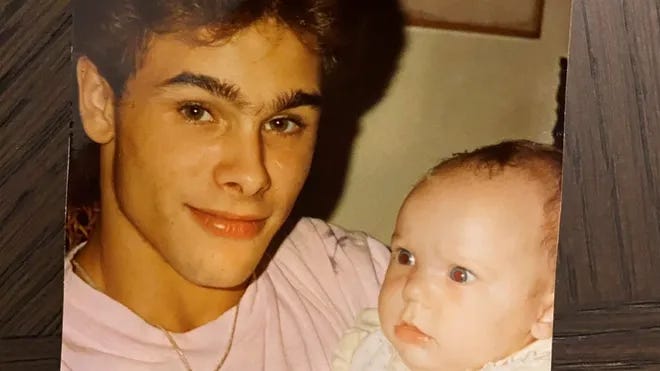
“He Was My Little Brother”
Before Gary Butler became a cold case, before he became a file in a prosecutor’s office or a name on a county website, he was a person. He was a son. He was a brother.
“He was adventurous,” says his sister Michelle. “He loved to ride dirt bikes. He was pretty independent. Never married, no kids, but he loved children. And he was a family guy — he liked to be with his family.”
Michelle Butler has carried the weight of her brother’s unsolved murder for over three decades. She calls the Somerset County Prosecutor’s Office every year. She has posted about the case on Reddit. She has reached out through social media, hoping something she says publicly will stir a conscience that has been silent for thirty years. She is not a trained investigator. She is a sister who wants to know what happened to her little brother, and she is one of the most important voices in a case that the justice system has so far failed to resolve.
Gary grew up in Metuchen, New Jersey, not far from Manville, and had found his footing as a young adult in the small Somerset County borough — renting a room, working a job nearby, shooting pool downstairs from where he slept. He was not a complicated man. He liked dirt bikes. He liked pool. He liked being around people he knew.
“He liked to shoot pool, he liked to dirt bike,” Michelle says. “Things like that.”
A Night That Began Ordinarily
February 25, 1996 started as an unremarkable winter evening in Manville. Gary Butler spent part of it at Perhach’s Bar on Main Street — though the bar and the rooming house where he lived were essentially the same building. The Chester House, where Gary rented a second-floor room, had a bar and pool tables on the ground floor. It was, in the most literal sense, his home turf.
“He liked to shoot pool,” Michelle explains. “He was not a big drinker at all. But he would shoot pool down there.”
According to the Somerset County Prosecutor’s Office, Gary spent the evening with several of the bar’s regular patrons. After leaving sometime after midnight, he walked a friend home and then returned to The Chester House. That was the last verified, peaceful chapter of his night.
Sometime between 2:00 and 6:00 a.m., Gary left his room and traveled to the neighboring town of Bound Brook — roughly three to four miles away by road. He didn’t own a car, so he walked everywhere; it was simply how he got around. Whatever brought him to Bound Brook that night, he was on his way back to Manville when he encountered whoever killed him.
He never made it home.
The Discovery, and the Story That Didn’t Add Up
On the morning of February 26, 1996, Gary Butler’s body was found in a retention pond on North Main Street in Manville, near the borough’s border with Bridgewater and the Raritan River. The Somerset County Regional Medical Examiner’s Office determined the cause of death: multiple blunt force trauma.
But before the truth of what happened began to emerge, investigators offered a different explanation to Gary’s family.
“When we first got the call, the police came to my mother’s house,” Michelle recalls. “They said that he was walking on the road — which made no sense because there’s a sidewalk — and got hit by a tractor trailer’s rear view mirror.”
Michelle went to Newark to identify her brother’s body at the coroner’s office. What she saw did not match the story she had been told.
“He just had — like, he was missing a tooth, and he had a bruise on the side of his face. And then he had a horseshoe cut in the back of his head. But it made absolutely no sense that he got hit by a truck.”
She is right. A person struck by the mirror of a passing tractor trailer would sustain a very different injury profile than what was documented in Gary’s case. The blunt force trauma that killed him speaks to close-contact violence, not a glancing vehicular impact. The hit-and-run narrative was wrong, and the physical evidence made that clear relatively quickly.
Michelle could read the scene as well as any investigator. She walked through the geography of it herself.
“There was a little bit of blood on the guardrail,” she explains. “So there’s the street, then there’s the guardrail, then there’s the sidewalk. There was a little blood on the guardrail, which to me seems like maybe somebody dragged him — like pulled him over the guardrail. And then there were drag marks going down to, like, an inlet. And then there was a big pile of blood there, right by the water.”
She pauses.
“So they must have put him down on the ground, and then they threw him into the retention pond.”
This is the picture that the evidence assembled: Gary was attacked near the road. He was beaten severely. He was then dragged over the guardrail and down to the water’s edge, where a large pool of blood accumulated as his body was positioned. Then he was thrown into the pond.
The dirt found under Gary’s fingernails during the examination is, for Michelle, the detail that cuts deepest. It tells her that her brother did not simply fall. He grabbed at the earth. He dug in. He fought.
A Killing Near His Workplace
One detail that Michelle raises — and that has never received much public attention — is the geography of the crime scene relative to Gary’s place of work.
“He worked for a company called Coolomatic in Manville, New Jersey, which was like a block away from where he lived,” she says. “And actually, where he was killed was right behind — or I should say the side — right there where Coolomatic is, where his company is.”
She lets the implication settle. “I wonder if there’s any significance to that. Like, maybe a co-worker or something like that. I don’t know. There are so many things. It just doesn’t make sense.”
It is a legitimate question. The fact that Gary’s body was disposed of in a location immediately adjacent to his workplace raises the possibility — speculative but not unreasonable — that whoever killed him had some familiarity with Gary’s routines, or with that stretch of North Main Street, or with Gary himself. The choice of that particular pond has never been publicly explained by investigators.
“The Whole Town Knows Who Did It”
The most striking thing Michelle Butler says about her brother’s death is also the most haunting.
“A lot of people I’ve talked to that live in that town still have given me a name,” she says carefully, without naming the person publicly herself. “Everybody keeps coming back to the same name. And apparently the whole town knows who did it, but nobody’s coming forward. So that’s the feedback I’m getting.”
She has posted about the case on Reddit. She calls the prosecutor’s office every year. She has reached out through social media. And consistently, she hears the same thing: people in Manville believe they know who killed Gary Butler. They just won’t say so to anyone with the authority to act on it.
“I wish this person would come forward,” she says. “The police have to know. The police have to know people are talking.”
When asked why people might be staying silent, Michelle is clear about what the answer is not. Gang involvement, organized crime — none of that applies here, she says. The dynamic is something more particular to a small, close-knit town.
“I don’t know why people aren’t coming forward,” she admits. “It’s just that kind of town.”
There is a particular kind of loyalty — or fear, or inertia — that can seal a small community around a secret for decades. Whether it is personal affection for the suspected perpetrator, distrust of law enforcement, or simply the accumulated weight of years passing, the result is the same: a man is dead, and the person believed responsible has lived freely in or near the community where it happened for over thirty years.
“If this person is walking around,” Michelle says, “how do I know they didn’t do it to other people? How do I know this person is not making a mockery of the justice system? Because they’re getting away with it.”
Tips, False Confessions, and Dead Ends
The investigation into Gary’s death was not without activity. Tips came in. People talked. And in one of the stranger chapters of the case, individuals came forward and actually confessed to the killing — individuals who, it turned out, had not done it.
“People have come forward when it first happened and said they did it,” Michelle says. “It came out that they didn’t do it.”
False confessions in high-profile community cases are more common than people realize. They arise from mental illness, a desire for notoriety, or complex psychological motivations that investigators must carefully untangle. Each one consumes resources and time, and in a case as already complicated as Gary Butler’s, they muddied already difficult waters.
A separate theory emerged through Michelle’s own research on Reddit, where she was contacted by people who had known Gary. They pointed her toward a man Gary had done some roofing work for — someone who, they claimed, had taken out a life insurance policy on him.
“The police checked him out,” Michelle says. “I really don’t think he did it.” The policy amount was minimal, and investigators apparently reached the same conclusion. But the episode illustrates something important about how cold cases evolve in the internet age: information — good and bad, credible and not — now circulates in ways that were impossible in 1996. Michelle has assembled fragments of community knowledge through social media and direct conversations with Manville residents over the course of decades. She has built a picture of what people in that community believe happened, even if it has not yet translated into a courtroom.
“Are They Not Looking Into It Because He Wasn’t Rockefeller?”
One of the most uncomfortable questions surrounding Gary Butler’s case is one that Michelle raises herself, and raises honestly.
“There’s a lot of cases out there,” she says, “like prostitutes or drifters or homeless people. And those seem to be the cases that aren’t getting the attention they need — maybe because they weren’t as important to somebody. But these people are still somebody’s son or daughter, somebody’s mom or sister or friend. Regardless of their life choices.”
She turns the lens on her own brother’s situation. Gary Butler was a young man renting a room in a boarding house, working a job a block away. He was not powerful. He was not wealthy. He was not connected.
“Are they not looking into it because he wasn’t Rockefeller?” she asks.
It is a question that cannot be answered definitively from the outside. What can be said is that the Somerset County Prosecutor’s Office does list Gary’s case as active, and that the county has demonstrated its capacity to close cold cases. Most recently, in December 2024, the 1997 murder of Tamara “Tammy” Tignor at Washington Valley Park in Bridgewater was solved after the perpetrator — Robert A. Creter, 61, of Winnipeg, Canada — pleaded guilty to aggravated manslaughter and was sentenced to ten years in state prison. A case nearly as old as Gary’s, finally closed.
Cold cases can be solved. The question is whether they receive the sustained investigative attention they require. For Michelle, the experience of calling the prosecutor’s office year after year has not always been encouraging.
“The last time I called, which was last year, I got somebody on the phone and they said to me, ‘Oh, there’s a lot of boxes here. You tell me — what do you know?’” she recalls. “And then I said whatever I said. And they said, ‘Oh, looks like you know more than I do.’ And then that was it.”
She pauses.
“It was terrible.”
“I Just Want to Know”
There is a particular kind of grief that attaches to an unsolved murder — different from the grief of a natural death, or even a solved homicide. It is grief without the closure that explanation provides. It is the permanent open question at the center of a family’s life.
Michelle has lived with that question for over thirty years. She has children now. Her mother is elderly and declining. The people who knew Gary are aging, moving away, dying. The window in which living memory can serve the investigation narrows with every year that passes.
“I would like closure, even for my mother, for my sisters and myself,” Michelle says. “I just want to know what happened. That’s all.”
She is not consumed by rage, though she would have every right to be. She is consumed by the need to understand.
“Did he do something and he deserved it? Was it a complete accident? Did somebody panic? I don’t know. Just let me know. It would just be nice to have some type of reason for this. So that you can know why you don’t have your brother in your life.”
And then, quietly: “My brother never got to meet my children. And that’s the one thing that hurts the most.”
A Community That Knows
If Michelle Butler is right — and she has spent thirty years talking to people who live in and around Manville — then the truth about Gary Butler’s death is not entirely unknown. It lives in the community. It has been whispered between people who grew up in that small borough, who knew Gary, who believe they know who killed him, and who have, for reasons of their own, chosen not to bring that knowledge to the people who could act on it.
“Everybody keeps coming back to the same name,” Michelle says.
That name has not led to an arrest. It may or may not be the right name. But the consistent recurrence of a single person in the community’s collective understanding of this case is itself significant. It suggests that the answer to who killed Gary Butler may not require extraordinary forensic breakthroughs or decades more of waiting. It may simply require one person — one person who knows what happened that night — to make a phone call.
“We’re all going to meet our maker,” Michelle says. “And you want to make it right before you meet your maker.”
It is as simple and direct an appeal as anyone can make. Whoever knows what happened to Gary Butler on the morning of February 26, 1996, is carrying that knowledge. Time passes. People age. But the weight of an unspoken truth does not lighten on its own.
If You Have Information
Gary Butler was 25 years old. He spent his last evening shooting pool at a bar where he was known and comfortable. He walked a friend home. He was killed before the sun came up, beaten and left in a pond on the edge of town — a block from where he worked, three miles from where he was heading.
He fought back. The dirt under his fingernails tells that story.
His family has waited thirty years for answers. His sister still calls the prosecutor’s office every year. His mother is running out of time. His nieces and nephews never got to know him.
If you have any information about what happened to Gary Butler — anything at all — please reach out. A tip does not require your name. It does not require certainty. It requires only the willingness to say what you know to someone who can act on it.
Anyone with information on the Gary Butler homicide is urged to contact:
Somerset County Prosecutor’s Office Major Crimes Unit 📞 908-231-7100
STOPit App — Anonymous digital tips
Somerset County Crime Stoppers’ Tip Line 📞 1-888-577-TIPS (8477)
All anonymous STOPit reports and Crime Stopper tips will be kept confidential.
TheColdCases.com is committed to keeping the stories of unsolved homicide victims alive until justice is served. If you have information about the death of Gary Butler, please contact the Somerset County Prosecutor’s Office or Crime Stoppers using the numbers above.


