



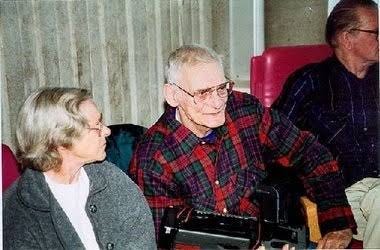
Missing Since: April 2, 1999 • Evans Mills, New York • Case #99-098194
“In my heart, in my mind, the only two things that I possibly think… he could have had some type of medical emergency and went off the road. Or he knew he was going to be going for this dementia testing. He knew there was a probability of them taking his license, him not being able to drive, him losing his independence — and just decided that that was it.”
— Jennifer Wood, granddaughter of Guy Monroe Pyke
He drove away on a clear April afternoon and was never seen again. No farewell. No distress call. No crash site. No body. Just a 70-year-old grandfather, a midnight blue Chevy Blazer, and a silence that has stretched for more than a quarter century.
The disappearance of Guy Monroe Pyke on April 2, 1999, is one of upstate New York’s most quietly haunting cold cases — a mystery with no blood, no witnesses, no crime scene tape, and no clear answer for why a man who had lived seven decades in the shadow of the Onondaga Hills simply ceased to exist one Friday afternoon. What remains is a family still searching, a sheriff’s office that has never officially closed the file, and a granddaughter who has spent more than two decades refusing to let the world forget a quiet man who took the shirt off his back for anyone who needed it.
The Man Before He Vanished
Guy Monroe Pyke was born on January 18, 1929, in New York State, to Walter Patrick Pyke and Florence Irene Coville Pyke. He came of age in Central New York during the Depression and World War II era, part of a large working-class family that included two brothers, Elmer and Wesley, and three sisters, Phoebe, Ilean, and Thelma. His roots ran deep in the region, in the chemistry-stained industrial belt west of Syracuse where the Solvay Process Company and Allied Chemical had employed generations of Onondaga County families.
In 1950, Guy married Arline Wilson. They would be together for 49 years, raising two sons — Dennis and Barry — and a daughter, Susan, near Solvay. Like his father Walter before him — who retired from Allied Chemical Corp. after 35 years of service — Guy built his working life at Allied Chemical in Solvay. When the plant shuttered in 1985, Guy retired. He was 56 years old.
By April 1999, Guy and Arline were living on Aitchison Road on the west side of Syracuse, in the Town of Onondaga. Their grandchildren — including Jennifer Wood, who would become the most tireless public advocate for her grandfather’s case — were a source of enormous pride. Jennifer was so close with her grandparents that she spent more time at their home than at her own as a child.
“He was a very quiet, laid back — would take the shirt off his back for anybody if he had to. He was just… he would do anything for anybody. He was a family man. We had horses that he took care of when I was younger. Just everything was family.”
— Jennifer Wood, speaking to TheColdCases.com
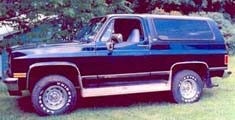
Guy Pyke was also fiercely independent. He had an almost sentimental attachment to his vehicle: a midnight blue 1989 Chevrolet Blazer with a black fiberglass top, chrome diamond-plate running boards, and blue velour interior. The truck, like Guy himself, was sturdy, unpretentious, and deeply Upstate New York.
There was, however, trouble gathering in the quiet of everyday life. Guy’s health had been declining. He had a heart condition requiring a prescription blood thinner. His hands shook. He tired easily. And there were signs — disputed in their severity — of cognitive decline. Arline had scheduled an appointment for Guy to undergo dementia testing in mid-April 1999. He disappeared before he could keep it.
The Dementia Question - A Family’s Long Fight for Accuracy
Perhaps no aspect of the Guy Pyke case has caused his family more frustration than the way his cognitive health was characterized in the immediate aftermath of his disappearance. When law enforcement distributed bulletins and spoke with media in April 1999, Guy was described as suffering from Alzheimer’s Disease and dementia. That framing stuck. It spread. It became the defining shorthand for why an elderly man might simply vanish: disoriented, confused, unable to find his way home.
The problem, according to Jennifer Wood, is that it wasn’t accurate. Guy Pyke had never been formally diagnosed with Alzheimer’s or dementia. The testing appointment that would have assessed his cognitive state was scheduled for after his disappearance. What existed were early signs — not a confirmed diagnosis.
“It’s not so much that we’re against those theories. It’s more so the way that it was put out to the public when he went missing. There was early signs of dementia. Nothing was ever officially diagnosed. My grandmother had an appointment scheduled for him for later in April of that year — I believe it was only like a week after he disappeared — to go through the dementia testing. When it was first put out to the media, it immediately went to he had Alzheimer’s, he had dementia. That wasn’t the case at all, and that really upset my grandmother. She fought for years to get them to correct that, and she never had any success with that.”
— Jennifer Wood
For Arline Pyke, Guy’s wife of nearly 50 years, this was not a minor grievance. She spent years trying to get investigators and media outlets to walk back the Alzheimer’s characterization, with little success. She died in 2012 without having secured the correction she sought — or the answers about her husband’s fate.
Jennifer eventually succeeded where her grandmother could not. Approximately three years before our interview, she managed to get investigators to amend official materials — revising the language from a definitive diagnosis to a more qualified “there may have been possible dementia, but nothing official.” It was a small victory, but a meaningful one: the difference between a man who was lost and a man who simply left.
The distinction matters enormously to the integrity of the investigation. A confirmed dementia patient who wanders is understood through one lens. A 70-year-old man with possible early cognitive changes, facing the imminent loss of his independence and driver’s license, is understood through quite another.
The Last Known Day
It was a Friday. The weather was clear and mild, the kind of early spring afternoon in Central New York that feels like a reprieve after a hard winter. Cher’s “Believe” was on the radio. A full moon would rise that night.
Guy Pyke told his family he was heading north to Watertown, New York, to visit a relative. He filled the Blazer’s tank — it was full when he left. He had no money on his person. No credit cards. He did not take his cigarettes. The only items in the vehicle were his driver’s license and the vehicle’s documents in the console. He backed out of the driveway on Aitchison Road and turned north.
At approximately 3:00 p.m., he pulled into the driveway of a cousin’s home on the 2000 block of State Route 11 in Evans Mills — a hamlet that sits just outside Fort Drum, north of Watertown. But he never got out of the car.
This moment has been a source of speculation for 26 years. Why didn’t Guy go inside? Jennifer offers a specific, grounded explanation: the cousin had a dog, and that dog had previously tried to bite Guy. This was not an abstract fear of animals — it was a documented history.
“I know they had a dog and I know in the past when he had gone there, the dog had actually tried to bite him. So from our understanding, when he pulled in the driveway, the dog came out barking and he just never got out of the car, backed out of the driveway and left. So all these years we’ve just kind of assumed that it was because of the dog, that he had a fear of their dog.”
— Jennifer Wood
He backed out of the driveway. He drove north, toward Gouverneur.
That was the last confirmed sighting of Guy Monroe Pyke. No one has seen him — or his Blazer — since.
The Delayed Report and the Cold Trail
The Pyke family did not immediately call law enforcement. Guy had a pattern of taking short, unannounced road trips and returning on his own. The family was accustomed to his comings and goings. Two days passed. When Guy still had not come home, the family contacted the Onondaga County Sheriff’s Office.
The two-day gap proved consequential. Any surveillance footage that might have captured the blue Blazer — at gas stations, diners, intersections along Route 11 — was almost certainly gone by the time investigators began asking questions. The trail, already faint, had grown cold almost instantly.
The Onondaga County Sheriff’s Office opened Case #99-098194. They distributed a bulletin throughout the United States and Canada. Air searches were launched. Ground searches were conducted. Officers checked the Canadian border crossing records — no sign of the Blazer or its plates (NY FMS-867) crossing into Ontario or Quebec. Nothing turned up. The Blazer, with its distinctive chrome running boards and black top, had seemingly dissolved into the landscape.
In the weeks and months that followed, investigators explored several leads. Guy had spoken of wanting to visit Florida. But there was no evidence he traveled south — no credit card activity, no sightings, no toll records. A 70-year-old man with a heart condition and shaking hands, driving a full tank of gas into the North Country in early April, with no money and no cigarettes, had vanished without a trace.
An Onondaga County Sheriff’s lieutenant summarized the baffling nature of the case with candor that has stayed with those who covered the story: “There were no peaks or valleys in this case. Just silence.”
The Words He Left Behind
Among the most striking details Jennifer Wood revealed in her interview with TheColdCases.com is something that only emerged after Guy disappeared: comments he had made to his brothers, in the years before his disappearance, that take on an entirely different weight in retrospect.
“There were comments made to his brothers a couple of times. We found out after the fact that he had told them that if he got to a certain point, that he was going to be a burden on people, not be able to take care of himself, that he would disappear and nobody would find him.”
— Jennifer Wood
Read in isolation, such statements might be dismissed as the idle dark humor that older men sometimes deploy around their own mortality. But placed in context — a man who was about to undergo dementia testing, who was fiercely independent, who was facing the possible loss of his driver’s license, who left without money, without cigarettes, and drove north into the North Country and was never seen again — they become something more difficult to dismiss.
Jennifer is careful here. She is not saying her grandfather ended his life. She notes that “there had never been any attempts of anything.” But she does not rule out the possibility that Guy, confronting the encroachment of dependence and the imminent loss of the freedom his truck represented, made a deliberate choice to leave on his own terms. “He was a very independent person,” she told us. And independence, for some people, is not negotiable.
The dementia testing appointment, the statements to his brothers, the full tank of gas, the absence of any money or identification beyond his license — these details form a portrait not of a confused man who got lost, but potentially of a man who knew exactly where he was going, and what he intended.
The North Country Terrain
To understand why Guy Pyke has never been found, it helps to understand the geography north of Evans Mills. The hamlet sits just outside the wire of Fort Drum, the massive Army installation that spreads across Jefferson County. To the northeast lies the St. Lawrence River. To the west are the Tug Hill Plateau’s dark forests. To the south, Onondaga and Oswego counties hold dozens of lakes, rivers, ponds, and drainage channels.
Route 11, the road Guy was last seen on, runs north from Evans Mills toward Gouverneur, then continues toward the St. Lawrence Valley. It is a road that passes through farmland, forest, and small towns, with numerous water features along its margins — drainage ditches, the Oswegatchie River and its tributaries, pond-dotted fields, and the Black River winding down toward Lake Ontario.
Jennifer has been direct about why she believes Guy is in the water:
“My strong belief is that he’s in the water somewhere. My thoughts with that is a vehicle of his size doesn’t just disappear. If it was in the woods or something like that at this point, I would think between developing an influx in outdoor activities that if it was in the woods somewhere, somebody would have come across it by now. There’s been no VIN traces, no activity on the VIN number, the plate, nothing like that, which is why I strongly believe that his vehicle is in the water with him in it somewhere.”
— Jennifer Wood
The logic is sound. The Blazer was a full-size SUV with distinctive chrome trim. Twenty-six years of expanded outdoor recreation — hiking, hunting, ATV trails, drone photography — have covered the forests and fields of Jefferson and Onondaga counties many times over. A truck sitting on the forest floor would likely have been spotted by now. A truck beneath ten or fifteen feet of murky river water, in a drainage ditch lined with reeds, or in one of the dozens of ponds that dot the landscape north of Evans Mills, could remain invisible indefinitely.
What Happened to Guy Pyke? The Theories
When asked directly what she believes happened to her grandfather, Jennifer Wood does not retreat to comfortable uncertainty. She outlines what she calls “two and a half” possibilities, and they are worth examining in full.
Theory One - A Medical Emergency
Guy Pyke had a heart condition and was on blood thinners. His hands shook. He tired easily. The most straightforward explanation for his disappearance is that he experienced a cardiac event or some other acute medical emergency while driving north on Route 11, and his vehicle left the road — likely entering a body of water — without any witnesses. In a rural corridor in early April, with limited traffic and virtually no surveillance infrastructure, such an event could occur without leaving any trace for investigators to follow.
Theory Two - A Deliberate Departure
The second theory — the one Jennifer herself has come to consider seriously — is more complicated and more human. Guy Pyke was weeks away from a dementia evaluation that could have resulted in the revocation of his driver’s license. For a man of his generation and temperament, driving was not merely a convenience; it was autonomy itself. The Blazer was freedom. The possibility that doctors might take that away may have felt, to Guy, like a kind of foreclosure on the life he had known.
Add to that the statements he had made to his brothers: that if he reached a point where he would be a burden on others, he would disappear and nobody would find him. Those words, shared before he ever vanished, describe the disappearance with unsettling precision.
“There’s the possibility that he knew he was going to be going for this dementia testing. He knew there was a probability of them taking his license, him not being able to drive, him losing his independence, and just decided that that was it.”
— Jennifer Wood
Something Else Entirely
Jennifer speaks of a “two and a half” possibilities, suggesting she has not fully ruled out some third explanation she finds harder to articulate — perhaps a combination of disorientation and accident, perhaps something involving foul play that has left no evidence, perhaps something else entirely. No evidence of foul play has ever emerged, and investigators have never named persons of interest. But the complete vanishing of both a man and a distinctive full-size truck, over 26 years, does not resolve easily into any single explanation.
Volunteers, Sonar, and the Long Game
For the first two decades after Guy’s disappearance, the search was largely conducted through traditional means: law enforcement follow-up, family inquiries, and the occasional media appeal. Jennifer Wood carried her grandmother’s promise through the years. When Arline died in 2012, Jennifer made a commitment: she would not stop looking.
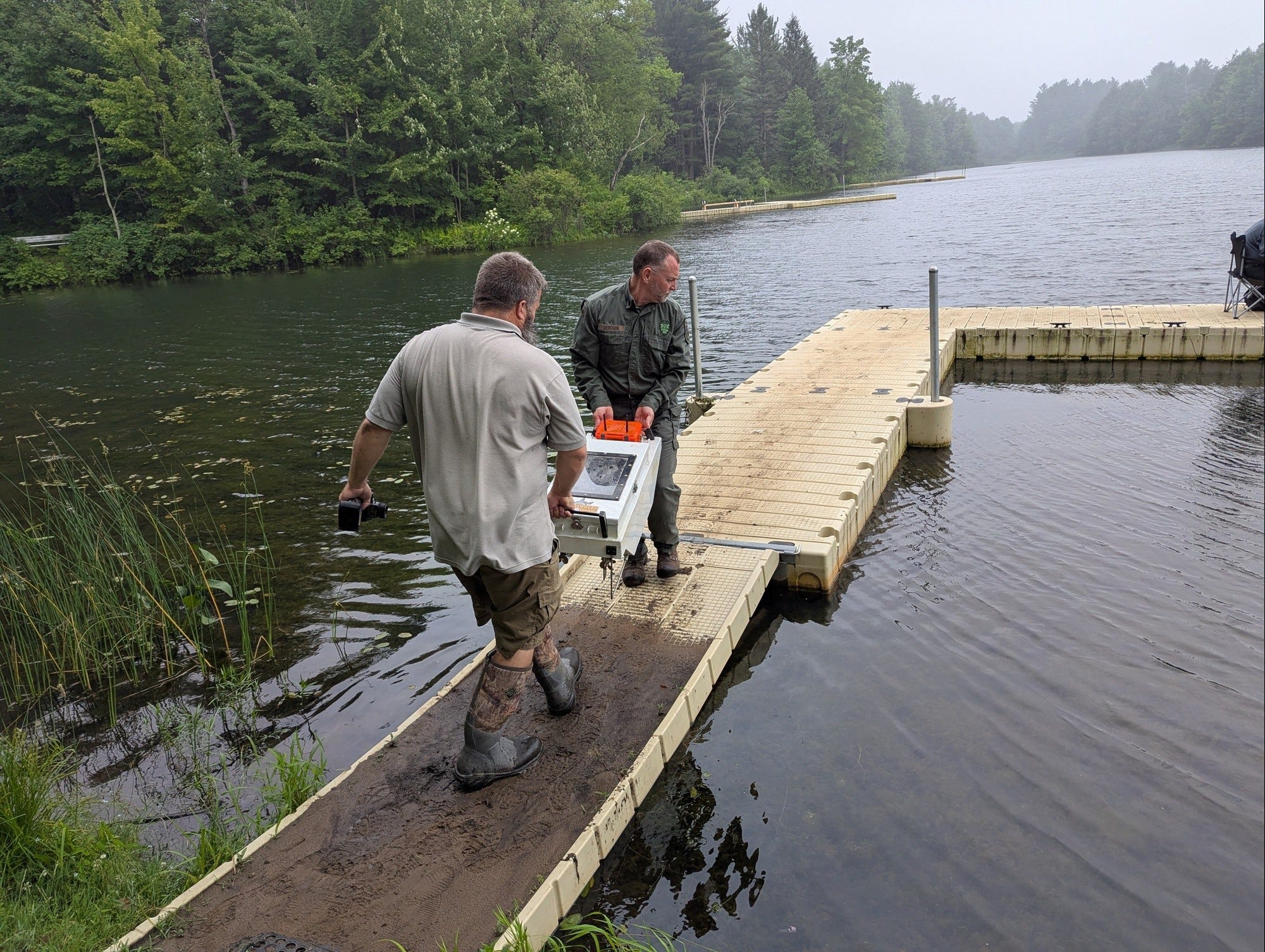
In 2022, a new chapter opened. Adventures with Purpose (AWP), a volunteer dive and sonar search team focused on locating missing persons submerged in their vehicles, came to Jefferson County after a referral from a family friend. AWP founder Jared Leisek described the scope of the mission before they began: “We’re looking at every potential body of water between this location and the Canadian border where Guy and his 1989 Chevy Blazer might be.”
The team scanned nine locations in September 2022, including a pond on Jewett Place at Route 11, the Oswegatchie River in Gouverneur, the Pope Mills ramp, Black Lake, the Black River in Dexter, a pond along Snake Creek, the Oneida River in Brewerton, and portions of Onondaga Lake. The search produced no results — but produced something almost as valuable: a methodical elimination of possibilities.
Jennifer framed the mission’s significance with characteristic pragmatism: “That would be the best scenario — I could lay him to rest, I could finally fill out that empty hole on the stone in the cemetery. But even if we don’t get that, we’re still getting the ‘okay, he’s not here, okay, he’s not here.’”
In 2023, AWP returned to search Onondaga County waterways. That same year, a second volunteer group, Chaos Divers, conducted independent searches covering Onondaga Lake, the south fork of the Seneca River, Oneida Lake at Sylvan Beach and Brewerton, the creek along Route 11 from Philadelphia to Coolidge Road, the Black River Bay, the Little Salmon River at Mexico Point, the Salmon River at Port Ontario, and portions of the St. Lawrence River. Dozens of miles of waterways. No trace of the Blazer.
The Onondaga County Sheriff’s Office has pledged it will never close the case, and continues to have detectives follow leads. On the 25th anniversary of the disappearance in 2024, the office again issued public appeals for information.
A New Clue Goes Public
On April 2, 2025 — the 26th anniversary of Guy’s disappearance — United Search Corps (USC), a 501(c)(3) nonprofit dedicated to solving missing person cases, announced a new development. Working with Jennifer Wood, the organization released a piece of information that had never before been made public: the full Vehicle Identification Number of Guy’s 1989 Chevy Blazer.
The VIN is: 1GNEV18K7KF176294
This number — stamped into the chassis, engine block, and various body panels of every vehicle manufactured in the United States — is unique to Guy’s truck. Even if the license plates were removed or changed, a VIN check can positively identify the vehicle. Jennifer’s reasoning is direct:
“This truck was everything to my grandfather. If we can find the vehicle, I believe we can find out what happened.”
— Jennifer Wood
USC noted that with cold case solve rates at an all-time high and advances in digital VIN tracking databases, the release of this information could trigger a breakthrough in ways that earlier searches could not. Someone, somewhere — a mechanic, a junkyard worker, a property owner, a diver who once pulled something unusual from a river — may hold a piece of information they don’t realize is significant.
That same week, on April 5, 2025, Jennifer attended New York State Missing Persons Day, hosted by The Center for Hope at the New York State Museum in Albany. She walked alongside other families of the missing in what has become an annual act of collective witness.
The Family That Never Stopped Looking
In cases that go unsolved for decades, the human story often reduces to the persistence of a single individual who refuses to let the file close. For the Guy Pyke case, that person is Jennifer Wood.
She has fought to correct the record on her grandfather’s diagnosis. She has coordinated with Adventures with Purpose and Chaos Divers. She manages the public Facebook page (“Help Find My Missing Grandfather Guy M. Pyke”), has worked with United Search Corps to push the VIN into public circulation, and has attended Missing Persons Day in Albany to put a human face on a name that has otherwise become a case number.
Her motivation is not complicated. There is a grave marker for Guy Pyke in a Syracuse-area cemetery. It has his name, his date of birth. The date of death is blank. That empty space is the physical embodiment of the mystery — a man who left on a spring afternoon and has never formally been found or declared dead, who exists in the liminal state of the missing.
Arline Pyke waited 13 years and died without knowing. Barry Pyke, Guy’s son, died in 2009 without knowing. Their grief was not the sharp, defined grief of confirmed loss — it was the slow, unresolved grief of absence without explanation, the wound that cannot scar over because it is never truly closed.
Jennifer Wood is still looking. The Onondaga County Sheriff’s Office is still looking. And somewhere in the waterways and back roads of the North Country, there is a midnight blue Blazer with chrome running boards and a VIN number stamped into its steel that has not yet been found.
If You Have Information
The Onondaga County Sheriff’s Office has maintained an active investigation for 26 years. If you have any knowledge of Guy Pyke’s whereabouts, have ever seen or worked on a 1989 midnight blue Chevrolet Blazer with VIN 1GNEV18K7KF176294, or have any information related to this case, please contact:
Onondaga County Sheriff’s Office Special Investigations Unit
Phone: (315) 435-5434
Agency Case Number: 99-098194 | NamUs Case: MP705
Facebook: “Help Find My Missing Grandfather Guy M. Pyke”
CASE FILE: GUY MONROE PYKE
Date of Birth: January 18, 1929
Missing Since: April 2, 1999
Last Seen: ~3:00 PM, 2000 block of State Route 11, Evans Mills, New York
Physical Description: Caucasian male, 6’0”, 168 lbs, gray hair, blue eyes, bifocal wire-frame glasses, no teeth, bowlegged
Last Clothing: Red/green/blue plaid shirt over maroon sweatshirt, blue Rider jeans, brown Gobie boots
Vehicle: 1989 Chevrolet Blazer, midnight blue/black top, chrome diamond running boards, blue velour interior
VIN: 1GNEV18K7KF176294
License Plate (1999): NY FMS-867
Investigative Agency: Onondaga County Sheriff’s Office | Case #99-098194 | NamUs MP705


