



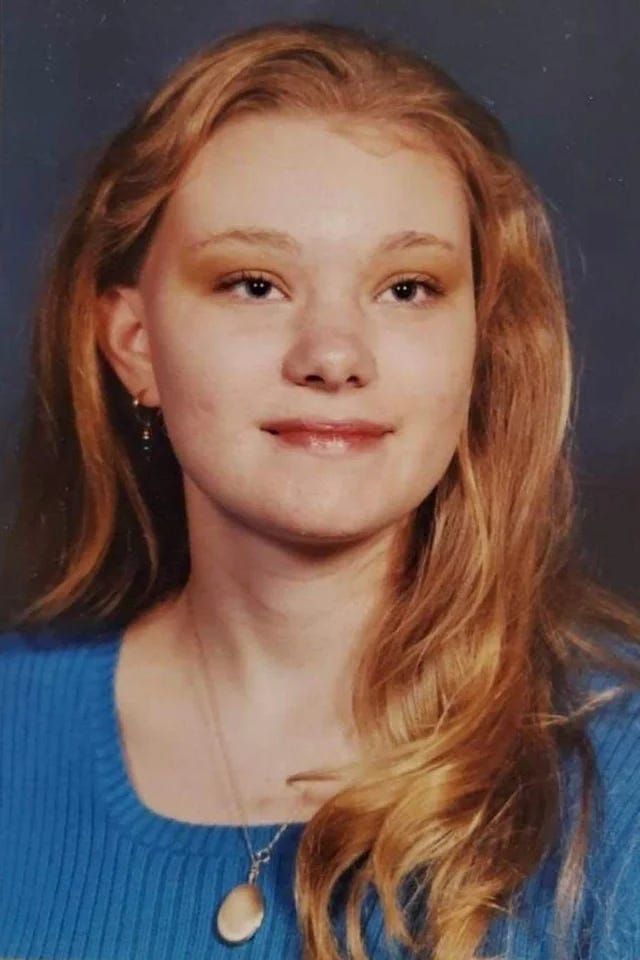
Found, But Not Known
On November 5, 2008, a crew from an Oklahoma City electric company arrived at what should have been a routine job — removing or replacing a utility power pole. What they found changed everything.
Amid the disturbed earth around the base of the pole, the workers discovered partial human remains. Investigators with the Oklahoma City Police Department responded, and the case was transferred to the Oklahoma Office of the Chief Medical Examiner (OCME) for examination.
The remains were skeletal — consistent with prolonged outdoor exposure, likely lasting as long as eighteen months before they were stumbled upon by that utility crew. A forensic examination established the basics: a young woman, estimated between 17 and 23 years of age, approximately 5 feet 3 inches tall, with bone structure consistent with Native American ancestry. The state of decomposition left investigators with no fingerprints to run, no dental records to match, and no DNA link to anyone already on file.
One thing remained among her remains. A pair of black slip-on shoes — women’s style, sold under the Croft & Barrow label, a brand carried exclusively through Kohl’s department stores. The shoes became her only identifier, the one tangible thread connecting an unknown young woman to the world she had once lived in.
For the sixteen years that followed, she would be known not by her name, but by her footwear: the Croft & Barrow Jane Doe.
For sixteen years, her only identifier was a pair of black slip-on shoes from a Kohl’s department store. That was the most the world knew about her.
The case was entered into the National Missing and Unidentified Persons System (NamUs), the federal database operated under the National Institute of Justice that serves as the national clearinghouse for unidentified remains and long-term missing persons. A forensic facial reconstruction was developed by artist Traci Schinnerer and released to the public in hopes of generating leads. Volunteer organizations dedicated to the unidentified, including the Justice for Native People blog and the Unidentified Awareness community, documented her case and proposed possible identities over the years: Rica Tillman-Locket, Kimberly Thrower, Kay-C Reid, Lauria Bible, Jascie Kaywaykla, Kateri Mishow, Patty Peterson. Each was ruled out. The file stayed open.
As of March 2026, just weeks before this article’s publication, Oklahoma City Jane Doe was officially identified as Amy Elizabeth Davis — confirmed after her brother submitted a DNA sample that matched the remains. She had been dead for nearly two decades before anyone knew for certain who she was.
A Life Between Two Families
Amy Elizabeth Davis was, by all accounts, a quiet and gentle person. Shy. Kept to herself. Those who knew her in her adult years described someone who moved through the world without making much noise.
She was also someone who fell between the structures meant to protect her.
Amy had been adopted, and it was through that adoption that she came to Oklahoma. Her biological family — including her cousin Darlene Nixon, who lives in Virginia — was told from the beginning that it was a closed adoption. They believed it. For years, they had little information about Amy’s life, her whereabouts, or what had become of her.
“We were told different things. We were all led to believe it was a closed adoption at first, and we found out on our end that it was not. So we weren’t aware that Amy was really even missing until around 2018.”
— Darlene Nixon, Amy’s biological cousin
When Darlene’s brother traveled to Oklahoma around 2018, the family began to piece together a different picture. By then, Amy had been dead for nearly a decade. But they didn’t know that yet. What they heard, through fragments and second-hand accounts, was that Amy had been on the streets, possibly on drugs. The family assumed she was still alive — struggling, perhaps, but out there somewhere.
“We never thought that she was dead,” Darlene said.
Amy had run away from her adoptive home at age 18. By Darlene’s account, it wasn’t a single dramatic departure — it was a pattern, a back-and-forth that had happened before. And then, one time, she didn’t come back.
She was 20 years old when she disappeared for good.
The Report That Was Never Filed
At the heart of why Amy Elizabeth Davis spent sixteen years unidentified is a story about institutional failure — and it begins not with indifference, but with a family that tried to do the right thing and was turned away.
According to Darlene Nixon, Amy’s adoptive family did go to the Oklahoma City Police Department to file a missing persons report. They tried. But what happened next is, in Darlene’s telling, a story that advocates for sex workers and missing Indigenous women have heard too many times.
“The adopted family did go down to the police department to file a missing person’s report. And the Oklahoma City Police Department kind of — I don’t wanna say talk them out of it, but they brushed it to the side — that she was a sex worker and that she was out in the street. She was 20 years old at that time.”
— Darlene Nixon
A missing persons report was never formally completed. Amy’s adoptive mother, Jane, has since passed away. Darlene says that before her death, Jane had been searching for Amy — that she cared, that the failure to file a report was not a reflection of indifference but of a door that was, in Darlene’s view, quietly closed by the very institution that should have opened it.
Darlene is also clear that she does not believe the adoptive family had any involvement in Amy’s death. She remains in contact with Amy’s adoptive father. “I don’t think that they had anything to do with it,” she said. “I think, unfortunately, Amy fell into a bad crowd and was down the street, and I think something happened to her in that sense.”
The missing persons report that would eventually be filed — the one that set the DNA identification process in motion — was filed by Darlene herself, in January 2026, approximately 18 years after Amy’s remains were first discovered.
The family tried to file a missing persons report. Police brushed it aside — she was a sex worker, they implied. She was 20 years old. No report was ever completed.
Amy’s case was being investigated by a homicide team as far back as 2011, according to documents Darlene found during her research. The cause and manner of death remain officially undetermined. The skeletal condition of the remains complicated any forensic determination. But Darlene has her own theory, grounded in something that strikes her as deeply suspicious: if Amy’s body had simply been there, in that outdoor location, for the full eighteen months before discovery, someone would have noticed. Someone would have said something.
“To me, it seems like she was dumped. Her remains were just there. If a body would have been laying there for that amount of time, somebody would have found her. And somebody would have said something. So that, to me, is suspicious.”
— Darlene Nixon
Will Rogers Court and the Streets Nobody Looks For
In the years before her death, Amy Elizabeth Davis is believed to have been working the streets in a part of Oklahoma City that carries its own grim history.
Darlene has pieced together, through years of research, that Amy was likely spending time around Will Rogers Court and the Robinson Avenue area of Oklahoma City. Those who know Oklahoma City’s history will recognize the name: this was the neighborhood made famous — or infamous — by Brian Bates, the so-called “video vigilante,” who spent years documenting street prostitution in the area in the late 1990s and early 2000s. It was a known corridor for sex work, and it was a place where women disappeared without anyone looking too hard for them.
Amy was Native American. She was young. She was, in the eyes of the institutions that were supposed to protect her, just another woman working the street. When she stopped appearing, nobody made her disappearance official.
This is the context in which Darlene’s most painful observation lands: in sixteen years of searching, she has not been able to find a single person who will speak to her about Amy. Not a teacher. Not a friend. Not someone from the streets who knew her face or her name.
“I have yet to find one person — a teacher, a friend — that knew her personally, that knew who she was hanging around, that could give me a trail of what happened to her when she was on the street. That’s my biggest thing — finding somebody and finding out what happened to her.”
— Darlene Nixon
The silence, Darlene believes, is not because nobody knew Amy. It’s because nobody is talking.
“Somebody knows somebody,” she said. “Somebody has to.”
The location of the power pole where Amy’s remains were found is in an area Darlene describes, through accounts relayed to her by a friend who visited the scene, as a known bad area of town — associated with prostitution and the kind of street-level activity that rarely attracts sustained law enforcement attention. She is not familiar with the specific geography, having never traveled to Oklahoma herself. But she knows enough to believe that Amy did not end up there by accident.
The System That Failed Her
To understand why Amy Elizabeth Davis lay unidentified for sixteen years, it helps to understand what has to go right for an unidentified person to finally receive a name — and how many things have to go wrong for them to remain unknown.
NamUs — the National Missing and Unidentified Persons System — is the federal infrastructure designed to solve exactly this kind of case. It works by maintaining two parallel databases: one for unidentified remains, one for missing persons. When a potential match is flagged, DNA comparisons, dental records, and other forensic data can be used to confirm an identity. The system also offers free forensic services, including genetic genealogy testing, to law enforcement agencies working cold cases.
But NamUs, and every tool like it, depends on one thing: a missing persons report. Without a report, there is no entry in the missing persons database. Without that entry, there is no match to make, no family DNA to compare, no pathway to an identification. The unidentified remain unidentified indefinitely.
Amy’s adoptive family tried to file that report. They were turned away. Her biological family didn’t know she was missing until 2018. When Darlene finally filed the report in January 2026, the DNA process began — and within roughly three months, Amy’s brother’s DNA confirmed what Darlene had long feared.
That timeline — three months from report to identification — makes the previous sixteen years even more devastating to contemplate.
Advocates for Native American and Indigenous women have documented for years the systemic gaps that allow cases like Amy’s to persist. Native women are disproportionately represented among the unidentified. They are disproportionately ignored when families attempt to report them missing. The MMIW — Missing and Murdered Indigenous Women — crisis is not abstract. It has a face. It had black slip-on shoes.
Oklahoma has made real strides in recent years. The OSBI’s Cold Case Unit, expanded NamUs partnerships, and advances in forensic genetic genealogy through laboratories like Othram have brought names to people who had none for decades. The state holds an annual Missing Persons Day. The tools are better than they have ever been.
But none of those tools work without the first step. And the first step — a missing persons report — was denied to a family that asked for it.
Three months. That’s how long it took from the day Darlene filed the report to the day Amy was identified. She had been unidentified for sixteen years.
What We Still Don’t Know
Amy Elizabeth Davis has been identified. That is something. That is, after sixteen years, a great deal. But identification is not justice, and Darlene Nixon is careful not to confuse the two.
The following questions remain unanswered as of this publication:
• What was the cause and manner of Amy’s death? Her case was assigned to a homicide team as early as 2011, but the official determination remains pending or undisclosed. Darlene acknowledges Amy could have died of a drug overdose — but the circumstances of where and how her remains were found make her believe something more sinister occurred.
• Was Amy’s body dumped? The location — a utility pole in a known high-crime area — and the eighteen-month estimated exposure period raise questions about whether she died there or was moved. Darlene believes she was dumped.
• Who knew Amy during the final period of her life? No teacher, friend, or street-level associate has yet come forward to help fill in the gap between Amy’s disappearance and the discovery of her remains. That silence may be the single most important obstacle to understanding what happened to her.
• Is there an active suspect? No arrests have been made. No suspect has been publicly named. The Oklahoma City Police Department and OCME have not issued a public statement regarding the investigation’s current status.
Darlene has accepted, with the quiet grief of someone who has been searching for years, that a full accounting may never come. “I’ve come to terms with we might not ever get that fully,” she said. “But somebody has to know her from somewhere.”
She is asking anyone who knew Amy — from Oklahoma City, from the Will Rogers Court area, from Amy’s school years, from anywhere — to come forward. Not necessarily to law enforcement, if that feels unsafe. But to someone. To this publication. To her.
Amy Elizabeth Davis deserves to have her story known. She deserves to have someone — anyone — say her name.
Reporter’s Note
This article is based on an interview conducted with Darlene Nixon, Amy Elizabeth Davis’s biological cousin, public case records from NamUs and affiliated databases, and independent research by TheColdCases.com. Quotes from Darlene Nixon are drawn directly from that interview. TheColdCases.com has not independently verified all details regarding the circumstances of Amy’s death or the specific forensic method used to confirm her identification. We have contacted the Oklahoma Office of the Chief Medical Examiner and the Oklahoma City Police Department for official comment; this article will be updated as new information is received. Anyone with information about Amy Elizabeth Davis is encouraged to contact the OCME at (405) 239-7141 or to reach out to TheColdCases.com directly.
Case File: Amy Elizabeth Davis
Previously Known As: Oklahoma City Jane Doe (2008) / The Croft & Barrow Jane Doe
Date Remains Discovered: November 5, 2008
Location Found: Oklahoma City, Oklahoma (near a utility power pole; Will Rogers Court / Robinson Ave area)
Physical Description: Female, approx. 17–23 years old, ~5’3” tall, Native American ancestry
Clothing/Evidence: Black slip-on Croft & Barrow shoes (Kohl’s exclusive brand)
Identified: March 2026, as Amy Elizabeth Davis, via brother’s DNA comparison
Death Investigation: Homicide team assigned (as of 2011); cause/manner officially undetermined at time of publication
Investigating Agency: Oklahoma Office of the Chief Medical Examiner, Central District — (405) 239-7141
Missing Persons Report Filed: January 2026, by biological cousin Darlene Nixon (no prior official report on file)
Status: Identified. Investigation ongoing. No arrests.
If you knew Amy Elizabeth Davis or have any information about her case, please contact the Oklahoma OCME at (405) 239-7141 or TheColdCases.com.
© 2026 TheColdCases.com — All rights reserved


