

Why Demeanor Is Junk Evidence
And Why Vibes Are Not Evidence

One of the laziest habits in crime talk is also one of the most popular.
People stare at a face, hear 15 seconds of speech, watch somebody hold their mouth the wrong way, and decide they have just witnessed guilt in the wild.
That habit is everywhere now.
It lives in haters, websleuth forums, true-crime spectators, comment sections, reaction channels, and self-appointed analysts who think a ring light and a thread full of agreement amount to professional standing.
It does not.
A great many of these same people are eager to sneer at forensic work as “junk science,” yet they build their own conclusions out of junk evidence and junk credentials without the slightest embarrassment.
A pause becomes proof.
A smirk becomes motive.
A flat voice becomes remorselessness.
A memory gap becomes deception.
A bad interview becomes guilt.
A rumor becomes source material.
A week of obsessive internet consumption becomes “research.”
Then they congratulate one another for having instincts. That is not instinct. That is contamination wearing confidence.
The first thing serious work teaches is that outward presentation is unstable material unless it is tied to context, baseline, sequence, corroboration, and stakes. Remove those and you are mostly left with projection. People think they are detecting truth. More often they are reacting to whether a stranger’s behavior matches their own private script for innocence, grief, fear, or shock. If it does not match, they call the person suspicious.
That is not behavioral assessment. It is bias with a costume on.
Trauma alone is enough to destroy the public fantasy that innocent people present cleanly. Acute stress changes speech, breathing, recall, attention, body movement, facial tone, reaction speed, emotional timing, and time sense.
Some people become flat.
Some become overtalkative.
Some grow mechanical.
Some laugh at the wrong moment because pressure leaks where it can.
Some sound cold because the nervous system is trying to keep them functional.
Some appear composed because they were raised never to break in public.
Some truly cannot feel much in the immediate aftermath because the body has pushed them into survival mode before emotion catches up.
The public keeps demanding a performance of innocence that real nervous systems do not reliably provide.
Then there is grief, which the internet treats like a costume contest.
Cry too much and you are theatrical. Cry too little and you are a monster. Stay calm and you must be hiding something. Fall apart and you must be manipulating. Speak carefully and you sound rehearsed. Speak badly and you sound deceptive.
There is no standard an accused or traumatized person can satisfy once a crowd has decided demeanor is evidence. The game is rigged because the audience is not testing evidence. It is testing compliance with its emotional preferences.
A few of the favorite public shortcuts deserve to be named frankly:
no tears equals guilt
tears equal innocence
awkward language equals confession leakage
poor memory equals lying
unusual body language equals hidden evil
None of those shortcuts can carry the weight people put on them.
None of them.
Memory gets mangled badly in these discussions too. Untrained people still imagine truthful memory as clean, chronological, coherent, and emotionally synchronized. That fantasy should have been dead years ago.
Human recall under fear or shock is often fragmented, sensory, incomplete, and nonlinear. A person may remember a noise before a sequence, a smell before a face, a texture before a timeline.
They may repeat part of the account and omit another part.
They may sound detached while describing something terrible.
They may fill in more detail later, or lose access to detail under pressure.
None of this is exotic. It is ordinary enough in real trauma work. Yet haters and websleuths keep treating normal instability in recall as though they have caught a liar in the act.
The same ignorance shows up in how they talk about body language.
They throw around terms they do not understand, borrow pop-psychology nonsense from low-grade content mills, and act like folded arms, eye movement, posture shifts, or a hand to the face amount to forensic gold. They peddle junk. Clean and simple. Body language without verified baseline, context, and supporting evidence is weak material that gets inflated because it looks scientific to people who do not know the difference between disciplined interpretation and theater.
And the credential issue deserves some sunlight too.
A lot of these people are not just wrong. They are unqualified in ways they keep trying to disguise. They use jargon badly, misstate how forensic work actually functions, mock trained disciplines as fake, then produce opinions grounded in nothing but confidence, social reinforcement, and algorithmic applause.
They have no case access.
No interview experience outside of their platform.
No trauma training.
No behavioral assessment background.
No forensic method.
No chain of evidence.
No accountability if they injure innocent people.
Still they talk as if a live chat and a monetized opinion stream put them shoulder to shoulder with professionals whose work is constrained by method, review, education, field experience, ethics, consequence, and other verifiable credentials.
That mismatch would be funny if it did not do so much damage.
Even trained professionals can get drawn off course by demeanor.
Investigators can overread calmness.
Jurors can punish flat affect.
Prosecutors can lean too hard on presentation because it sells well.
I am not pretending the system is immune to this weakness. It is not. But there is still a large difference between a trained error inside accountable work and an amateur accusation ecosystem built on posture, vibe, and rumor. One at least has formal limits. The other often has none except an appetite for attention.
And that appetite is exactly what drives a lot of this.
People want guilt to look guilty. They want innocence to look innocent. They want truth to arrive with clean lighting and obvious cues so they can feel sharp without doing the harder labor of uncertainty.
Demeanor feeds that appetite because it is immediate, visual, and emotionally satisfying. Evidence is slower. Evidence is less flattering to the ego. Evidence often refuses to give people the villain they already picked.
That is why junk evidence spreads so easily.
It flatters the watcher. It lets the crowd pretend it has X-ray vision. It gives low-skill observers a feeling of superiority over strangers in crisis. It turns ignorance into status as long as enough other people clap.
A face is not a lab report.
A voice crack is not a confession.
A missing tear is not a homicide enhancement.
A strange smile is not a forensic finding.
The public keeps trying to solve cases from vibe because vibe is cheap and certainty is addictive.
Real work does not get to be that cheap.
The next time somebody with no training dismisses forensic work as “junk science” while building a case out of posture, tone, gossip, and self-issued expertise, the problem is not hidden. Most often, it is sitting right there in plain view.
Their evidence is junk.
Their credentials are junk.
Their certainty is borrowed from each other and passed around like fact.
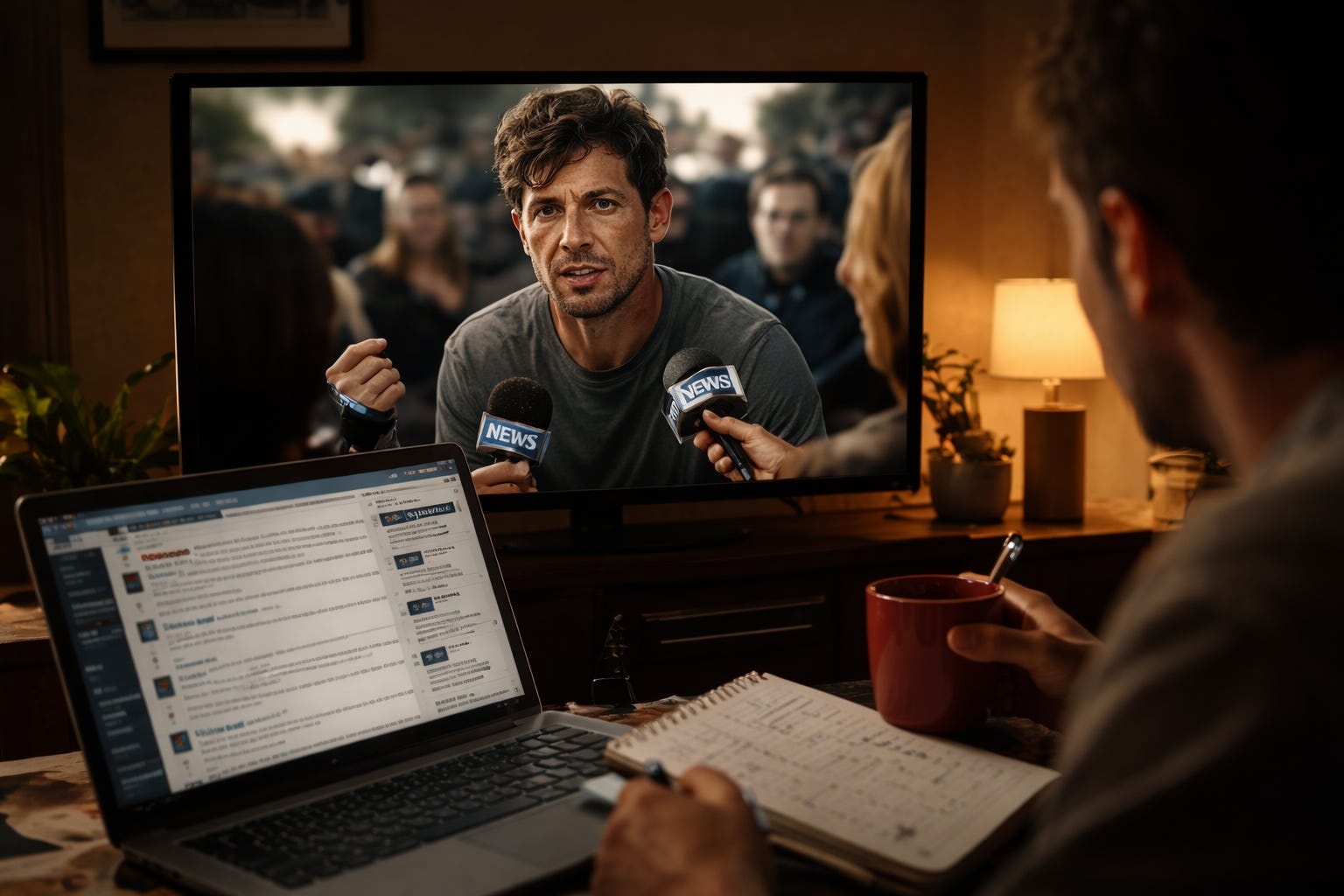
Sources That Don’t Suck
DePaulo, B. M., Lindsay, J. J., Malone, B. E., Muhlenbruck, L., Charlton, K., & Cooper, H. (2003). Cues to deception. Psychological Bulletin, 129(1), 74–118.
Kassin, S. M., Dror, I. E., & Kukucka, J. (2013). The forensic confirmation bias: Problems, perspectives, and proposed solutions. Journal of Applied Research in Memory and Cognition, 2(1), 42–52.
Loftus, E. F. (2005). Planting misinformation in the human mind: A 30-year investigation of the malleability of memory. Learning & Memory, 12(4), 361–366.
van der Kolk, B. A. (2014). The body keeps the score: Brain, mind, and body in the healing of trauma. Viking.
Vrij, A. (2008). Detecting lies and deceit: Pitfalls and opportunities (2nd ed.). Wiley.
Vrij, A., Granhag, P. A., & Porter, S. (2010). Pitfalls and opportunities in nonverbal and verbal lie detection. Psychological Science in the Public Interest, 11(3), 89–121.
Yuille, J. C., & Cutshall, J. L. (1986). A case study of eyewitness memory of a crime. Journal of Applied Psychology, 71(2), 291–301.