

Why Air Force General William McCasland's Disappearance is Significant
Loose Ends for UFO Exposure?

The Disappearance of William Neil McCasland: The Air Force General, UFO Secrets, and a Mystery Still Unfolding
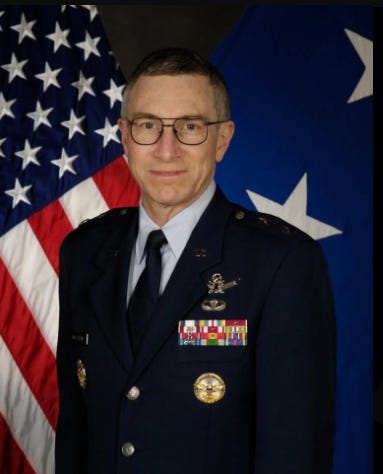
In the shadowy world where national security, aerospace technology, and unexplained aerial phenomena intersect, few figures are as intriguing as retired U.S. Air Force Major General William Neil McCasland.
For decades, McCasland operated at the highest levels of American military research and advanced aerospace development. His career placed him at the helm of some of the most sophisticated scientific programs ever run by the U.S. military—programs that have long been connected, fairly or not, to rumors about unidentified flying objects and secret propulsion technologies.
But today, McCasland is known for something else entirely: his sudden and unexplained disappearance.
In late February 2026, the decorated general vanished without a trace from his home in Albuquerque, New Mexico. His phone was left behind. There were no confirmed sightings. Search teams, drones, and investigators scoured the surrounding area.
And the mystery deepened when people realized who McCasland was—and what he might have known.
Because years earlier, his name surfaced in a strange and unexpected place: leaked emails connected to musician and UFO disclosure advocate Tom DeLonge.
Those messages suggested the retired general may have quietly helped launch one of the most influential UFO disclosure movements of the modern era.
Now, with McCasland missing, questions are swirling.
Was this simply a missing person case?
Or does the disappearance of a man connected to some of America’s most secret aerospace programs carry deeper implications?
A Career at the Center of Advanced Military Research
To understand why McCasland’s disappearance has captured attention, it’s important to understand the world he inhabited during his military career.
McCasland served more than three decades in the U.S. Air Force and rose to the rank of major general. Over the course of his career, he worked on advanced space systems, classified military technologies, and cutting-edge aerospace research.
One of his most significant assignments was commanding the Air Force Research Laboratory (AFRL) at Wright-Patterson Air Force Base in Ohio.
The AFRL is one of the most important scientific institutions in the U.S. military. It oversees billions of dollars in research focused on developing the next generation of weapons systems, propulsion technologies, and aerospace platforms.
The lab employs thousands of scientists, engineers, and analysts tasked with pushing the boundaries of what is technologically possible.
But Wright-Patterson has another reputation.
For decades, it has been at the center of UFO lore.
The base once hosted Project Blue Book, the U.S. Air Force program that investigated UFO sightings from the 1950s through the late 1960s. The project collected over 12,000 reports of unidentified aerial phenomena, hundreds of which remained unexplained.
Even earlier, Wright-Patterson became entangled in speculation surrounding the 1947 Roswell incident.
Conspiracy theories have long claimed that debris recovered from the alleged UFO crash near Roswell, New Mexico, was secretly transported to Wright-Patterson for analysis.
Official explanations state that the debris came from a classified surveillance balloon known as Project Mogul. Still, the rumors persisted—and they became part of the mythology surrounding the base.
For many UFO researchers, the idea that McCasland eventually commanded the very laboratory tied to these legends was significant.
It placed him at the crossroads of science, secrecy, and speculation.
The Unexpected Connection to Tom DeLonge
Years after his military service, McCasland’s name resurfaced in an unusual context.
In 2016, thousands of emails from political strategist John Podesta were leaked during a high-profile cyberattack.
Within those emails were conversations with Tom DeLonge—the former guitarist of the band Blink‑182.
But DeLonge had moved far beyond music.
He had become one of the most prominent civilian advocates pushing for government transparency about UFOs.
DeLonge was attempting something ambitious: assembling a team of insiders from the military, intelligence community, and aerospace industry to help gradually reveal what governments might know about unidentified aerial phenomena.
According to emails revealed during the leak, DeLonge claimed that McCasland had helped guide him during the early stages of that effort.
In one message, DeLonge described the retired general as an extremely important adviser who had helped assemble members of his advisory team.
The implication was extraordinary.
If true, it suggested that a senior figure who had once overseen major aerospace research programs had quietly helped encourage a public discussion about UFOs.
DeLonge would later launch the organization To The Stars Academy of Arts & Sciences, which brought together scientists, intelligence veterans, and defense insiders to study unidentified aerial phenomena and advanced technologies.
The group would go on to play a role in pushing the U.S. government toward greater transparency about UFO encounters.
In 2017, previously classified U.S. Navy footage showing mysterious aerial craft performing seemingly impossible maneuvers was released to the public.
Those videos helped spark a new era of serious government discussion about unidentified aerial phenomena.
But one question remained unanswered.
How much did McCasland actually contribute to the effort?
The retired general never publicly confirmed or denied the claims.
He remained silent.
A Disappearance Without Answers
Then, in February 2026, the story took a dramatic turn.
McCasland vanished.
Authorities say the 68-year-old retired general left his home in Albuquerque and disappeared on foot. His cellphone remained behind, and there were no immediate signs of where he had gone.
A Silver Alert was issued due to concerns about his safety, and investigators quickly launched a large-scale search effort.
Local authorities canvassed neighborhoods and asked hundreds of residents to check security cameras for possible sightings.
Search teams deployed drones, helicopters, and K-9 units.
The FBI joined the investigation.
Yet despite these efforts, there were no confirmed sightings of the missing general.
No abandoned vehicle.
No trail.
No clear explanation.
The disappearance immediately sparked concern among those familiar with his career.
McCasland had spent decades working in some of the most sensitive corners of American defense research.
He had overseen advanced aerospace programs and technologies that remain classified to this day.
Even without UFO connections, that alone made him an unusual missing person.
A “National Security Concern”
Some investigators and journalists have gone so far as to suggest that McCasland’s disappearance could have implications beyond a typical missing persons case.
Those concerns stem largely from the level of knowledge someone in McCasland’s position might possess.
During his time at the Air Force Research Laboratory, he oversaw massive scientific programs involving advanced propulsion, space technologies, and classified defense systems.
People with that level of clearance often retain knowledge that remains sensitive long after retirement.
While there is currently no evidence connecting his disappearance to classified information or UFO programs, the speculation has continued.
The timing has also raised eyebrows.
In recent years, the U.S. government has begun slowly acknowledging the reality of unidentified aerial phenomena.
Congress has held hearings.
Military pilots have testified publicly.
And intelligence agencies have admitted that some aerial encounters remain unexplained.
What was once considered fringe speculation has moved closer to mainstream discussion.
In that context, the disappearance of a retired general linked—however loosely—to UFO research has inevitably fueled theories.
But at this point, they remain just that: theories.
The Thin Line Between Myth and Reality
The story of William Neil McCasland sits at a strange intersection.
On one side is a highly decorated military officer whose career involved real and documented scientific work on advanced aerospace technologies.
On the other side is a cultural fascination with UFOs, government secrecy, and hidden knowledge.
When those two worlds overlap, the result can blur the line between fact and speculation.
It is entirely possible that McCasland’s disappearance has nothing to do with UFOs, classified programs, or national secrets.
Many missing persons cases begin with similarly mysterious circumstances and ultimately turn out to have far more ordinary explanations.
Yet the details surrounding McCasland’s career make the story difficult to ignore.
Few missing persons cases involve someone who once oversaw billions of dollars in military research.
Even fewer involve someone whose name appeared in leaked emails connected to the modern UFO disclosure movement.
An Unsolved Mystery
As of now, the disappearance of William Neil McCasland remains unsolved.
Search efforts have produced no clear answers.
Authorities continue to urge anyone with information to come forward.
For investigators, the goal is simple: locate the missing general and determine what happened.
For those watching from the outside, however, the story has become something larger.
It touches on one of the most enduring questions of our time.
What do governments really know about unidentified objects in our skies?
And who, exactly, has been quietly guiding the conversation behind the scenes?
Whether McCasland’s disappearance ultimately proves to be a tragic personal event or something more complex, one fact remains clear.
A man who once stood at the center of America’s most advanced aerospace research has vanished without a trace.
Until answers emerge, the mystery surrounding William Neil McCasland will continue to grow—fueling speculation, debate, and a lingering sense that some stories are far from finished.