


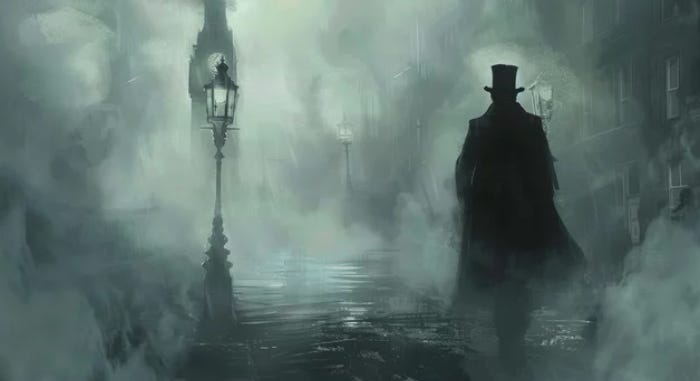
In the fog-filled streets of Whitechapel in 1888, a killer struck with terrifying precision and then vanished into London’s shadows. Over three months, five women were brutally murdered, leaving the city’s police baffled.
Few criminal investigations in history have captured the public imagination as persistently as the case of Jack the Ripper, the unidentified serial killer who terrorized London in 1888. The murders swept through the impoverished district of Whitechapel during the late Victorian era, leaving residents petrified. Despite extensive police work and more than a century of investigation by historians, criminologists, and amateur detectives, the identity of the killer remains uncertain to this day. The case is widely regarded as one of the most famous cold cases in modern policing.
Understanding why the case remains unresolved requires examining the historical context of the murders, the police investigation, the suspects, the theories proposed over time, and recent attempts to solve the mystery with modern forensic science.
Victorian Whitechapel: Poverty & Peril
The social environment of Whitechapel in the late nineteenth century helps explain how Jack the Ripper’s crimes unfolded as they did. London’s rapid industrial growth brought both opportunity and severe poverty. Whitechapel, in the East End, became a hub for overcrowded housing, unemployment, and crime.
Thousands of immigrants, particularly from Eastern Europe, settled there in search of work. Many shared cramped lodging houses, with entire families often crammed into a single room. Poverty forced residents into unstable employment, and crime thrived.
Women in particular faced extreme vulnerability. With limited job prospects, many turned to prostitution to survive, oftentimes wandering the streets alone after dark. These same shadowed streets quickly became the hunting ground of a merciless killer.
The Canonical Five
Between August and November 1888, a string of brutal murders believed to have been committed by Jack the Ripper shocked London. At least five victims—widely known as the “canonical five”—likely fell to the same killer: Mary Ann Nichols, Annie Chapman, Elizabeth Stride, Catherine Eddowes, and Mary Jane Kelly.
The murders stunned the public. Victims’ throats were cut, and their bodies mutilated. In some cases, organs were removed, leading investigators to speculate that the killer possessed anatomical knowledge.
Mary Jane Kelly, the final victim, was murdered indoors in her small, rented room. Kelly’s murder exemplified the most severe mutilation among the canonical five, reportedly shocking even seasoned investigators. Consequently, these crimes generated panic across London and placed enormous pressure on the police to catch the killer quickly.
The Origin of the Name “Jack the Ripper”
The killer’s infamous name was derived from letters sent to newspapers and police. The most famous, the “Dear Boss” letter, arrived at the Central News Agency in September 1888.
The author signed it “Jack the Ripper,” mocking the police and suggesting he intended to continue killing. Another letter, known as the “From Hell” letter, was delivered to George Lusk. Lusk was the head of the Mile End Vigilance Committee, formed by residents to patrol the streets and assist in finding the killer. The “From Hell” letter was sent along with half a human kidney. The kidney’s origins were unclear.
Historians consider many letters sent in this case to be hoaxes written to attract attention. Regardless, these certainly played a major role in shaping the Ripper legend and perpetuating fear across London.
The Police Investigation
The Metropolitan Police Service and the City of London Police led the investigation. Because some murders occurred in the City of London and others in the Metropolitan jurisdiction, the two forces had to coordinate their investigative efforts.
Detective Frederick Abberline became a prominent figure, leading many aspects of the inquiry. Officers conducted hundreds of interviews, searched lodging houses, and increased foot patrols. Civilian groups, such as the Whitechapel Vigilance Committee, organized citizen patrols in an attempt to protect residents.
The investigation faced severe obstacles; policing methods in 1888 lacked modern forensic tools, the officers had limited training in evidence collection, and forensic science was in its infancy. As a result, many clues and pieces of valuable evidence were overlooked, mishandled, or lost entirely.
Media Sensation and Public Panic
While detectives worked, the press amplified every grisly detail of the murders. Newspapers competed fiercely for readership, publishing sensational stories that fueled fear and paranoia.
The Star and The Illustrated Police News printed dramatic accounts and speculated widely about the killer’s identity. Crowds gathered at crime scenes, disturbing critical evidence by contaminating the sites. Police stations were flooded with letters from people claiming to be the killer or offering false leads, wasting valuable time and resources of law enforcement.
The Ripper case became one of the earliest examples of a modern, media-driven criminal investigation.
Major Suspects & Theories
Over the years, investigators and historians have proposed many possible suspects and theories, some of which were considered by police at the time, while others were suggested later by researchers.
Montague John Druitt, a barrister and schoolteacher who died by suicide shortly after the final murder, appeared on police lists as a potential suspect. Viewing the timing of the suicide as suspicious, senior officer Melville Macnaghten suggested Druitt was “sexually insane” and declared him a suspect, though evidence remains weak.
George Chapman, later convicted of poisoning women (specifically three of his former wives), is another suspect. Chapman was known for his violent tendencies, and some believe he could have committed the Whitechapel murders before changing up his methodology.
Aaron Kosminski, a Polish immigrant in Whitechapel with a history of violent behavior, remains frequently discussed as a potential suspect. Police records indicate Kosminski suffered from severe mental illness and was eventually committed to an asylum. Investigators suspected him but lacked enough evidence to arrest him.
Why the Case Became a Cold Case
The Jack the Ripper murders became a cold case for several key reasons.
First, forensic science was extremely limited in the late nineteenth century. Techniques such as fingerprint identification, DNA analysis, and blood typing had not yet been developed. Without physical evidence linking a suspect to the crime scenes, police struggled to definitively prove guilt.
Second, crime scene preservation was poor and unstandardized. Large crowds frequently gathered at scenes, and police lacked procedures for securing and documenting evidence.
Third, Whitechapel’s social environment complicated investigative processes. Many residents moved frequently between lodging houses, making it difficult to track suspects or verify alibis. Witnesses were often reluctant to cooperate with authorities due to widespread mistrust of the police force.
Finally, the killer may have died, left London, or been imprisoned for unrelated crimes, which could explain why the murders stopped suddenly after November 1888.
Modern DNA Evidence
Could modern science finally unmask a killer who has haunted London for over a century? The answer remains uncertain.
In recent years, advances in forensic science have encouraged researchers to reexamine the Jack the Ripper case using DNA analysis. One of the most widely discussed claims involves a silk shawl allegedly recovered from the crime scene of the murder of Catherine Eddowes.
In 2007, the shawl was purchased by researcher Russell Edwards, who arranged for scientific testing of stains found on the fabric. Scientists extracted mitochondrial DNA from the material and compared it with DNA samples from living descendants of both Eddowes and potential suspect Aaron Kosminski.
The results reportedly showed genetic similarities linking the biological material on the shawl to descendants of Kosminski. Supporters of the research argue that this evidence suggests Kosminski could have been the killer.
The findings attracted international attention and sparked renewed debate about the identity of Jack the Ripper.
Controversy Surrounding the DNA Findings
Despite the excitement generated by this DNA evidence, many scientists and historians remain skeptical about the conclusions.
One major issue concerns the origin of the shawl. There is no definitive historical documentation proving that the item belonged to Catherine Eddowes or that it was present at the crime scene. Without clear evidence of its authenticity, the shawl’s connection to the murder is uncertain.
Another concern involves DNA contamination. The shawl has been handled by many individuals over more than a century, often without protective measures in place. This increases the possibility that modern DNA could have contaminated the sample.
Additionally, the analysis used mitochondrial DNA, which cannot uniquely identify a single person. Because mitochondrial DNA is passed through maternal lines, many individuals can share identical sequences.
For these reasons, many historians and forensic experts do not consider the shawl DNA evidence definitive proof of the killer’s identity but view it as suggestive at best.
Cultural Legacy of the Case
The mystery surrounding Jack the Ripper has had a lasting impact on popular culture. The case has inspired numerous books, films, documentaries, and works of fiction. Historians and enthusiasts who study the murders are often referred to as “Ripperologists,” reflecting the extensive research devoted to the subject.
The story continues to attract interest because it combines several elements that fascinate audiences: a mysterious killer, gruesome crimes, historical intrigue, and the enduring possibility that the truth might still be discovered.
Even after more than a century, the case continues to influence discussions about criminal investigation, forensic science, and media coverage of violent crime.
Conclusion
More than 138 years after the Whitechapel murders, Jack the Ripper’s identity remains unknown. Policing methods and forensic technology in the 1880s limited the investigation, and key evidence was likely lost.
Modern forensic techniques, including DNA analysis, have renewed interest in the case and pointed toward suspects such as Aaron Kosminski. However, significant doubts remain about the reliability of the available evidence.
For now, the Jack the Ripper murders remain one of history’s most famous cold cases and continue to fascinate historians, criminologists, and the public alike. Despite centuries of speculation and endless theories, the Ripper remains a ghost in Whitechapel’s fog—his identity unknown, his legend enduring.
Sources: The research for this article draws on several authoritative sources covering both the historical investigation and modern forensic claims. Donald Rumbelow’s book, The Complete Jack the Ripper, provides a detailed overview of the murders, the social context of Whitechapel, and the original law enforcement investigation. Stewart P. Evans and Keith Skinner’s book, Jack the Ripper: Letters from Hell, analyzes the notorious letters sent to newspapers and police during the investigation and evaluates their authenticity. Russell Edwards’ book, Naming Jack the Ripper, details his research on the shawl allegedly recovered from Catherine Eddowes’s murder and the resulting DNA analysis. Additional reporting on the DNA controversy appears in articles from Ars Technica (https://arstechnica.com/science/2019/03/dont-believe-the-hype-we-may-never-know-the-identity-of-jack-the-ripper/) and Smithsonian Magazine (https://www.smithsonianmag.com/smart-news/jack-rippers-dna-collected-shawl-though-doubts-linger-180971726/), which critically evaluate the evidence and highlight the limitations of modern forensic claims. Together, these sources provide both historical context and insight into ongoing debates regarding the identity of Jack the Ripper.