

Venezuelan Father Romeyvi Ortiz Disappears Into ICE Custody Never Heard From Again
ICE Took Him and Now He's Disappeared

How a Venezuelan father who entered the U.S. legally vanished into the government’s detention machine — and ended up in a Salvadoran prison with no charges, no hearing, and no explanation
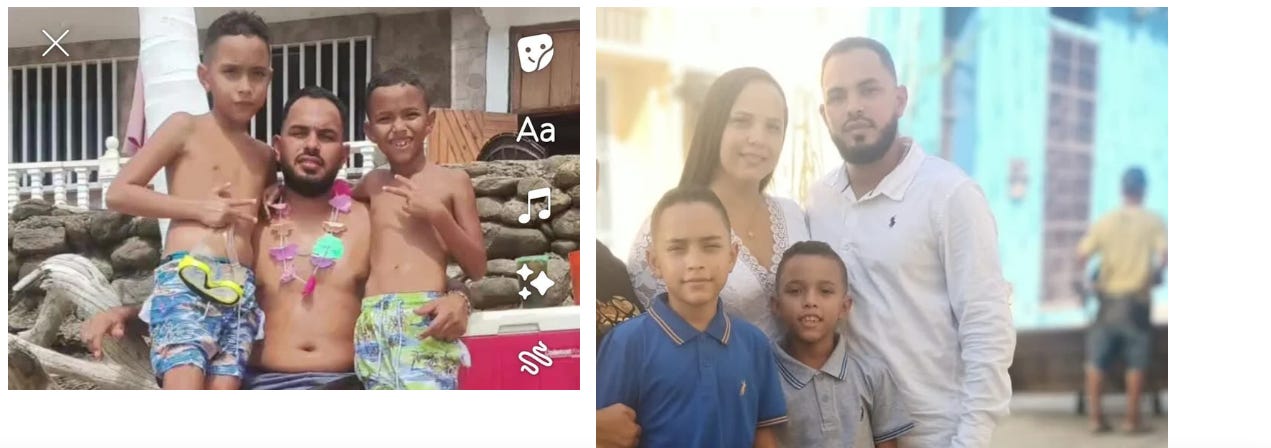
The last message Romeyvi Ortiz received from her husband arrived at 10 o’clock in the evening. “My love, I will call in 5 minutes,” Rodmel José Angulo Orta typed from a detention tablet somewhere in Arizona. The call never came.
The next day: silence. The day after: silence. On April 12, 2025, scrolling through Instagram from her home in Venezuela while her two boys slept, Romeyvi saw a post claiming that seven or ten more Venezuelans had been put on a flight to El Salvador. A terrible feeling settled over her. She called Rodmel’s cousin in the United States. No word from him either.
Within days, a news report published the names of seven Venezuelans believed to have been on a flight on April 13th. Rodmel’s name was on the list.
He had entered the United States legally. He had a pending immigration court date. He had no criminal record — not in Venezuela, not in Ecuador, not in Mexico, not in the United States. He had never been charged with a crime. And yet, according to his family, Rodmel José Angulo Orta, 32 years old, a father of two boys who still asks about him, has been transferred to CECOT — El Salvador’s maximum-security megaprison — without a hearing, without a charge, and without an explanation.
This is his story.
A MAN FROM LA GUAIRA
Rodmel Angulo grew up in La Guaira, the coastal Venezuelan state that hugs the Caribbean just north of Caracas. He was the oldest of three brothers in a close family. He graduated from high school and started college but dropped out to support his family — a decision his wife describes as entirely in character.
“He loves to travel and explore new places. He’s not a party person; he’s more family oriented. He’s very easygoing and really likes to help others,” said Romeyvi Ortiz, his wife of seventeen years — the two met as teenagers in high school in 2008.
Rodmel had four tattoos. This fact would later become central to the nightmare his family now lives. The tattoos: the names of his two sons. The planet Saturn. An octopus.
In recent years, U.S. officials and media have cited tattoos as one of the primary visual markers used to identify alleged members of Tren de Aragua, the Venezuelan prison gang that has been the stated justification for the Trump administration’s mass deportations of Venezuelan nationals under the Alien Enemies Act. Experts and human rights advocates have repeatedly warned that this methodology is dangerously imprecise — that tattoos of stars, crowns, clocks, and even children’s names have been used as evidence of gang affiliation, sweeping up people with no gang ties whatsoever.
Rodmel’s tattoos honored his children. The United States government has offered no documentation to his family explaining what, if anything, was used to justify his detention or transfer.
“He has no criminal record in Venezuela, Ecuador, Mexico or the US. He has never been part of any gang.” — Romeyvi Ortiz, his wife
FLEEING ONE CRISIS, THEN ANOTHER
For six years, the Angulo family lived in Ecuador. Venezuela’s economic collapse — hyperinflation, food scarcity, collapsing public services — had driven millions of its citizens across the continent, and Rodmel and Romeyvi were among them. They built a life in Ecuador, running two small businesses: a services operation and a fast food stand.
But Ecuador, too, became dangerous. A surge in gang violence and organized crime transformed neighborhoods that had once been livable into places of fear.
“There were a lot of hitmen, a lot of robberies, you couldn’t go out on the street, and I had already had quite a few scares,” Romeyvi recalled. “In Ecuador, I was practically kidnapped, and we also had two businesses, one for services and one for fast food, and they were already charging us protection money. They threatened to steal our children. So that was the last straw.”
The family returned to Venezuela. But the same economic reality that had driven them out greeted them on their return. “We had plates,” Romeyvi said, “but there was no food.”
Rodmel had relatives in the United States. They told him about CBP One — the legal appointment-based system established under the Biden administration that allowed asylum seekers to schedule a port-of-entry appointment through a mobile app. This was not a back-channel or a loophole. It was the official, legal pathway.
On November 25, 2023, Rodmel, his brother, and a cousin left Venezuela.
THE JOURNEY
The route from Venezuela to the U.S. border is among the most dangerous in the Western Hemisphere. The Darién Gap — a lawless jungle corridor between Colombia and Panama — claimed thousands of lives in the years Rodmel would have been traveling. Bodies on the trail are not uncommon.
Rodmel’s brother panicked somewhere in the Darién. Rodmel steadied him. Along the way, they encountered a woman traveling alone with six children. According to Romeyvi, they gave her their food.
Rodmel developed kidney stones from dehydration during the journey — a painful condition that he carried through the rest of the crossing.
He spent nearly a year waiting in Mexico for his CBP One appointment to come through. During that time, he found work at a market. He waited.
On October 4, 2024, Rodmel José Angulo Orta crossed legally into the United States at a port of entry. He had his CBP One appointment. He traveled to Washington, D.C., where he had relatives. He applied for a work permit. He was assigned an immigration court date.
He drove for Uber. Later, he found work on a military base. When it snowed for the first time in his life, he sent Romeyvi photographs.
“He also sent me a photo of people decorating outside,” she said. “He was so excited about everything there.”
“When it started snowing, he sent me photos. He was excited about all the new things there.” — Romeyvi Ortiz
THE DECISION TO CROSS INTO CANADA
When Donald Trump won the presidency in November 2024, the political climate in the United States shifted rapidly. The incoming administration had campaigned on mass deportations and had specifically targeted Venezuelans — accusing many of gang membership with what critics said was thin or nonexistent evidence.
Rodmel grew frightened. He had done everything legally, but he watched the news and understood that legality had not protected others. He had cousins living in Canada who encouraged him to come north and claim asylum there. He thought it might be faster — that he could get the paperwork he needed to bring Romeyvi and the boys over sooner.
On February 5, 2025, Rodmel crossed into Canada at the Buffalo border.
Canadian officials arrested him.
They handed him over to U.S. Immigration and Customs Enforcement.
“I have a text message where he says, ‘I’m at the Buffalo border,’” Romeyvi said. “But the next day, he called me and said that they had detained him.”
INSIDE DETENTION: NO ANSWERS, CHANGING COLORS
From the beginning of his detention, Rodmel asked why he was being held. Immigration officials gave him no reason. He was moved from Buffalo to Arizona. He had a court date scheduled for March 18th.
On March 18th, he received a notification on the tablet provided to detainees: his charges had been dismissed. His family never learned what those charges were.
But Rodmel was not released. Instead, something changed. His uniform — the color-coded system detention facilities use to classify detainees — was changed first to green and then to red. Red is the designation for violent detainees.
Rodmel asked the guards why his uniform had been changed. He messaged the detention officer through the tablet system. Nobody answered him.
“He was upset about it; he was depressed and desperate to get out. He seemed afraid too. They didn’t treat him well in there,” Romeyvi said. “I told him to be calm, he hadn’t done anything.”
She did not know then that she was giving him the last advice she would be able to give him for the foreseeable future.
“My love, I will call in 5 minutes.” — Rodmel’s last message to his wife, April 10, 2025
APRIL 10TH: THE LAST MESSAGE
On April 10, 2025, Rodmel sent Romeyvi a message: he was going to call her. She waited. When she tried to connect, there was an error message. She waited longer. Nothing.
The next day: nothing. He had credit on his account to make calls. He simply did not call — could not call.
On April 12th, Romeyvi saw the Instagram post. Seven or ten more Venezuelans. El Salvador.
She reached Rodmel’s cousin in the United States. No contact from him.
She told her father-in-law. He tried to reassure her: the tattoo didn’t link Rodmel to anything, he had no criminal record.
“No, Rodrigo,” she told him. “They’re not sending criminals there. They’re sending innocent people.”
A news report soon published a list. Seven Venezuelans believed to be on the April 13th flight. Rodmel’s name was on it.
THE CONTEXT: A PATTERN, NOT AN ANOMALY
Rodmel Angulo’s case must be understood in the context of what has emerged as a systematic policy. On March 15, 2025, the Trump administration transferred 238 Venezuelan men to CECOT — El Salvador’s Terrorism Confinement Center — invoking the Alien Enemies Act of 1798, a wartime statute last used during World War II.
Almost immediately, families of those men began publicly asserting that their relatives were not gang members. They were taxi drivers, barbers, construction workers, fathers. Many had legal status or pending immigration cases. The administration’s evidence, to the extent it was made public, relied heavily on tattoos and physical appearance.
A federal judge ordered the deportation flights halted. The Supreme Court subsequently ruled that deportees must be given notice and an opportunity to contest their removal. The administration has contested these rulings and, in some cases, proceeded with transfers anyway.
Human rights organizations and immigration attorneys have documented dozens of cases similar to Rodmel’s: men with no criminal history, no gang affiliation, and legal immigration status or pending cases, transferred to a foreign prison without charge, without hearing, and without the ability to contact family or legal counsel.
The Salvadoran government, under President Nayib Bukele, has positioned CECOT as a regional counterterrorism facility available for U.S. use. The conditions inside have been described by international human rights observers as severely restrictive. Detainees are held in large group cells. Contact with the outside world is extremely limited.
For Romeyvi, in Venezuela, contact has been impossible.
WHAT REMAINS
Romeyvi Ortiz has not spoken to her husband since April 10, 2025. She does not know his current condition. She does not know what, if any, legal process has been or will be applied to his case. She does not know when or whether he will come home.
Their 12-year-old son began banging his head against the wall after his father disappeared. Romeyvi had to take him to a therapist. Their younger son recently had a birthday. When asked what he wanted, he said he wanted only one thing: for his papa to be released.
Rodmel was the family’s breadwinner. Romeyvi has had to ask her family for help to afford basic necessities. She has also joined the growing network of families of the detained and disappeared — attending marches, participating in protests, trying to get the attention of anyone who might be able to help.
“Because, well, they humiliated him,” she said. “Accusing him of ugly things that he has never done in his life.”
“On his recent birthday, their younger boy asked for nothing else than his papa to be released.”
WHAT WE KNOW — AND WHAT WE DON’T
What is documented: Rodmel Angulo entered the United States legally on a CBP One appointment on October 4, 2024. He had no criminal record in Venezuela, Ecuador, Mexico, or the United States. He applied for a work permit and had an active immigration case. His detention charges were listed as dismissed on March 18, 2025. He was subsequently transferred to a detention facility in Arizona, his uniform changed to red — the classification for violent detainees — without explanation. His last known contact with his family was April 10, 2025. His name appeared on a list of Venezuelans believed to have been flown to El Salvador on April 13, 2025.
What is not documented — at least not publicly, and not to his family: any evidence of gang membership. Any criminal conviction. Any formal charge that survived. Any due process hearing before his transfer to a foreign country’s prison system. Any legal basis for classifying him as a violent detainee. Any timeline for review of his case.
ICE and the Department of Homeland Security did not respond to requests for comment for this report.
EDITOR’S NOTE
This case is part of TheColdCases.com’s ongoing series on ICE Disappearances — documenting the cases of individuals who have vanished into the U.S. immigration detention system or been transferred abroad without public record, charge, or hearing. If you have information about Rodmel José Angulo Orta or another case in this series, contact us through our secure tips line.