


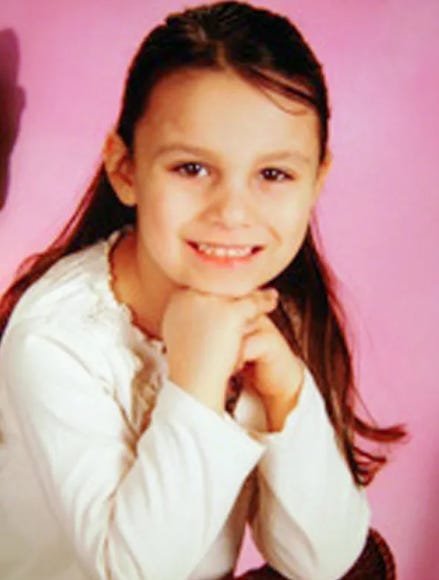
In the summer of 2009, a small Michigan city became the epicenter of national grief and outrage. The disappearance and death of five-year-old Nevaeh Buchanan captured headlines across the United States, not only because of the brutality of the crime, but because of the haunting uncertainty that followed. More than 16 years later, the case remains unsolved, suspended between memory and mystery.
Nevaeh Buchanan lived in Monroe, Michigan, a working-class community along Lake Erie. Her name, “Heaven” spelled backward, quickly became a symbol repeated across television broadcasts and front pages. Behind the symbolism was a child whose life ended violently, leaving behind a family searching for answers and a community grappling with fear.
The Day Nevaeh Disappeared
On May 24, 2009, Nevaeh was playing outside at the Charlotte Arms Apartments, where she lived with her mother. It was a familiar setting. Children often played in the shared spaces of the complex, and neighbors were accustomed to the presence of young families.
At some point during the afternoon, Nevaeh vanished.
The exact timeline of her disappearance has been a subject of scrutiny. There was a delay before authorities were notified, a detail that would later raise questions about whether critical early hours were lost. When a child disappears, especially in a populated area, time is often a highly decisive factor in recovery.
By the time law enforcement was alerted, the situation had already shifted from routine concern to a potential abduction.
The Search Effort Intensifies
Once law enforcement became involved, the response escalated rapidly. Monroe Public Safety coordinated with state agencies, and a large-scale search began. Volunteers joined officers in canvassing fields, wooded areas, and nearby waterways.
Dive teams searched rivers and ponds. Helicopters surveyed the landscape from above. Search dogs were deployed to track any possible scent trail. The effort quickly became one of the most extensive in the region’s history.
National media coverage followed almost immediately. News outlets broadcast continuous updates, and Nevaeh’s photographs circulated widely. The story resonated deeply with the public. A young child had disappeared from a familiar environment in daylight, a scenario that rattled and unsettled parents across the country.
A Devastating Discovery
Ten days after Nevaeh was last seen, the search ended in tragedy.
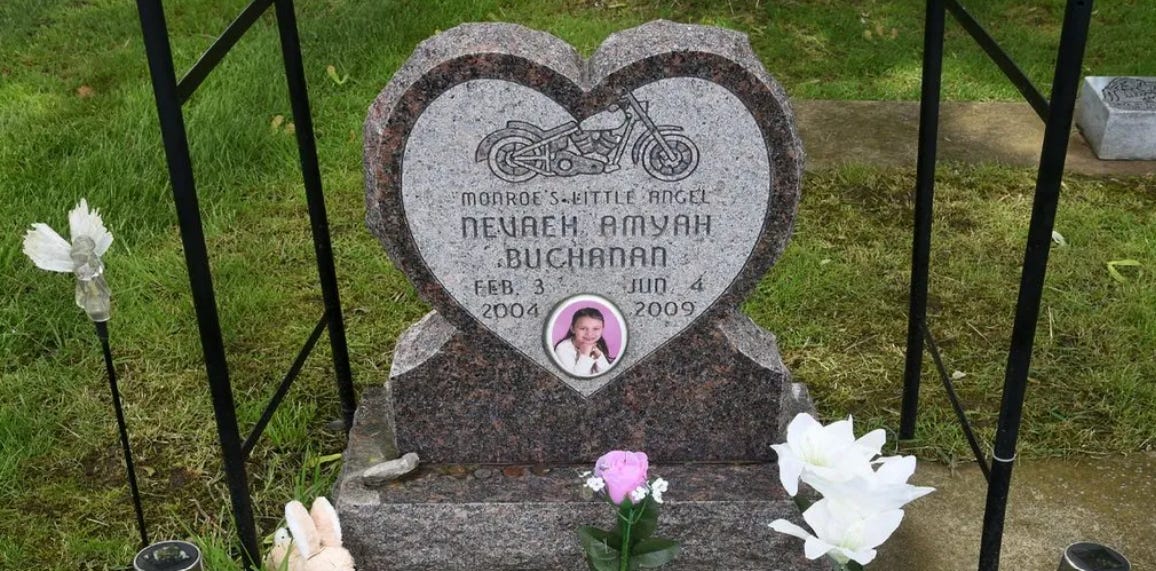
On June 4, 2009, her remains were discovered in the River Raisin, approximately 25 miles from the apartment complex. Authorities confirmed that she had been the victim of a homicide.
Investigators chose not to release specific details about the cause of death. This decision, while standard in many homicide cases, left the public with a limited understanding of what had occurred. The absence of information created space for speculation, but it also protected critical elements of the investigation.
Early Leads and a Person of Interest
From the beginning, investigators identified a man who had been present near the apartment complex on the day of Nevaeh’s disappearance. He quickly became the central focus of the investigation.
He was later arrested on unrelated charges and questioned extensively. Law enforcement indicated that he was not cooperating and suggested that he possessed knowledge relevant to the case.
Despite these suspicions, no charges were ever filed against him in connection with Nevaeh’s murder.
This distinction is important. In criminal investigations, suspicion does not equate to prosecutable evidence. Without physical evidence, a confession, or corroborated witness testimony, prosecutors cannot meet the burden of proof required to bring a case to trial.
Investigative Challenges
The investigation into Nevaeh Buchanan’s murder faced several structural challenges.
The delay in reporting her disappearance may have limited the ability to secure early evidence. Outdoor crime scenes are inherently difficult to preserve, and environmental exposure can degrade forensic material quickly.
The recovery of her remains in a river introduced additional complications. Water can significantly impact DNA evidence and obscure other forensic indicators that might otherwise provide clarity.
At the same time, the intense media attention generated an overwhelming volume of tips. While some were credible, many were not. Investigators were required to allocate resources to evaluate each lead, which can slow progress in complex cases.
Media Pressure & Public Scrutiny
The national spotlight brought both assistance and pressure.
On one hand, widespread coverage increased awareness and encouraged individuals to come forward with information. On the other hand, it amplified public scrutiny of law enforcement decision-making.
Questions emerged about the initial delay in reporting, the handling of suspects, and the overall direction of the investigation. In high-profile cases, these pressures can influence both public perception and investigative strategy.
Balancing transparency with the need to protect sensitive information is a persistent challenge. Releasing too much can compromise the case. Releasing too little can erode public trust.
Transition to a Cold Case
As active leads diminished, the case transitioned into what is formally considered a cold case.
This designation does not indicate closure. It reflects a shift in operational status. Investigators continue to review evidence, but the case no longer has active daily investigative momentum.
Cold cases often depend on new developments. Advances in forensic science, particularly DNA analysis, have led to breakthroughs in cases that remained unsolved for decades. Investigators have expressed hope that similar advancements could eventually yield results in Nevaeh’s case.
Ongoing Efforts and Reexamination
Law enforcement agencies periodically revisit cold cases through a process known as case reanalysis. This involves reviewing evidence, reexamining witness statements, and applying new forensic techniques where possible.
In some instances, fresh perspectives can uncover details that were previously overlooked. Investigative methods evolve, and what was once inconclusive may later become significant.
There is also the possibility that new witnesses may come forward. Over time, relationships change, loyalties shift, and individuals may feel more willing to share information.
The Human Impact
For Nevaeh’s family, the absence of answers has prolonged their grief. The loss of a child is devastating under any circumstances. When coupled with uncertainty, that grief becomes even more complex.
The community of Monroe continues to remember Nevaeh through vigils and commemorations. These acts serve not only as memorials but as reminders that the case remains unresolved.
Navaeh’s story has also contributed to broader discussions about child safety and investigative response. It has prompted reflection on how quickly authorities are notified in missing child cases and how communities respond in the critical early hours.
Broader Implications
The case of Nevaeh Buchanan highlights systemic challenges within criminal investigations.
It underscores the importance of rapid response, the limitations of forensic evidence in certain environments, and the difficulty of prosecuting cases without definitive proof.
It also illustrates the tension between public expectation and legal reality. Communities often expect swift justice. The legal system, however, requires a high standard of evidence, particularly in homicide cases.
These realities can leave cases unresolved even when suspicion exists.
The Possibility of Resolution
Despite the passage of time, there remains a possibility that Nevaeh’s case could be solved.
Cold cases are not static. They evolve with new technologies and new information. Breakthroughs often occur unexpectedly, sometimes decades after the original investigation.
A single piece of information, when combined with existing evidence, can shift the trajectory of a case. Investigators continue to emphasize that even minor details can be significant.
If You Have Information
Anyone with information related to the murder of Nevaeh Buchanan is urged to contact the Monroe Public Safety Department or the Michigan State Police. Tips can often be submitted anonymously. Information that may seem insignificant could prove critical, especially when combined with other evidence.
Sources: This article is based on publicly available law enforcement statements, contemporaneous news reporting from 2009 onward, and general research into cold case investigative practices. Information has been synthesized from multiple credible media outlets and official summaries to provide a comprehensive overview of Nevaeh’s case.