



In the humid, sun-bleached summer of 1973, panic gripped Broward County, Florida. Over six short weeks between mid-July and late August, three women and teenage girls were found brutally strangled, while another woman narrowly survived a violent home invasion.
The weapon of choice was not a cord, rope, or bare hands, but men’s stretch dress socks. The moniker that seized headlines—The Gold Sock Killer—derived from the mustard-gold nylon socks used in the earliest attacks. Despite massive manhunts, polygraph screens, and local hysteria, the case remains officially unsolved over fifty years later, standing as one of the most chilling cold cases in Florida law enforcement history.
A Timeline of Terror: July – August 1973
The attacks spanned Fort Lauderdale and Hollywood, leaving behind a trail of isolated crime scenes, missing personal belongings, and ligature evidence:
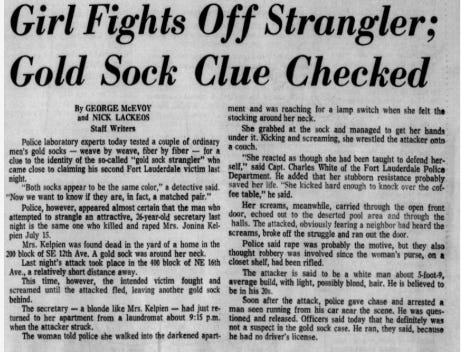
July 15, 1973 – The Murder of Jonina Kelpien: Forty-two-year-old Icelandic native Jonina Gudjonsdottir Kelpien was discovered dead in her car parked in the driveway of her Fort Lauderdale home. Her purse was gone, but her cocker spaniel, Sponge, remained unharmed in the back seat. She had been raped and garroted from behind with a gold men’s stretch knee sock.
July 25, 1973 – The Ambush on Northeast 16th Avenue: Ten days later, a 25-year-old secretary returned to her first-floor apartment in Fort Lauderdale. An intruder, who had pried open a window and rifled through her purse, ambushed her from behind with another gold sock. She fought back fiercely, overturning furniture and screaming until the attacker fled into the night.
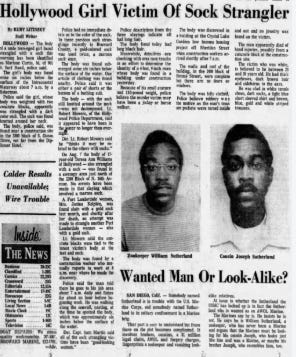
August 8, 1973 – The Marsh Discovery (Teresa Ann Williams): Seventeen-year-old Teresa Ann Williams, last seen alive on August 3 after her car was found with a flat tire, was discovered by men hunting land crabs in a dense marsh off Sheridan Street in Hollywood. Her body had been dragged across tidal creeks; a maroon stretch sock was tightly bound around her neck.
August 29, 1973 – The Intracoastal Waterway (Marisue Curtis): Sixteen-year-old Marisue Curtis vanished after going downstairs at her Surf Road apartment complex to meet a friend. The following morning, a construction worker spotted her nude body submerged in the Intracoastal Waterway, anchored by two concrete cinder blocks. Around her neck was a black men’s stretch sock.
The Signature and the Misnomer
The press seized upon the yellow-gold hue of the first two attacks to coin the moniker, but forensic analysts noted an evolving pattern:
The Ligature Material: While color varied—gold, maroon, and black—the weapon remained strictly uniform: nylon, synthetic men’s dress socks. Crime lab analysts determined that even the two gold socks recovered in July were not from the same manufacturer or pack, ruling out the idea of an identical pair split between the first two victims.
Victim Typology and Opportunism: The victim pool was demographically varied, spanning working women in their 40s to high schoolers in their teens. The common denominator was physical opportunity: isolated vehicles, accessible ground-floor apartment windows, and victims caught unawares.
Prowler Burglary Elements: In multiple instances, the assailant rifled through the victims’ purses and drawers before or during the attacks, combining classic predatory prowler behavior with escalating sexual sadism.
The Investigation and the Primary Suspect
In the wake of Marisue Curtis’s murder, Broward County mobilized. Task forces staked out coastal construction sites, set up surveillance at tidal marsh access points, and interviewed over 200 local men and known offenders. Detectives administered 35 polygraph examinations, all producing passes or inconclusive results.
The surviving victim from the July 25 attack provided the only direct eyewitness description: a slender, blond, Caucasian male in his late teens or early twenties. Plaster casts of shoe prints and partial fingerprints were recovered from the apartment window ledge, but 1973 forensic technology lacked automated databases (AFIS) to run instant cold matches.
The Shadow of Gary Jay Matus
The sudden cessation of the sock stranglings in August 1973 puzzled investigators until early 1974.
In February 1974, 32-year-old office manager Ann Raub Newman was found raped and strangled with a scarf inside her Fort Lauderdale residence. Investigators lifted a latent fingerprint from a pried-open window screen and traced it to Gary Jay Matus, a 19-year-old local construction worker.
Matus matched the physical profile given by the July 1973 survivor. During interrogations, his explanations shifted repeatedly—from claiming he had never been near the neighborhood, to admitting he had accompanied an unidentified associate named “Roy” or “Steve” to the scene. Matus was eventually convicted of Newman’s rape and second-degree murder, drawing a 165-year prison sentence.
Police and press heavily linked Matus to the Gold Sock killings. However, prosecutors lacked physical evidence—such as a clean fingerprint match from the 1973 scenes or DNA—to formally charge him with the murders of Kelpien, Williams, or Curtis.
Why the Case Went Cold
Decades later, the files remain active under cold-case squads within Broward County and the Florida Sheriffs Association’s unsolved task force:
Evidence Degradation: In the early 1970s, evidence preservation techniques were primitive. Items submerged in brackish water (as in Curtis’s recovery) or exposed to subtropical tidal marsh rot (as with Williams) suffered substantial organic degradation, complicating modern touch-DNA extraction.
Alternative Suspects in the Florida “Boom”: South Florida in the 1970s was an epicenter of transient labor, runaway migration, and roaming serial predators (including contemporary activity associated with Gerard John Schaefer and later Ted Bundy). While Matus remains the principal person of interest, detectives have never officially foreclosed the possibility of an itinerant predator who moved on after August 1973.
The Gold Sock killings remain a somber snapshot of South Florida’s rapid 1970s urban expansion—a time when unlocked windows, isolated coastal waterways, and darkness allowed a calculated strangler to vanish into Florida folklore.