


A Mother’s Three-Year Fight for Answers

On March 18, 2023, Milwaukee police officers responding to a 911 call discovered Kayla F. Calderon — an 18-year-old high school student, young mother, and aspiring veterinarian — dead in a bedroom chair with a gunshot wound to the right side of her head. She was two months from graduation. She weighed 109 pounds. Her right eye and cheek were swollen and bruised.
The man who called 911 and claimed to have discovered her — her relatively new boyfriend — would go on to walk free. Nearly three years later, he remains uncharged in her death, despite what law enforcement sources describe as threatening text messages, an alleged confession, and DNA evidence potentially linking him to the weapon.
Kayla’s mother, Iris Miranda, has spent those three years fighting for answers — writing to the Wisconsin Attorney General, meeting with the District Attorney, going undercover as a Lyft driver to gather information in the suspect’s neighborhood, and conducting videotaped witness interviews. Her determination has been so relentless that the suspect obtained a restraining order preventing her from mentioning him on social media.
“I am seeing where criminals are provided more lenience and rights than those that they have harmed in Milwaukee County,” Miranda told Wisconsin Right Now, “and it concerns not only myself but a long list of families that are facing the same tragedy of losing a family member to gun violence and not getting the help we need to keep the community safe.”
The Evidence Police Say They Have
According to an arrest detention report reviewed by Wisconsin Right Now, detectives believed they had enough to state plainly: “It is believed that [the suspect] did intentionally shoot Kayla Calderon, causing her death.”
The alleged evidence includes:
Threatening text messages sent days before Kayla’s death, believed to be from the suspect using another man’s phone:
“Tell that bitch come outside idgaf if y’all call y’all family or police I’ll shoot through that bitch n kill whole house in the kids I’m coming to every address…”
“N that bitch have me a std I’m ready killing her I told that bitch don’t play wit me idgaf you a die to bitch…”
Additional texts from March 12, 2023 — just six days before her death — in which the suspect allegedly told a friend he was going to “bust her down,” which that friend interpreted to mean shoot her.
An alleged confession: A man held in the Milwaukee House of Correction told detectives that the suspect told him directly that “he beat her and shot her in the head.”
Potential DNA evidence: According to Kayla’s mother, the suspect’s DNA — along with Kayla’s — may have been found on the gun. Wisconsin Right Now was unable to independently verify this claim with authorities.
The suspect was arrested on February 18, 2026, and booked for first-degree intentional homicide. A court commissioner found probable cause and set bail at $100,000.
He was released shortly after.
The DA’s Puzzling Non-Prosecution
The Milwaukee County District Attorney’s office declined to prosecute the case. The suspect was released on an administrative release signed by prosecutor Paul Tiffin.
When Wisconsin Right Now asked DA Kent Lovern’s office why charges were not filed, spokesman Jeffrey J. Altenburg offered a response that raised more questions than it answered: “Our office received a Disorderly Conduct referral in February of 2026 that related to conduct that occurred in March 2023 as outlined in the police report you provided. That referral was reviewed and because we determined that we could not meet the elements of the referred charge beyond a reasonable doubt, the referred charge was not issued.”
Disorderly conduct — for a case in which police had booked the suspect for first-degree intentional homicide.
When the outlet pressed Altenburg for clarification on the discrepancy, they received no response.
A prosecutor from another county who reviewed the Calderon documents told Wisconsin Right Now that he believed the case was “chargeable.”
This non-prosecution, however troubling, is not unusual in Milwaukee County. In recent years, the DA’s office has declined to prosecute approximately 60 percent of cases referred by police — meaning six out of every ten cases brought by law enforcement result in no charges being filed.
Milwaukee Police: Contradictions and Misinformation
The Milwaukee Police Department’s handling of the case has been marked by contradictions.
When Wisconsin Right Now first asked MPD about the case, a spokesman stated: “This was ruled a suicide by the Medical Examiner’s Office. At this time, there is no information to determine anything different.” He later doubled down: “Both [police and the ME ruled it a suicide]. We do not refer suicides to the DA.”
But through an open records request, Wisconsin Right Now obtained the 2024 Medical Examiner’s findings — which ruled the manner of Calderon’s death “undetermined,” not suicide.
When presented with this document, the MPD spokesman changed his position, acknowledging the original ruling may have been from a November 2023 report and that it “must have been updated on their end.” He maintained, however, that the case was “not classified as a homicide.”
Meanwhile, MPD declined a request to speak with the lead detective — and denied a subsequent open records request for all police reports in Calderon’s case, citing the investigation as still “open.” As the outlet noted, there would be no reason for a suicide case to remain open.
There are also troubling gaps in the investigation. According to Kayla’s mother’s detailed timeline, evidence was not sent to the crime lab for months after her death. Whether gunshot residue tests were conducted on the suspect’s or Kayla’s hands remains unclear from publicly available documents.
The Scene Tells a Story
Kayla’s boyfriend told detectives he was in the shower when he “heard a bang” at approximately 5:43 a.m. He said he found her on a chair with the gun on her lap.
But the Medical Examiner’s report says the gun was found on the bed — not on Kayla’s lap.
The ME also documented multiple contusions on Kayla’s body, consistent with a beating. Her right eye and cheek were visibly swollen and bruised when officers arrived. The gun — a 9mm handgun — had a spent casing that failed to eject properly.
Kayla’s medical records tell another contradictory story. Her mother asked her healthcare provider, Ascension, to review all records for any signs of depression or suicidal ideation. The response was unambiguous: “Your daughter’s medical record was thoroughly reviewed, and based on the findings of my investigation, there is no documented diagnosis of depression within the chart.”
Yet the suspect claimed Kayla had a history of suicidal statements, saying she “would drive off a bridge or drink herself to death.” There is no documented medical support for this claim.
A witness also told Miranda on video that she had seen the suspect brandishing a gun a week before Kayla’s death, and described witnessing him physically abuse Kayla: “He came out, and he had the gun, and he looked at me… He was going to kill her.”
The Bigger Picture: Milwaukee’s Homicide Crisis
Kayla Calderon’s case does not exist in a vacuum. It is one thread in a much larger tapestry of violence and institutional failure in Milwaukee County.
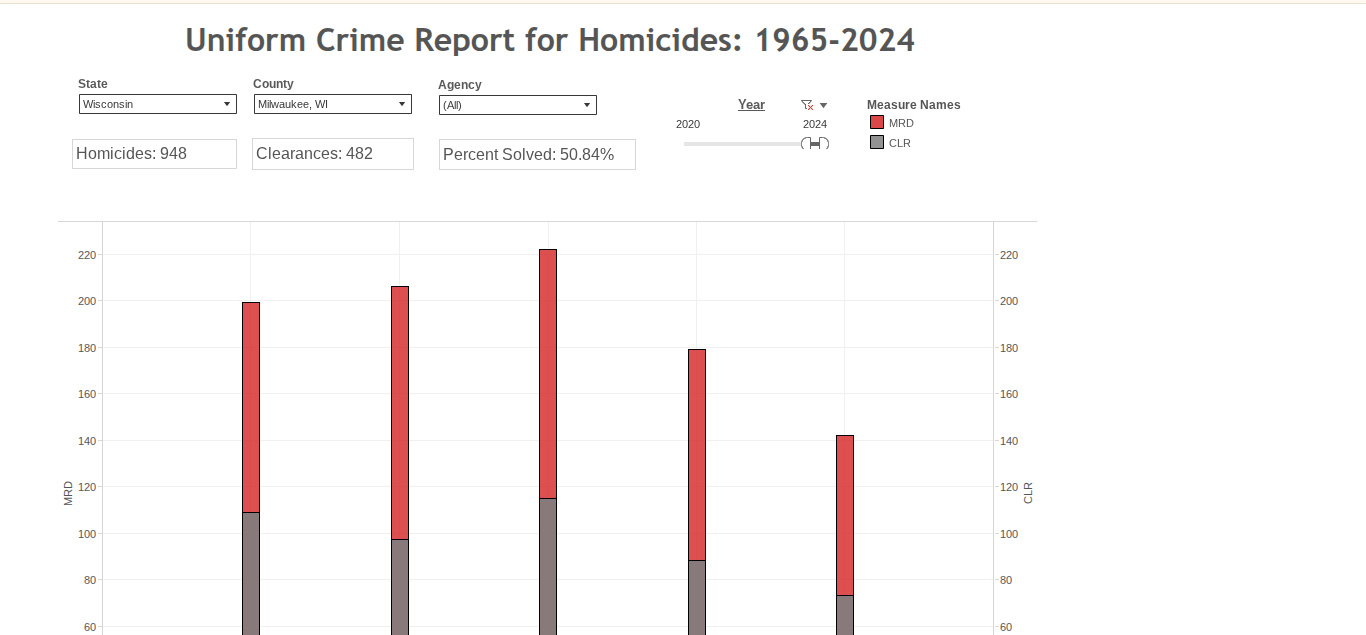
According to data from the Murder Accountability Project (murderdata.org), which tracks homicide and clearance data from FBI Uniform Crime Reports, Milwaukee County recorded 948 homicides between 2020 and 2024, with only 482 clearances — a solve rate of just 50.84 percent.
That means nearly half of all homicides in Milwaukee over that five-year period went unsolved. Nearly 500 families — like Iris Miranda — left without answers, without justice, without closure.
The data, which spans 1965 to 2024, shows Milwaukee has struggled with homicide clearance rates for decades. But the convergence of a high unsolved homicide rate and a DA’s office that declines nearly 60% of referred cases creates a system in which perpetrators of violence face remarkably low odds of accountability.
“I haven’t been able to function, keep a job, I haven’t been able to date, I don’t want to go out in public, I have severe anxiety because I have never gotten answers,” Miranda says. “I’ve come up with all of these theories.”
Who Was Kayla Calderon?
Amid the legal maneuvering, institutional contradictions, and unanswered questions, it is easy to lose sight of who Kayla Calderon was.
She was artistic. She loved animals — especially horses — and visited the zoo often with her mother. She had four fish tanks. She was a young mother who, by her own mother’s account, was doing well. She was two months away from a high school diploma she had worked hard to earn. She brought homeless kids home when she found them with nowhere to go.
“She had a passion for helping people,” Miranda says. “I found homeless kids in my basement a few times. She would find kids who had no place to go and bring them home.”
Kayla’s life had real hardships. The fathers of her two children had serious criminal histories. Her own father died of a heart attack at 56. She made difficult choices in her relationships. But none of that changes what her mother is asking — and what any family in her position deserves: the truth about how she died, and accountability if someone took her life.
What Happens Now?
The suspect remains free. He picked up a felony drug dealing conviction in Waukesha County in December 2025 — while the Calderon investigation was ongoing — and was sentenced to probation. He has a prior misdemeanor battery conviction.
No charges have been filed in Kayla’s death.
Miranda continues to push forward. She has asked the Wisconsin Attorney General’s office to intervene. She has met with the DA. She has conducted her own investigation. She has spoken publicly, even at the cost of a restraining order.
Milwaukee’s homicide clearance numbers suggest she is far from alone. Across the city, families are living with the same unanswered questions, the same institutional indifference, the same grief compounded by the knowledge that someone may be walking free.
“I am seeing where criminals are provided more lenience and rights than those that they have harmed,” Miranda says.
The numbers from the Murder Accountability Project suggest she may be right.
Sources: Wisconsin Right Now (wisconsinrightnow.com/kayla-calderon/); Murder Accountability Project, Uniform Crime Report data for Milwaukee County, 2020–2024 (murderdata.org); Milwaukee County District Attorney’s office statement; Milwaukee Police Department statements; arrest detention report and Medical Examiner’s report as reviewed by Wisconsin Right Now.