


The Sex House Homicide
How a secret apartment, a life insurance policy, and a husband’s cold calculation turned a routine welfare check into Florida’s most chilling premeditated murder case.
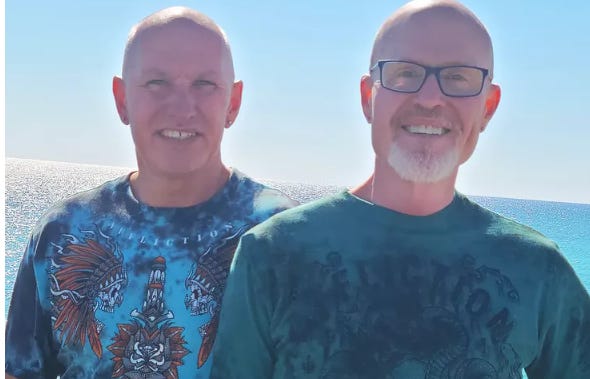
The call came in just after 9 a.m. on a warm Saturday morning, March 25, 2023. A man named Herbert Swilley had dialed the Marion County Sheriff’s Office, his voice steady, his concern measured. His husband, he explained, hadn’t shown up to work the day before. Wasn’t answering his phone. Might someone go check on him?
It sounded routine. Welfare checks happen dozens of times a day across Florida’s sprawling counties — missed calls, worried partners, elderly residents who’ve simply forgotten to charge a phone. Deputies drove to a second apartment the couple maintained in Citrus City, a quiet community tucked along the edges of Ocala. The Jeep was parked outside. Swilley claimed he didn’t have a key.
When deputies finally entered the apartment, they found 59-year-old Timothy Floyd Smith dead on the bedroom floor, wearing only a T-shirt and shoes. Dark ligature marks ringed his neck. His face and body bore signs of brutal assault. A fractured cervical spine. The sharp chemical scent of bleach hung in the air. And all around him — the trappings of a secret life: a sex swing suspended from the ceiling, whips mounted on the walls, a massage table in the corner.
This was no ordinary domestic call. What detectives were about to unravel was a case of breathtaking premeditation — a murder planned with cold precision, staged for maximum misdirection, and nearly executed without consequence. It would take nearly three years to conclude. But it would end with a life sentence, and a jury’s verdict that Herbert Swilley had committed the one crime no staging could conceal: the calculated killing of the man he had promised to love.
A MARRIAGE IN ITS FINAL HOURS
By the spring of 2023, the marriage between Herbert Swilley and Timothy Smith had deteriorated into something toxic and unmanageable. Friends described a household fractured by alcohol, jealousy, and mounting resentment. Timothy Smith, for his part, had made a decisive change: he had gotten sober through Alcoholics Anonymous, stepped back from the chaotic lifestyle the couple had shared, and begun quietly building a way out.
Smith, 59, was a respected professional in the Ocala community. He served as executive director of a senior living center — a role that demanded both competence and compassion — and by all accounts he excelled at it. Colleagues remembered him as dedicated and capable, the kind of leader who showed up early and stayed late. His New Year’s Eve parties were the stuff of local legend.
In the weeks before his death, Smith had quietly taken a significant step. He had secured an interview for a similar executive director position in DeLand, Florida — a city far enough from Ocala to represent a genuine fresh start. The job, if he got it, would require relocation. He intended to go alone. He intended to leave Swilley behind.
For Herbert Swilley, that prospect was apparently intolerable. Not merely emotionally — financially. Smith’s life insurance policies and retirement accounts totaled approximately $333,000, money that would be Swilley’s upon his husband’s death. A divorce would take all of that off the table.
Prosecutors would later argue that Swilley, faced with the reality of being left with nothing, made a calculation. He chose murder.
THE SECRET APARTMENT
The apartment in Citrus City served a particular purpose. It was not the couple’s primary residence — they maintained a separate home together — but a private retreat where they would meet with other men, partners recruited through dating apps and social media. Investigators, with characteristic understatement, would come to call it the “sex house.”
The contents of the apartment confirmed its purpose: a sex swing suspended from the ceiling on chains, a standing toolbox stocked with sex toys, whips mounted decoratively on the walls, a massage table positioned in the corner. To outside investigators, it initially raised the question of a different kind of crime — a hate crime, perhaps, or a sex encounter turned violent. That ambiguity, prosecutors would argue, was not an accident.
The evidence would eventually tell a different story. Smith had not died in that apartment. He had been murdered elsewhere — most likely at the couple’s shared home — and his body had been transported to the Citrus City apartment after the fact. Surveillance footage captured Swilley’s truck leaving the residence during the early morning hours, at a time when Swilley claimed to be asleep in bed. The Ring camera system at their home, which might have recorded the critical hours, was mysteriously missing its footage from that night.
The staging was elaborate. After transporting the body, Swilley allegedly arranged Smith’s remains to suggest the aftermath of a sexual encounter gone wrong. He cleaned the scene with household bleach — hence the chemical smell that greeted deputies. He placed Smith’s phone and Jeep keys in the washing machine, presumably to delay identification or confuse the timeline. He drove to a landfill to dispose of two carpets from the couple’s home. Then he returned to their shared residence, drove Smith’s Jeep back to the apartment, and walked home.
The following morning, he placed a welfare check call to the sheriff’s office.
THE TOXICOLOGY REPORT THAT CHANGED EVERYTHING
In the early days of the investigation, detectives were already treating the case as a suspicious death. But it was the autopsy results that transformed suspicion into certainty.
The toxicology screen returned a finding that shocked investigators: Timothy Smith had been dosed with diphenhydramine — the active ingredient in over-the-counter sleep aids like Benadryl and Unisom — at concentrations thirty times higher than a standard therapeutic dose. Someone had drugged him before the killing began.
It was a detail that spoke volumes about premeditation. This was not an impulse, not a crime of passion, not a confrontation that spiraled into violence. Whoever killed Timothy Smith had planned it carefully enough to incapacitate him first. They had obtained a sufficient quantity of a sedative, found a way to administer it, and waited for it to take effect before inflicting the blunt force trauma that fractured his cervical spine and left ligature marks around his neck.
Combined with the staging of the crime scene, the transportation of the body, and the disposal of evidence, the toxicology report painted a portrait of a killer who had thought through every detail. Almost every detail.
A DAUGHTER’S TESTIMONY
Jordan Swilley had lived with her father and Timothy Smith since she was fifteen years old. By the time the case went to trial in September 2025, she was twenty-two — and she took the stand against her own father.
Her testimony was devastating. Jordan described a household that had become progressively unlivable as the marriage deteriorated. When Smith got sober, the fighting intensified rather than subsided. Her father began speaking openly about divorce. Jordan started going to work early in the mornings, she said, simply to escape the tension that had taken over the home.
On the night before Smith’s disappearance, Jordan heard sounds in the house that she could not fully explain. She said nothing about it at the time. But in the days that followed, she told the jury, her father came to her with specific instructions: if investigators asked, she was to say she hadn’t heard anything.
There was more. In the immediate aftermath of Smith’s death, Herbert Swilley enlisted his daughter’s help in disposing of Smith’s personal belongings — including, Jordan testified, family photographs. While doing so, Swilley was simultaneously and urgently searching for Smith’s life insurance documentation.
For the prosecution, Jordan’s account was among the most powerful evidence in the case. It spoke not only to Swilley’s behavior in the days after the murder — behavior consistent with guilt rather than grief — but to his willingness to involve his own child in his attempt to evade justice.
THE FRIEND WHO WALKED AWAY
Candace Baker had known both men well. She was a sober coach — someone who had presumably celebrated, at least in part, Timothy Smith’s journey to sobriety. After Smith’s death, she watched Herbert Swilley’s behavior with growing unease.
Baker told investigators — and later the jury — that Swilley displayed a striking absence of grief. Where a bereaved husband might have been consumed by shock or sorrow, Swilley was focused, purposeful, and unsettlingly forward-looking. In one exchange that Baker found particularly chilling, Swilley told her: “Now I’m finally going to get the house I always wanted.”
There were other red flags. Swilley became obsessed with cleaning Smith’s Jeep — specifically with removing fingerprints. He told Baker he was doing so because he didn’t want to give police “ammunition” against him. He pressured Baker to stop discussing Smith’s death. He pivoted insistently to the subject of life insurance. And when Baker continued to raise concerns, he attempted to shut the conversations down entirely.
Baker eventually did what she felt she had to: she cut ties with Herbert Swilley and contacted law enforcement. Her decision to come forward would prove critical to building the prosecution’s case.
THE INVESTIGATION AND ARREST
From the beginning, Herbert Swilley was the primary suspect. Detectives faced the challenge of transforming a circumstantial case into an airtight one — a process that would take months of painstaking work.
Cellphone location data proved particularly valuable. Investigators were able to establish that Swilley’s movements during the critical hours contradicted the timeline he had presented. Surveillance footage from the neighborhood showed his truck on the road at times he claimed to be home and asleep. Digital forensics established a pattern that placed him with Smith’s Jeep at moments he couldn’t explain.
In August 2023, five months after the murder, the Marion County Sheriff’s Office announced publicly that Swilley had ceased cooperating with the investigation and would only speak further if granted immunity from prosecution. It was a significant moment — an implicit acknowledgment from Swilley himself that his exposure was serious.
No immunity was offered. On November 3, 2023, detectives arrested Herbert Swilley and charged him with first-degree premeditated murder and tampering with evidence. He was held without bail. He would remain incarcerated as the case moved, slowly, toward trial.
THE TRIAL: DEFENSE, PROSECUTION, AND VERDICT
The trial of Herbert Swilley began in September 2025. The defense mounted the argument that investigators had fixated prematurely on Swilley and failed to adequately pursue other leads. They pointed to DNA evidence recovered from the Citrus City apartment that matched two other men — both with criminal records — who had been known visitors to the space. They noted that neighbors had reported seeing a young white male with blond hair in the vicinity around the time of Smith’s death.
It was a reasonable theory to raise. The apartment’s history as a venue for sexual encounters with multiple partners provided genuine alternative suspects. But it ran headlong into the prosecution’s evidence, which was comprehensive, corroborated, and damning.
The cellphone data. The surveillance footage. Jordan Swilley’s testimony about the noises she heard and the instruction to stay silent. Candace Baker’s account of Swilley’s cold, calculating behavior in the days after the murder. The life insurance motive. The disposal of carpets. The staging of the body. The missing Ring camera footage. Each element, individually, might have been explained away. Together, they formed a portrait that the jury found impossible to dismiss.
On September 19, 2025, the jury returned its verdict: guilty of premeditated first-degree murder. The judge sentenced Swilley immediately to life in prison without the possibility of parole.
Herbert Swilley, 57, showed no visible reaction as the sentence was read.
THE MAN BEHIND THE CASE
In the coverage of cases like this one, it is easy for the victim to become an abstraction — a name, a set of facts, a body at the center of a story that is really about the killer. Timothy Floyd Smith deserves better than that.
He was, by all accounts, a man in the middle of becoming himself again. His path to sobriety was not easy — sobriety rarely is — but he had walked it. He had reoriented his professional ambitions, sought out a new chapter in a new city, and made the difficult but necessary decision to leave a toxic situation behind. He was, in the clearest sense, on his way out of a bad situation toward something better.
He never got there. The man he had married — the man he had trusted, shared a home with, built a life alongside — took that future from him. Drugged him, fractured his spine, staged his body to suggest something other than what had actually happened, and called the sheriff’s office the following morning to report him missing.
The case was eventually featured on People Magazine Investigates, in an episode titled “Sex House Homicide” that aired in January 2026. The title, sensationalistic as it is, captures something real: the deliberate misdirection that Swilley built into the crime, the way he used the most private aspects of their lives as camouflage for an act of pure, calculating greed.
AFTERMATH
The apartment in Citrus City has been quietly vacated. The Marion County Sheriff’s Office closed the case file with Swilley’s conviction. Jordan Swilley, who found the courage to testify against her own father, has had to reckon with the wreckage of a family built around two men, one of whom turned out to be capable of something monstrous.
Herbert Swilley is currently serving his life sentence in a Florida correctional facility. He will not be eligible for parole. He will die there.
Criminologists and domestic violence researchers often note that the most dangerous moment in an abusive or controlling relationship is the moment the controlled partner attempts to leave. The data bears this out, case after case. The departure — the job interview in DeLand, the packed bags, the plan for a life without Swilley — was precisely what triggered the murder. Smith’s act of self-preservation became, in Swilley’s calculus, an unacceptable threat.
What distinguishes this case from so many others is not the motive — which is devastatingly familiar — but the degree of planning. The sedative. The staging. The landfill run. The welfare check call, placed by the man who had committed the crime. For a brief time, it seemed it might work. The sex house offered so many other directions for investigators to look.
But premeditation also leaves traces. Cellphones move through cell towers. Surveillance cameras record timestamps. Daughters remember sounds in the night. Friends notice the absence of tears.
Timothy Smith had earned his sobriety. He had earned his fresh start. He had earned every step of the new life he was building in DeLand. The jury, in September 2025, gave him what the justice system could offer in place of all that: a verdict, a sentence, and a reckoning for the man who took it from him.