

The Disappearances of Monica Reza and General William Neil McCasland
Are they connected?

Vanished: Two People, One Shadow – The Disappearances of Monica Reza and General William Neil McCasland
An investigative report on two unsolved vanishings, their possible connection, and the national security questions at their center
Prologue: A Coincidence Too Strange to Ignore
In a remote part of the Angeles National Forest, 6,000 feet above the Los Angeles basin, aerospace engineer Monica Reza smiled and waved at the hiker ahead of her. She was never seen again.
Nine months later and nearly 800 miles away, in a quiet neighborhood of Albuquerque, New Mexico, a retired two-star Air Force general walked out of his front door on a mild February morning, left his phone and glasses on the counter, and disappeared without a trace.
Two people. Two vanishings. No bodies recovered. No confirmed explanations. And, according to investigators who are now actively examining the question, a professional thread that may link them.
That thread passes through some of the most sensitive areas of American military research, including rocket alloys, aerospace labs, a well-known Air Force base linked to UFO stories, classified government programs, and the ongoing debate about what the U.S. government knows about unidentified aerial phenomena. Investigators say it is still unclear whether this thread is a real connection. But the question can no longer be ignored.
Part One: The Engineer Who Vanished on the Mountain
On the morning of June 22, 2025, Monica Reza went hiking from the 6,000-foot Day Use Parking area along Angeles Crest Highway in the Angeles National Forest, north of Los Angeles. She was not alone. She went with a hiking companion, and some reports say it was a yoga group. These were people who knew her and the trail.
One account from a neighbor described Reza going out “with her yoga group/friends,” adding that her car had been parked at one of their houses, making it all the more shocking that someone in a group setting could simply disappear.
Reza was last seen smiling and waving about 30 feet behind her hiking companion before she suddenly vanished. The lead hiker made contact with her just before taking a northerly right-hand downhill turn. She acknowledged his communication with a wave. And then she was gone.
Investigators who later visited the location noted that the terrain was steep but “didn’t feel like it was steep enough to be fatal if someone fell,” and that the area was open enough that even steep slopes could be seen with binoculars. Nothing about the physical geography easily explains how a person 30 feet behind their companion could simply cease to exist.
What followed was a major coordinated rescue effort. The Crescenta Valley Sheriff’s Station brought in search-and-rescue teams from as far as San Diego County and Tulare County, and volunteers from across Southern California joined in over several days. Drones searched the canyons. Helicopters with FLIR thermal imaging scanned the ridgelines in the hours after she disappeared. K-9 units searched the trails. Wildlife experts were consulted about possible mountain lion or bear attacks, but they mostly ruled out animal involvement. Bears, they said, leave obvious evidence, and while mountain lions can carry prey, no signs of such an attack were found in the area.
A hat belonging to Reza was eventually located, providing investigators with a rough area of focus. But her body has never been found.
Days after Reza disappeared, even though her remains were not found, she was listed as having a biodegradable burial. This detail has puzzled online investigators and family advocates, and it has never been officially explained.
What is confirmed is that Monica Jacinto Reza was not simply a weekend hiker. She was a professional aerospace engineer, a co-inventor of a specialized metal alloy used in U.S. rockets, developed through a government-funded research project. That project, according to NewsNation reporting, was overseen by a man who would later vanish himself: retired Air Force Major General William Neil McCasland.
Part Two: The General Who Walked Out the Door
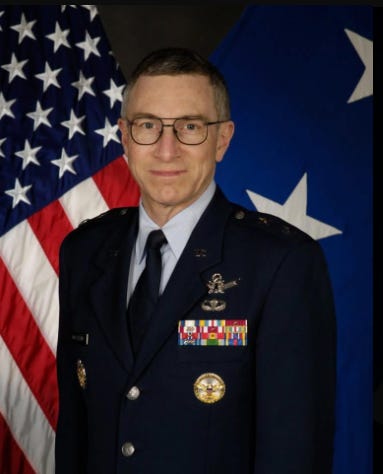
On the morning of February 27, 2026, retired Air Force Maj. Gen. William Neil McCasland, 68, left his home in Albuquerque, New Mexico, on foot at approximately 11 a.m. He has not been in contact with family or friends since.
The circumstances of his disappearance are disquieting in their specificity. A repairman visited the home around mid-morning. McCasland’s wife, Susan McCasland Wilkerson, later left for a doctor’s appointment, and when she returned about an hour later, her husband was gone. She reported him missing at 3:07 p.m. that afternoon.
His phone, prescription glasses and wearable devices were left behind at the house. Investigators believe his hiking boots, wallet, and a .38-caliber revolver with a leather holster are missing.
The Bernalillo County Sheriff’s Office issThe Bernalillo County Sheriff’s Office issued a Silver Alert, which is New Mexico’s emergency notification system for missing people over 50 who may have cognitive decline. However, people who knew him best have challenged this description. The FBI special agent leading the investigation said, “There’s no indication that Mr. McCasland was disoriented, confused. Arguably, he would still be the most intelligent person in the room.” Silver Alert’s implied framing. “He was not confused and disoriented,” Wilkerson said in a public Facebook post. Yet investigators had noted that McCasland had reported experiencing “mental fog” before his disappearance, a condition he cited as the reason for stepping down from various groups he had been working with.
What followed was one of the most intensive missing-person searches in New Mexico’s recent memory. Authorities contacted more than 600 homeowners in the neighborhood, and drones, helicopters and canines were deployed across the surrounding area. Surveillance cameras cover both ends of McCasland’s street, yet authorities used weeks combing through that footage, along with video provided by residents, without identifying McCasland’s direction of travel.
Authorities have recovered a light green long-sleeve button-up outdoor shirt and hiking boots in their continued search, but McCasland’s wallet, revolver and leather holster, and red backpack remain unaccounted for.
As of this writing, the FBI is involved in the investigation. The sheriff offered a sobering assessment: “If we receive information that would lead this to become a recovery mission, we would pursue that with the same vigor.” He acknowledged the grim reality that if McCasland had gone into the mountains, the likelihood of surviving several weeks would be very low.
Part Three: The Connection Investigators Are Examining
The professional link between Monica Reza and General McCasland is what drives the most serious investigative attention and the strongest public speculation.
Reza worked on a government-funded rocket materials project overseen by McCasland, according to NewsNation. Specifically, she is described as having developed a specialized metal alloy used in American rockets through that government-funded program. McCasland, during his tenure as commander of the Air Force Research Laboratory, oversaw the kinds of science and technology portfolios in which such materials research would naturally sit.
The Bernalillo County Sheriff’s Department told Newsweek that detectives are actively investigating whether there is any connection between the two disappearances. This confirmation, coming from law enforcement rather than online forums, marks a significant development. It means that, at least for investigators, the coincidence is now being taken seriously and formally examined.
It is worth being precise about what is and isn’t established. There is no confirmed reporting from law enforcement or the government establishing that Reza worked for a company directly overseen by McCasland during his tenure at the Air Force Research Laboratory. The professional link, as reported by NewsNation, has not been independently confirmed at the level of documentary evidence made public. And law enforcement has been careful to say only that they are looking for connections, not that they have found them.
Still, the similarities are striking. An aerospace engineer involved in classified government research disappears without explanation on a mountain trail. Nine months later, the retired general who oversaw her program also disappears from his home, with no explanation. Both are still missing.
Part Four: The Man at the Center of the Nation’s Most Sensitive Secrets
To understand why McCasland’s disappearance has alarmed the national security community, it is necessary to understand the arc of his career.
Commissioned in 1979 after earning a Bachelor of Science in astronautical engineering from the U.S. Air Force Academy, McCasland built a career covering varied roles in space research, acquisition, and operations within both the Air Force and the National Reconnaissance Office.
His biography on the Air Force website states he managed the Air Force’s “$2.2 billion science and technology program as well as additional customer funded research and development of $2.2 billion” as commander of the Air Force Research Laboratory at Wright-Patterson Air Force Base. That alone represents a staggering portfolio of classified and sensitive defense research.
His Pentagon roles included director of Space Acquisition in the Office of the Secretary of the Air Force and later director of Special Programs under the Under Secretary of Defense for Acquisition, Technology & Logistics. These positions put him at the center of major national defense space and technology projects.
During McCasland’s tenure, the Air Force Research Laboratory played a central role in developing technologies that later became key elements of modern U.S. military capability, including directed-energy weapons, advanced satellite systems, hypersonic research and next-generation sensors, while partnering with universities and defense contractors to transition experimental technologies into operational systems used by the Air Force and Space Force today.
And then there is Wright-Patterson.
The base is home to the National Air and Space Intelligence Center, which analyzes foreign aerospace systems and new threats. It also has a more mysterious reputation. Wright-Patterson was the site of Project Blue Book, the Air Force’s official UFO investigation. For decades, it has been linked in the public imagination—and, some say, in classified reality—to the aftermath of the 1947 Roswell incident. A former national security analyst who worked for the Department of Defense described Wright-Patterson as “where all the super secret research happens” and “a hub for all things in Air Force intelligence, military intelligence, but also has those very, very interesting links, both to UFOs and McCasland himself.”
After retiring from the Air Force in 2013, McCasland did not completely leave the UFO field. He briefly worked with Blink-182 frontman Tom DeLonge, who started the organization To The Stars, which has researched UFOs. His wife described this involvement as limited and unpaid. McCasland served as an unpaid consultant on military and technical topics to help give credibility to DeLonge’s fiction and media projects.
But the association exists. And it matters to how his disappearance is being interpreted.
Part Five: The National Security Aspect
The disappearance of a retired two-star general with this kind of institutional knowledge would, under any circumstances, attract serious national security attention. What has transformed McCasland’s case from a routine missing-person matter into something more charged is its timing.
His disappearance came just days after President Donald Trump announced in a Truth Social post that he was directing the Pentagon and other federal agencies to release government records related to alien life and UFOs.
That announcement was, by any measure, extraordinary. For the first time in the modern era, a sitting president was directing federal agencies toward formal UAP disclosure. And within days, one of the men most likely to know what those records contain had disappeared.
Investigative journalist Ross Coulthart, recognized for his extensive UAP reporting, called McCasland’s disappearance “a grave national security crisis for the United States of America,” describing him as a man carrying “some of the most sensitive secrets of the United States in his head.”
Coulthart went further, noting that “if you were Russia, or you were China, God forbid, General Neil McCasland would be one of your targets.”
Luis Elizondo, a former Department of Defense intelligence officer who spent years working on UAP-related programs before becoming a leading advocate for government transparency, was more measured but no less grave. He said he hoped McCasland would be found “happy and healthy,” adding: “Whether or not his disappearance had anything to do with any legacy involvement he may have had in UAP research, I prefer to allow law enforcement the necessary time to do their work before speculating.”
Republican Representative Eric Burlison of Missouri, who serves on the House Oversight and Supervision Committee, which has held hearings on UFOs and government transparency, said it was “really disturbing” for someone “that we believe has a lot of information” to disappear.
That last phrase, “a lot of information,” carries a lot of weight. During his career, McCasland had access to classified aerospace research. Even if he did not know about extraterrestrial phenomena, he still had deep knowledge of directed-energy systems, hypersonic research, satellite design, and special access programs that foreign adversaries would find extremely valuable. His unexplained disappearance, especially after recent political moves toward disclosure, is exactly the kind of situation that worries counterintelligence officers.
Part Six: What Official Investigators Have — and Haven’t — Said
Law enforcement, as is standard practice, has been deliberately cautious about the story surrounding both cases.
In McCasland’s case, Bernalillo County Sheriff John Allen has been clear: when asked whether something nefarious may have happened, he stated, “We haven’t ruled anything out, but we have nothing pointing to it either.” A federal agent involved in the investigation confirmed that authorities have “absolutely nothing that would suggest anything nefarious has occurred.”
New Mexico law enforcement has stated there is no evidence linking UFO research or classified government programs to McCasland’s disappearance.
McCasland’s wife has repeatedly pushed back against speculation linking her husband’s disappearance to UFO secrets or classified military programs, writing in a public Facebook post that her husband had no secret knowledge concerning extraterrestrial technology or materials. She also noted that McCasland retired nearly 13 years ago, and that it “seems quite unlikely that he was taken to extract very dated secrets from him.”
These points are important to balance the speculation about the case. Retired generals sometimes go missing for tragic but ordinary reasons. Cognitive decline is real and heartbreaking. Mental fog, which McCasland reportedly described, can come before a crisis. The Sandia Mountains foothills, where McCasland liked to hike, are rugged and unforgiving.
And yet, there are details that do not fit the idea of a confused elderly man wandering off. The phone, glasses, and wearable devices were left behind. The wallet and revolver were taken. There are no verified sightings on a street with cameras at both ends. The FBI is involved. All of this suggests something more complicated.
Part Seven: Two Vanishings in a New Disclosure Era
The wider context in which these disappearances have occurred is one of unprecedented institutional upheaval around the government’s treatment of UAP information.
In recent years, congressional hearings have included credible whistleblowers who testified under oath about supposed secret programs involving non-human intelligence and recovered materials. The Intelligence Authorization Act of 2023 included rules to push government agencies to disclose more information. Trump’s February 2026 order to the Pentagon to release UAP records was, at the very least, a major political moment, no matter what people believe about those records.
According to several sources, McCasland supported the idea of more public clarity about what the government knows. Coulthart said, “in recent years, McCasland was seen as being sympathetic to the idea of educating the public about classified topics,” and thought the timing of his disappearance, right after Trump’s disclosure order, was “screechingly relevant.”
Whether that sympathy placed him in any kind of danger is entirely unknown. But the pattern — a UAP-adjacent figure disappearing in the immediate aftermath of a major disclosure moment — will not be easily dismissed by those who study these matters professionally.
Monica Reza’s professional link to this world is less direct but still interesting. As an aerospace engineer developing specialized rocket alloys for government contracts, she worked at the intersection of classified materials science and national defense. What she specifically worked on, and what she may have known beyond that, is not public. Her disappearance has received much less attention than McCasland’s, partly because she vanished nine months earlier and partly because she was not a general.
Conclusion: An Open Investigation in Uncertain Times
As of today, both cases remain active and unsolved.
Monica Reza disappeared while hiking with a companion in California. Her body has never been found. General William Neil McCasland has been missing from his Albuquerque home for more than three weeks, with the FBI involved and search teams still searching.
Investigators are examining whether there is any connection between the two disappearances. They have not said that there is one. They have not said there isn’t.
What is certain is this: two people with clear ties to America’s most sensitive aerospace and defense research programs have disappeared within nine months of each other. Neither has been found, and no explanation, ordinary or otherwise, has been confirmed for either case.
The families of Monica Reza and General McCasland are facing unimaginable uncertainty. Whatever the truth is—whether accident, tragedy, or something worse—they deserve answers. If those answers involve the security of classified programs or the fate of people who worked on them, then the stakes are bigger than just two families. They reach into the institutions meant to protect the country.
The search goes on. The questions are still unanswered. In the strange and unsettling space between these two disappearances, the silence feels overwhelming.
Anyone with information about Monica Reza should contact the Crescenta Valley Sheriff’s Station at (818) 248-3464. Anyone with information about General William Neil McCasland should contact the Bernalillo County Sheriff’s Office tip line at 505-468-7070, or text “BCSO” to 847411.
An investigative report on two unsolved vanishings, their possible connection, and the national security questions at their center