

The Closed Loop System in Venango County, Deaths, & Why I Couldn't Sign an NDA
Over 60 people have turned up dead in Venango County, Pennsylvania. A confidential informant reached out with answers — then asked me to sign an NDA. Here’s why I couldn’t, and why the story still nee

It started the way a lot of tips do these days — a message from a stranger who had been watching my work.
They had read my piece right here on TheColdCases.com: Something Isn’t Adding Up in Venango County. The piece documented a deeply troubling pattern — over 60 people have wound up dead in Venango County, with investigations stalled or not taken seriously enough to merit thorough follow-up, leads stopped being followed, and cases going quiet, leaving families with nothing but grief and unanswered questions.
My source said they grew up in Venango County. They left at the first opportunity. And they said they knew things — provable things, they emphasized, “in black and white” — that could help explain why this rural county in western Pennsylvania keeps producing unexplained deaths that never seem to generate the scrutiny they deserve.
They also said they needed me to sign a non-disclosure agreement before they would share anything more.
I understand, completely, why a source in that position would want legal protection. What I could not do was sign. I’ll explain that decision in full — but first, you need to understand the full weight of what is happening in Venango County and how it connects to something much larger and more entrenched than any single case, any single body found in any single river.
The Deaths That Don’t Add Up
People in Venango County have been talking. Quietly at first, and then, as the names have built up over time, louder and louder. The concern isn’t simply that people died. It’s that they keep showing up dead in neighborhoods, rivers, and across the county without any formal investigation into why.
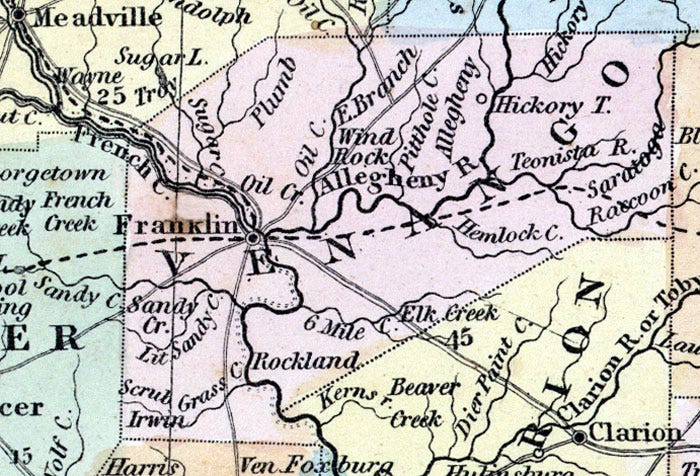
The geography of these deaths is itself telling. The Allegheny River, which runs through the heart of Venango County past Oil City and Franklin, has become a recurring scene. In February 2024, the body of 23-year-old Michael J. Austin of Oil City was found near the river’s shoreline along Sage Run near Pumphouse Road, and the Venango County Coroner confirmed the identification — another name added to a list that keeps growing. In September 2024, a hunter discovered skeletal remains in a wooded area near Colonial Village in Cornplanter Township, and State Police opened an investigation, sending the remains to Mercyhurst University for analysis. A separate set of human skeletal remains discovered in the Allegheny River also prompted a multi-agency investigation to identify the deceased and determine cause of death.
These are not isolated incidents. They are data points in a pattern that residents have been naming for years. Bodies in the river. Bodies in the woods. Bodies in neighborhoods. The investigations, when they exist at all, are not thorough. Leads stop being followed. Cases go quiet.
Speak Up Venango, a grassroots organization founded in 2020, describes itself as a group of county residents dedicated to exposing political and criminal justice system corruption that has plagued their community for over 25 years — corruption spanning police departments and the judiciary. That organization did not materialize from nothing. It materialized from decades of watching the same institutions fail the same families over and over again.
Every single one of these people mattered. No one should be written off because of their past, their struggles, or whether their name was “known” around town. The sentiment shared by everyone who has reached out to TheColdCases.com is simple and non-negotiable: every family deserves transparency in the death of their loved one. Your income, your history, your relationship with local institutions — none of it should determine whether someone investigates how you died.
And yet, in Venango County, it apparently does.
Pennsylvania’s Broken Architecture of Accountability
To understand why Venango County is the way it is, you have to understand Pennsylvania itself — because the conditions that allow a closed loop to survive in a small rural county are baked into the very structure of how this state is governed.
Pennsylvania is divided into 67 counties, which are collectively subdivided into 2,560 municipalities. There are no unincorporated territories in Pennsylvania — every inch of the state belongs to some municipal government. That sounds organized. In practice, it is the opposite.
Spotlight PA has raised serious questions about whether taxpayers are best served by Pennsylvania’s fragmented system of more than 2,500 cities, townships, and boroughs, noting that the many layers of local government make public oversight more cumbersome, and that newsrooms and advocacy groups face the same obstacles to information that ordinary residents do.
Pennsylvania has one of the densest networks of local government in the country. Many municipalities, particularly those with low populations, lack the resources and people to effectively run a government. A rural county like Venango, with a shrinking tax base and a long history of industrial decline, is especially vulnerable to this dynamic.
The result, in the words of urban policy expert David Rusk, is a state full of what he calls “little box” governments. Rusk argues that the almost unspoken mission of every little box government is “to keep our town or keep our schools just the way they are, for people just like us” — and that major reform would require the legislature to recognize that this very structure of little box governments in Pennsylvania is a significant problem. Most of them do not.
Local governments in Pennsylvania exhibit systemic accountability gaps stemming from this extreme fragmentation, with over 2,500 municipalities, 66 counties, and thousands of special districts operating under disparate ethics codes and oversight mechanisms. This structure dilutes centralized enforcement, as the State Ethics Commission primarily handles state-level violations, leaving many local entities to self-regulate with minimal mandatory audits or conflict-of-interest disclosures beyond basic financial reporting.
That self-regulation, in places like Venango County, is exactly the problem.
The Watchdogs That Cannot Watch
When residents in a county like Venango see something go wrong — when bodies turn up without proper investigation, when cases go cold before they even open — they want to believe there is somewhere to turn. Some authority that can step in. Some oversight mechanism with actual teeth.
There isn’t. Not really.
Pennsylvania’s Office of State Inspector General sounds powerful on paper. But when you read the fine print of what it is empowered to investigate, the gap becomes clear. The Office of State Inspector General explicitly states that it is not the appropriate forum for complaints related to city or municipal officials, county officials, federal officials, or state judges. In other words, the very officials most likely to be implicated in local institutional failure — county law enforcement, county coroners, county judges, local police departments — are the officials the Inspector General has no authority to investigate.
This creates a devastating accountability vacuum at exactly the level where accountability is most urgently needed. As one Pennsylvania observer documented after going in circles seeking an investigation into local corruption, the Inspector General’s office has long been part of a circular run-around that prevents real investigations of corruption in Pennsylvania, noting that corruption in the state has become interconnected between state, federal and local agencies in ways the Inspector General cannot properly investigate.
Think about what that means in practice. If you believe the Venango County Sheriff’s department is incompetent or corrupt, the State Inspector General cannot help you. If you believe the county coroner is misclassifying deaths, the Inspector General cannot help you. If you believe local judges are protecting their allies, the Inspector General cannot help you. You are told to contact “local, state, or federal law enforcement” — which, in a closed loop system, means contacting the very institutions you’re trying to hold accountable.
Pennsylvania has known about this structural failure for a long time. The state received an F grade in a State Integrity Investigation conducted by the Center for Public Integrity, with analysts finding that the lack of legislative or executive accountability and the absence of effective ethics entities, combined with weak laws and lackluster oversight, had created a culture of casual acceptance for corruption that became a self-sustaining force in the Keystone State — breeding such broad voter cynicism that there was little effective public pressure for reform.
Among 40 members or top aides of the Pennsylvania Legislature found guilty or having pleaded guilty to public corruption charges over four decades, not one was ever censured or reprimanded by an ethics committee of their own chamber. Not one. That is not a system that polices itself. That is a system that protects itself.
How the Closed Loop Works in Rural Pennsylvania
What my source described about Venango County is not a local anomaly — it is the logical endpoint of a system that was built to be ungovernable from the outside.
When you have a small rural county where the same families and professional networks have held institutional power for generations, where a shrinking population means fewer fresh faces in government and fewer resources for independent oversight, where the local newspaper may have closed or guttered, where the nearest television market may pay the county little attention — you have all the ingredients for a closed loop to calcify completely.
Small towns face a particular vulnerability to corruption, because their small size and workforce do not allow for the kind of oversight and enforcement mechanisms that larger cities, state governments, and the federal government can employ. Nor can small towns usually count on oversight from county-level or state oversight mechanisms absent a specific complaint about egregious conduct that is deemed important enough to act on.
The DuBois case in neighboring Clearfield County offers a documented, public example of exactly this dynamic. A Spotlight PA investigation found that the former city manager wielded vast powers as the city’s chief administrator, held outside jobs that presented conflicts of interest, and allegedly stole hundreds of thousands of public and nonprofit dollars because city government oversight was lacking — and that even now, the city doesn’t have job descriptions or employee handbooks. Panelists who reviewed the case agreed that proper oversight of governments requires a participating public, and one local business owner described attending council meetings where “nothing was public, everything was behind the scenes.”
That case involved money. What is alleged in Venango County involves something far more serious: the systematic failure to investigate unexplained deaths. The lives of real people. The grief of real families. If financial misconduct can survive for years in a small Pennsylvania town because oversight is circular and toothless, ask yourself what that same environment does to the question of why over 60 people are dead.
A Spotlight PA investigation into Tioga Borough in northern Pennsylvania found that the government nearly collapsed after a controversial police hire unearthed disorganization, personal vendettas among elected officials, and a lack of critical oversight. These are not exceptional stories. They are representative ones — glimpses into what happens all across rural Pennsylvania when the architecture of accountability is this fragile.
My source put it plainly: in Venango, oversight exists on paper and sounds good in theory. In practice, the loop is closed. The system is geared toward self-preservation, not public service. And the proof, they said, is in black and white.
I believe them. What I cannot do is sign a document that prevents me from telling you what that proof shows when the time comes.
Why I Couldn’t Sign the NDA — And Why That Matters
After I responded to the tip and shared my email address, a DocuSign agreement arrived. It contained several provisions: restrictions on disclosing information to third parties, prohibitions on reproducing official documents without consent, and — most critically — a requirement to withhold certain details until the final resolution of all related legal proceedings, including any appeals, settlements, and court orders.
I want to be transparent about my thinking here, because I think the reasoning matters.
There is no version of my job in which I sign an agreement about the content of my reporting before I report it. Not because I don’t trust sources, and not because I don’t understand why someone in my source’s position would want that protection. I do understand. The fear is rational. The caution is earned. Anyone who has tried to hold a closed institution accountable from the inside knows what the cost of exposure looks like.
But here is what signing that document would actually mean: the moment I agree to withhold information until all related litigation concludes — including appeals — I have surrendered editorial control to a timeline I cannot predict or influence. Appeals in complex cases can take years. Settlements can include their own confidentiality terms. A court order can arrive and reshape everything. All of that time, I would be legally prohibited from reporting what I know — even if what I know becomes urgent, even if more people are in danger, even if the public interest demands it.
An NDA about reporting content is not a source protection agreement. Source protection is something I do unconditionally — without any document, without any legal formality. I will not name this source. I will never describe them in a way that leads anyone back to them. That commitment is real and it does not require a signature. It is simply how I operate.
What the NDA asks for, beyond source protection, is something altogether different. It asks me to let someone outside my newsroom determine what I can say and when I can say it. That is a form of prior restraint. It is asking a publisher to bind their editorial judgment before they have reported a single word. No publisher with integrity can agree to that — not because the information isn’t important, not because the source isn’t credible, but because the moment you sign, you are no longer a journalist. You are a contractor operating under conditions set by someone else, in service of their interests rather than the public’s.
I’ll say this as plainly as I can: if my source is sitting on documented evidence that explains why 60+ people are dead in Venango County without proper investigation, that information belongs to the public. Not exclusively, not recklessly — but ultimately. The public’s right to know what is happening in their county, in their institutions, in the law enforcement apparatus that is supposed to protect them, cannot be subordinated indefinitely to the legal strategies of any private party.
I am still here. My door is still open. But I cannot walk through it with a legal leash around my neck.
What the Loop Protects
Here is the thing about a closed loop system that my source named so precisely: it doesn’t just protect the people inside it from accountability. It protects itself from the very act of being seen.
When bodies turn up in the Allegheny River and investigations go nowhere, the loop closes around the explanation. When skeletal remains are found in the woods and the analysis takes months with no public follow-up, the loop closes. When families spend years asking questions and getting silence, the loop closes. When a source with documented evidence reaches out to a journalist and then asks for a legal agreement that would silence that journalist, in a very real way — the loop is trying to close again.
Staying quiet doesn’t protect anyone. It only makes it easier for cases to go unsolved. When neighbors talk, journalists ask questions. When journalists ask questions, advocates shine a light. When advocates shine a light, witnesses find courage. And when witnesses find courage, officials who let things slide face accountability.
That is the cycle that breaks a closed loop. It requires everyone in the chain to hold their part.
I Am Still Reporting on Venango County
The questions don’t disappear because one conversation hit an impasse. The 60+ deaths don’t become less real because the source who knows the most about them is still afraid to speak without conditions I can’t accept.
I am asking for your help.
If you have information about unexplained deaths in Venango County — if you worked in local law enforcement, the coroner’s office, county government, the court system, child welfare, social services, or any other institution — I need to hear from you. You do not need to sign anything. I do not need to sign anything. My commitment to protecting sources is unconditional and permanent.
The Submit a Tip button on the homepage of TheColdCases.com is there for exactly this. It is confidential. It is watched. You can also reach me directly at dustinreedterry@gmail.com.
State legislators and the Pennsylvania Attorney General’s office have the authority to request reviews of local investigations. To everyone reading this who has that power — the community of Venango County is asking you to use integrity.
Every person who turned up dead in that county deserved a real investigation. Every family still waiting for answers deserves to know the truth. That is not an unreasonable demand. It is the absolute minimum that justice requires.
If you have information about deaths or institutional failures in Venango County, Pennsylvania, use the Submit a Tip button at TheColdCases.com or contact Dustin Reed Terry directly at dustinreedterry@gmail.com. All tips are treated with complete confidentiality.
TheColdCases.com is an independent, reader-supported publication. Become a paid subscriber to fund investigative journalism that holds the powerful accountable.