


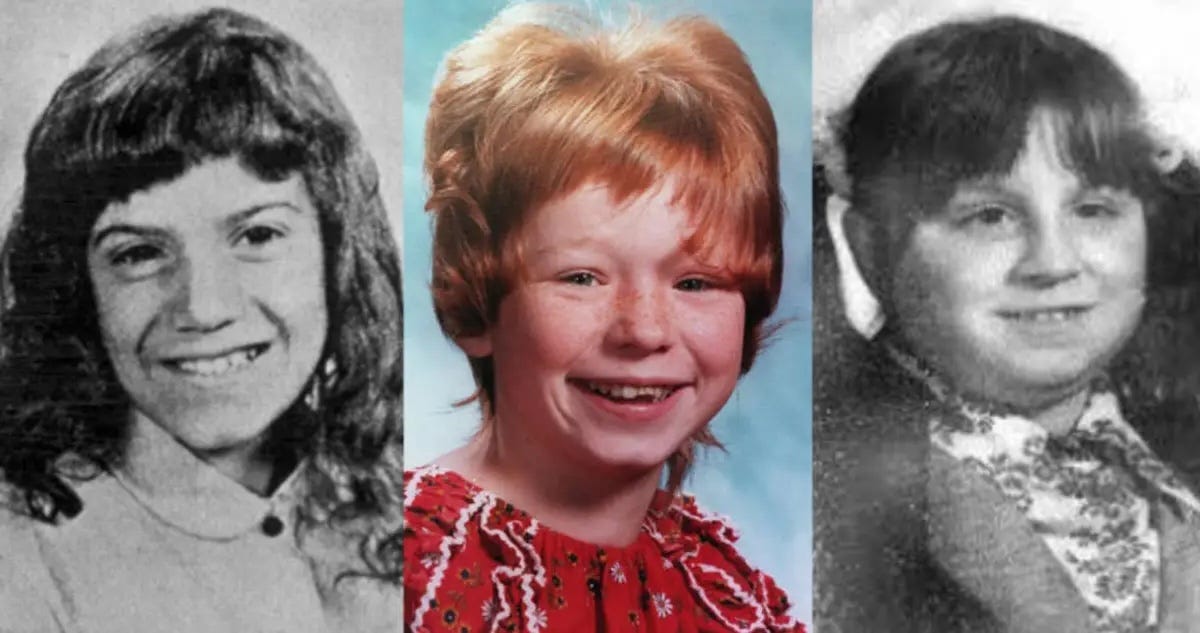
In Rochester, some names never really leave. Carmen Colón. Wanda Walkowicz. Michele Maenza.
For more than half a century, those three names have been tied together under one chilling label: the Alphabet Murders, also known as the Double Initial Murders. The name came from the victims’ matching initials and from the places where their bodies were found — Carmen in Churchville, Wanda in Webster, and Michele in Macedon. But even now, New York State Police make one point clear: the three killings were grouped by the media, yet they have never been officially connected. All three cases remain open.
That unresolved tension is part of what has kept the case alive for so long. To the public, it looked like a pattern too disturbing to ignore. To investigators, it remained three separate child homicides with similarities that were never conclusively proven to point to one offender. Between those two realities sits one of western New York’s most haunting cold cases — a mystery built from fear, coincidence, violence, and decades of unanswered questions.
Carmen Colón: The First Child
Carmen Colón was 10 years old when she disappeared on Nov. 16, 1971. Later reports on the case say she was sent on an errand to a pharmacy on West Main Street to pick up a prescription for her grandfather. It was the kind of task that would have seemed ordinary at the time, a quick trip in a familiar city. Instead, it became the beginning of a murder case Rochester would never forget. Her body was later found in the Town of Churchville.
Carmen’s case remains especially haunting because of what may have happened before she died. Historical reporting says drivers saw a young girl believed to be Carmen running from a vehicle along what became Interstate 490, partially unclothed and trying to wave down help. No one got to her in time. Later accounts say she had been sexually assaulted and manually strangled. That image — a child seen in distress, then lost — became one of the most haunting details in the entire case.
Carmen was the first. That matters. Before her murder, Rochester had not yet attached a lasting fear to the idea that a child could leave home in daylight and simply never return. After Carmen, that fear had a face and a name. Her killing changed the emotional landscape of the city, and decades later, the case still stands as the first wound in what would become one of the region’s darkest mysteries.
Wanda Walkowicz: The Case With the Strongest Official Trail
If Carmen’s death opened the wound, Wanda Walkowicz’s made it impossible to dismiss as a terrible one-time horror.
On April 2, 1973, 11-year-old Wanda left her home on Avenue D to pick up groceries for her mother. According to New York State Police, she made it to the store, bought several items, and was last seen walking home around 5:15 p.m. She never made it back. The next morning, a state trooper found her body at a rest area off Route 104 in Webster. Authorities said she had been sexually assaulted and strangled.
Wanda’s case remains central to the larger Alphabet Murders story because it is the most clearly documented in current public reporting. Local coverage says witnesses saw her carrying grocery bags shortly before she vanished, and investigators have revisited those details for years. News10NBC also reported that authorities believe she may have had at least some familiarity with the person who took her, and that investigators think she was redressed after the assault.
What keeps Wanda’s case at the center of modern interest is the evidence. News10NBC reported that biological evidence still exists in her case, and investigators have publicly expressed hope that modern forensic testing could still lead to answers. More than 50 years later, that makes Wanda’s homicide not just a story from the past, but an active cold case that may still hold the possibility of resolution.
Michele Maenza: The Killing That Cemented the Legend
Later that same year, the fear returned again.
New York State Police says 11-year-old Michele Maenza was raped and killed between Nov. 26 and Nov. 28, 1973, and that her body was found in the Town of Macedon in Wayne County. Her death became the third case folded into the public story of the Alphabet Murders. By then, Rochester was no longer reacting to one horrific crime or even two. Families were already watching these cases with growing dread, and Michele’s murder made the pattern feel impossible to ignore.
Publicly available official details on Michele’s final movements are thinner than what is available in Wanda’s case, but later reporting has long treated Michele’s death as the moment the broader legend hardened in the public mind. Three girls. Three matching initials. Three bodies were found outside the city in places with the same initial pattern. Whether law enforcement could formally prove a connection was, in some ways, secondary to the fear Rochester families were already living with.
Michele’s case also sharpened the question that still hangs over the entire mystery: was there one killer, or more than one? Later, true-crime reporting has argued that differences in the killings suggest Carmen may have been killed by someone different from the person who killed Wanda and Michele. That is not an official law-enforcement conclusion, but it helps explain why the case has remained so difficult to solve. The public narrative points toward one monster. The evidence may tell a more complicated story.
Why Rochester Still Remembers
What made the Alphabet Murders endure was not only the brutality of what happened, but the ordinary way each story began. Carmen was on an errand. Wanda was carrying groceries home. Michele was another child moving through the familiar geography of her life. The terror was not abstract. It lived on sidewalks, corner stores, and short walks home before dinner. That is why the case still lingers in Rochester’s memory more than 50 years later.
Today, the cases remain open. New York State Police still publicly identifies Wanda Walkowicz’s homicide as unsolved and still references Carmen Colón and Michele Maenza as part of the same group of notorious Rochester-area child killings long known as the Alphabet Murders. Time has passed, but not enough to bury what happened. The names remain. The questions remain. And for the families, that may be the cruelest part of all.
It’s extra saddening that Carmen was seemingly close to escaping her killer yet was unable to. RIP to all three innocent victims of this often exceedingly cruel world. Thank you for telling their stories. I believe it’s a duty of the living to speak up for the dead who are unable to speak for themselves.
I am a mom, my kids are very young but how do i balance letting them have freedom and grow and such with the fear of something awful happening?