


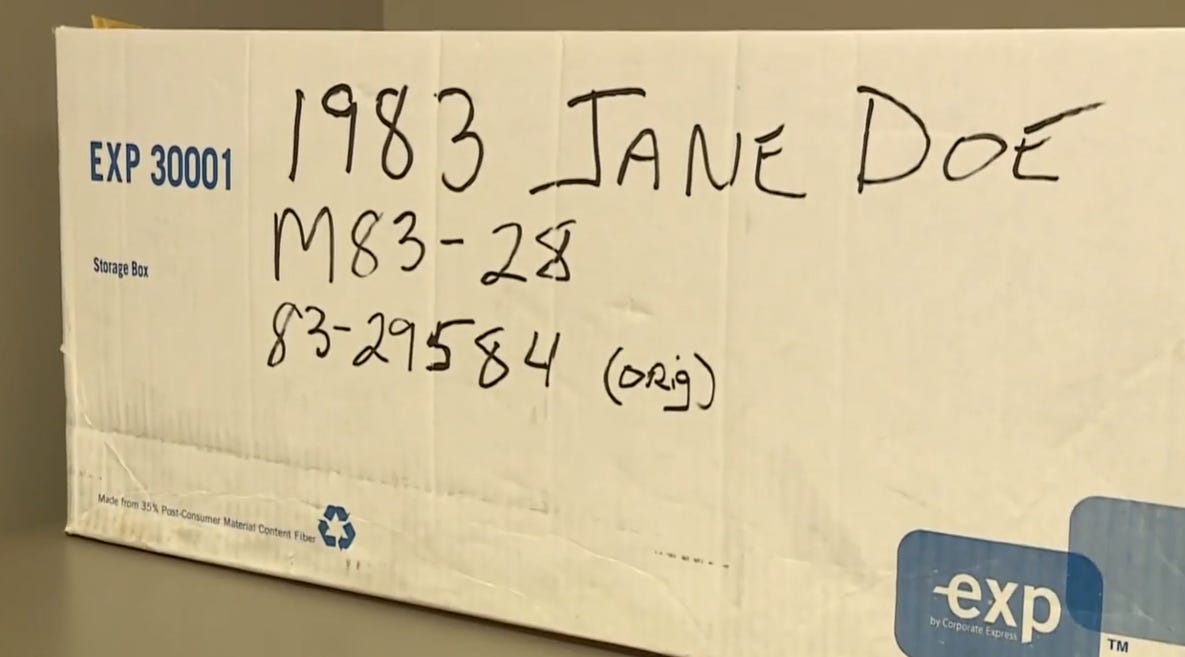
The Gruesome Discovery
On February 28, 1983, two men searching an abandoned red-brick building in north St. Louis descended a narrow set of basement steps. They had entered the crumbling structure at 5635 Clemens Avenue, hoping to salvage scrap metal.
Instead, the two men stumbled upon one of the most gruesome and disturbing crime scenes in modern American homicide investigations.
On the cold, concrete floor lay the body of a child.
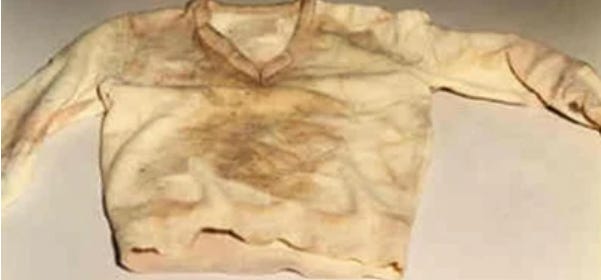
She was face down; her wrists bound behind her back with nylon rope. The only clothing on her small frame was a bloody, yellow V-neck sweater.
Most disturbingly, the child’s head was missing. Investigators believed the child’s head had been severed cleanly by a large knife. The removal of her head was likely an effort to prevent identification through facial reconstruction or dental records.
More than four decades later, the girl referred to as the “St. Louis Jane Doe” remains unidentified, as does her killer.
The Investigation
Police were notified of the discovery at once. Detectives from the St. Louis Metropolitan Police Department soon flooded the building.
The victim was an African-American girl estimated to be between eight and eleven years old, standing between 4’10” and 5’4” (considered unusually tall for her age).
Jane’s nails were painted with red fingernail polish.
Detective Herb Riley, one of the first officers on scene, later described the case as one that “possessed” him, and described the investigation as unlike anything he had seen in his decades of homicide work.
The Autopsy
The medical examiner’s findings further deepened the mystery. The autopsy revealed the child had been sexually assaulted and strangled before the decapitation.
The body had been placed in the basement several days prior to its discovery, but investigators quickly realized something else: the building was not where Jane’s murder had occurred.
There was no blood surrounding her body. This suggested to investigators that the child had been killed somewhere else, her body drained of blood, and she was then dumped in the abandoned structure.
Green paint was found embedded in the cut marks around Jane’s neck. This odd, obscure forensic clue suggested the blade had previously been used on painted surfaces.
Her stomach was empty, indicating she had not eaten shortly before death.
What investigators did not find was also troubling. There were no scars, no medical abnormalities, no signs of long-term abuse on Jane’s body. This was relevant because it meant there was nothing to help easily distinguish her from thousands of other children.
The First Catastrophic Problem: No Missing Child Reported
Detectives assumed the case would break quickly, that a child would be reported missing. But days and weeks passed, without anyone coming forward. Investigators reviewed missing-person reports from Missouri and surrounding states, but none matched Jane’s description.
Police searched a sixteen-block radius around the building in an attempt to locate the girl’s head, checking sewers, dumpsters, and vacant lots. They never found it.
The inability to establish the identity of the child contributed to a devastating investigative dead end.
A Case Defined by Missing Pieces
From the beginning, the investigation was defined by missing pieces: a missing identity, a missing head, missing witnesses, and missing context.
Frustratingly, investigators even misidentified the victim as an adult at first. Because of her height and build, some detectives initially speculated that the body might belong to a sex worker or drug user from the nearby housing projects. It was only when the body was examined more closely that they realized the victim had not yet reached puberty, that this was the murder of a child.
The FBI later described the case as the only decapitation of a child of that age known in the United States at the time.
A Burial Without a Name
For months, the body of the unidentified child remained in the city morgue while detectives searched for answers that would not come.
In December 1983, she was at last buried in a pauper’s grave within a historic Black cemetery in north St. Louis.
Her funeral was attended only by the medical examiner, a few homicide detectives, and reporters. She was buried under the name “Jane Doe”.
The Investigation Turned Cold
As years passed, the case turned cold. Leads appeared periodically, but none produced answers.
At one point, Jane’s yellow sweater was sent to a psychic in Florida in hopes of generating further leads. The garment was never returned to law enforcement.
Another devastating setback occurred decades later.
When authorities attempted to exhume the girl’s remains in 2013 to test new DNA techniques, they initially could not locate the grave due to poor cemetery record-keeping. In essence, the child had effectively been lost twice. Thankfully, a team from the Department of Computer Science & Engineering at Washington University was able to successfully assist by pinpointing Jane’s grave using aerial images from the U.S. Geological Survey.
Forensic Clues
When scientists re-examined Jane’s remains, one of their techniques included isotope analysis.
The chemical composition of Jane’s bones suggested she likely spent much of her life outside Missouri, possibly somewhere else in the Midwest or in the southeastern United States.
Potential childhood regions identified included Pennsylvania, Ohio, Michigan, Wisconsin, West Virginia, Tennessee, Georgia, Texas, and Florida. The wide geographic spread of where Jane may have spent her childhood intensified the mystery and raised a chilling possibility: the child may very well have been transported across state lines before her death.
Genealogical databases have helped identify victims decades after they died in other cases. The hope is that advances in genetic genealogy will eventually give the St. Louis Jane Doe her true identity back.
Theories
Without an established identity, investigators have long been forced to rely on circumstantial speculation and behavioral analysis.
1. A Family Crime
One possibility is that the killer may have been someone relationally close to the victim. The decapitation could have been intended to prevent recognition by family members or acquaintances.
2. Child Trafficking or Exploitation/Transient Movement
The sexual assault and lack of a missing-child report have led some investigators to speculate that Jane may have been living outside traditional family systems.
The isotope analysis suggested that Jane may have lived in multiple states, possibly moving frequently.
3. Intentional Erasure of Her Identity
Jane’s decapitation suggests a deliberate attempt to erase her identity.
Whoever killed her may have planned the concealment carefully, the reasons of which we can only speculate.
The Unanswered Question
One haunting aspect of the St. Louis Jane Doe’s case remains: How can a child vanish without relatives, teachers, neighbors, or anyone noticing?
Investigators believe the answer to this may lie in poverty, family instability, or straight-up child neglect. These are factors that can, and historically have, caused vulnerable children to disappear from public records entirely.
St. Louis Still Haunted by this Case
Over forty years later, the St. Louis Jane Doe’s case remains open. Her file includes photographs of her bloodied yellow sweater, the rope used to bind her hands, and the skeletal remains of a girl who never got to grow up. The child’s killer has never been identified, and neither has she.
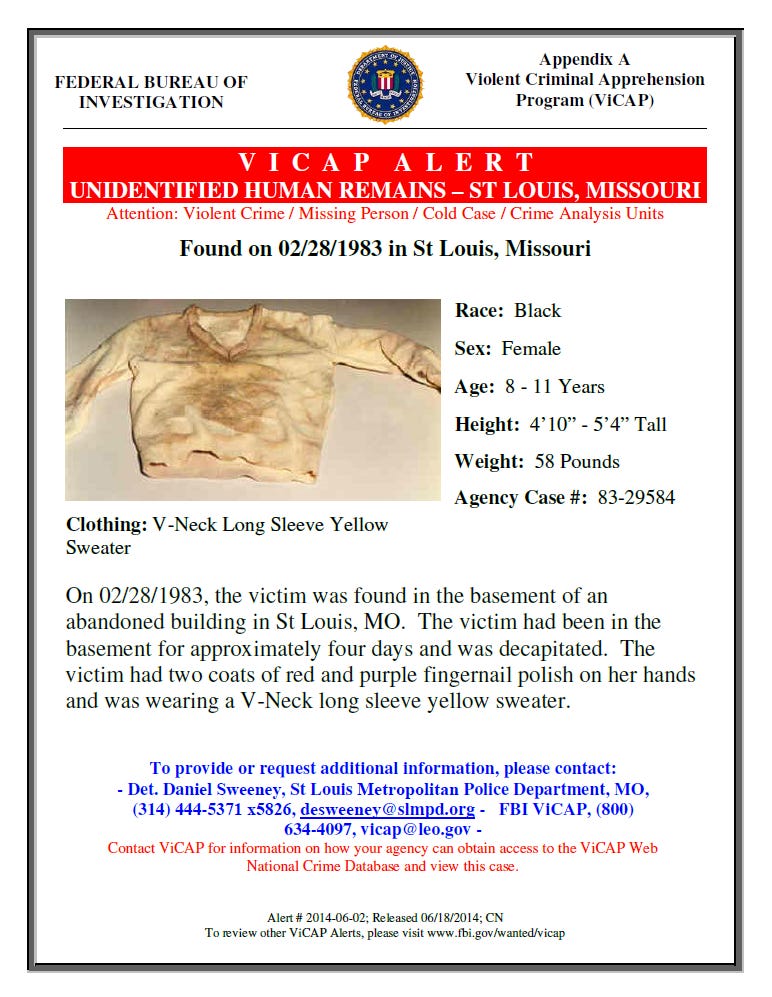
To provide or request additional information, please contact: Detective Daniel Sweeney, St. Louis Metropolitan Police Department at (314) 444-5371, ext. 5826, Email: desweeney@slmpd.org. You can also contact FBI ViCAP at (800) 634-4097, Email: vicap@leo.gov
Sources: Forensic details, case descriptions, and victim characteristics were sourced from the unidentified persons database maintained by the Federal Bureau of Investigation (https://www.fbi.gov/wanted/vicap/unidentified-persons/jane-doe-44), the nonprofit missing-persons clearinghouse, The Doe Network (https://www.doenetwork.org/cases/54ufmo.html), as well as the National Center for Missing & Exploited Children (https://www.missingkids.org/es/poster/ncmu/1104360/1). Together, these sources provide details of the publicly available investigative record regarding the unidentified victim and the ongoing efforts to determine her identity.