


Case File Overview
Full Name: Shannon Marie Sherrill
Date of Disappearance: October 5, 1986
Location: Thorntown, Boone County, Indiana (Plum Street)
Age at Disappearance: 6 years old (Born August 12, 1980)
Physical Description: 3’0”, 30 lbs., brown hair, blue eyes
Distinguishing Marks: Approx. 4-inch surgical scar on abdomen, pierced ears
Last Seen Wearing: White sundress with blue trim, barefoot (no shoes or socks)
Investigating Agencies: Thorntown Police Department, Indiana State Police Cold Case Unit, FBI
Tip Line: Indiana State Police: 1-800-453-4756 / Clearinghouse: 1-800-831-8953
A Sunny Yard, A Game of Hide-and-Seek
Sunday, October 5, 1986, began as an unseasonably warm autumn afternoon in Thorntown, Indiana. A rural enclave of roughly 1,500 residents tucked off Interstate 65 in Boone County, the town was just winding down its annual “Festival of the Turning Leaves.” Screen doors swung open, and children spilled into backyards to soak in the final remnants of summer warmth.
In the 600 block of Plum Street, six-year-old Shannon Marie Sherrill was playing outside her family’s mobile home. A bashful, blue-eyed kindergarten student at Thorntown Elementary School, Shannon was joining neighborhood children in a game of hide-and-seek. Barefoot, clad in a lightweight white sundress accented with blue trim, she darted behind the trailer to find a hiding spot.
It was roughly 1:30 p.m. Inside, her mother, Dorothy, went about her afternoon routine. Less than three minutes elapsed before Dorothy stepped out to check on her daughter.
The other children were still laughing and running. Shannon was nowhere to be seen.
“It wasn’t even two minutes, three minutes. Went back out and she was gone, just that quick,” Dorothy recounted decades later. “I remember that as if it was still yesterday. It’s just there, all the time.”
Dorothy hurried from trailer to trailer, checking beneath steps and calling Shannon’s name. When her cries went unanswered, panic rippled through the neighborhood.
“They kept saying, ‘Maybe she ran off,’” Dorothy recalled. “I said, ‘No, there’s no way she would leave the yard without permission.’ That’s just the way she was.”
Overcome by the sudden certainty that her child had been taken, Dorothy collapsed in the yard.
Skirting, Cornfields, and Stalled Leads
Within twenty minutes of the realization that Shannon was missing, local authorities and Indiana State Police descended on the Plum Street trailer park.
What followed was an exhaustive, multi-agency mobilization. More than two hundred state troopers, sheriff’s deputies, volunteer firefighters, and local citizens swept the area on foot and by air. Search crews dismantled the skirting beneath every mobile home in the park, peered into crawlspaces, searched septic tanks, combed nearby outbuildings, and inspected closets inside neighboring residences.
Kandi Killin, a reporter for the Lebanon Reporter who was dispatched to Plum Street the following morning, watched a quiet farming town transform overnight into a community paralyzed by dread.
“People were on edge,” Killin remembered. “Moms didn’t want their children going outside.”
Investigators systematically questioned every child who had participated in the game. None of them had seen an unfamiliar vehicle, heard a cry, or witnessed an adult approach. Shannon had simply slipped behind a trailer and evaporated.
Every potential lead unraveled almost as quickly as it surfaced:
The Field Footprints: Searchers discovered bare footprints in a freshly harvested cornfield adjacent to the park. Initial hopes surged, but forensic measurements confirmed the prints were too large to belong to a thirty-pound six-year-old child.
The Ohio Van: Detectives chased down tips concerning a suspicious van spotted traveling toward Ohio shortly after the disappearance, but exhaustive highway checks yielded no actionable evidence.
Non-Traditional Methods: Desperate for direction after conventional tactics stalled, investigators even consulted a hypnotist to jog neighbors’ memories, and later permitted a psychic to review the scene—neither producing a break.
Both Dorothy and Shannon’s biological father, who lived in Tipton, Indiana, were interviewed, submitted to polygraphs, and completely cleared by investigators early in the probe. As days turned to months, the search teams withdrew, and the headlines gradually faded.
False Dawns and Cruel Hoaxes
For a parent of a missing child, silence is agonizing—but false hope can be devastating.
“I’ve known people that have lost their children in different ways—wrecks, sickness,” Dorothy said. “What they don’t seem to understand is they got that closure. I do not.”
The cruelest chapter in the investigation unfolded seventeen years later, in the summer of 2003. A young woman contacted the Sherrill family out of the blue, making an astonishing claim: she believed she was Shannon.
“That’s when she said, ‘I think I might be your daughter,’” Dorothy remembered.
For several days, Dorothy lived in an emotional crucible, asking the caller about Shannon’s childhood, memories, and distinct physical markers, including the four-inch abdominal surgical scar from an infancy operation.
“I just kept thinking, could this really be her?”
Indiana State Police stepped in to vet the woman’s claims. The investigation quickly unmasked the caller as Donna Lynette Walker, an itinerant woman with a pattern of inserting herself into high-profile cold cases across the country. Walker had fabricated the entire story.
The revelation crushed the family. “It was like losing her all over again,” Dorothy said. Walker was subsequently arrested, extradited to Indiana, and convicted for her fraudulent claims.
DNA Detectives and the Cold Case Unit
Four decades after Shannon vanished, the investigation sits in the hands of the Indiana State Police Cold Case Unit.
Formed as a dedicated squad, the unit is commanded by Sgt. Jeffrey Coffey, a 31-year veteran of the ISP, and comprises five detectives and five civilian investigators stationed across Indiana. The team carries the burden of investigating more than 900 missing Hoosiers—including unsolved cases like 12-year-old Joseph Spisak (missing from Hammond since 1974) and 22-year-old Margaret Ann Hayes (disappeared from Bloomington in 1977).
“A lot of these cases are very tough and there’s a lot of time that has passed, but that does not diminish our resolve in order to try and bring those families that resolution and justice that they seek,” Sgt. Coffey noted. “I’m a parent, so I can only imagine how a parent would feel when their child goes missing. You would want to move heaven and earth to try to find them and bring them back to safety.”
The primary frontier for solving decades-old mysteries rests on emerging forensic science. ISP became one of the first state law enforcement agencies in the United States to employ an in-house forensic genetic genealogist, Bradly Marchant.
By building comprehensive family trees from DNA profiles uploaded to public genealogical databases like GEDmatch and FamilyTreeDNA, genealogists can trace overlapping ancestral branches down to living persons. The technique has already cracked longstanding Indiana mysteries—including identifying the perpetrator in the 1975 abduction and sexual assault of three Indianapolis girls.
Applying genetic genealogy, however, hinges on having suspect or unidentified victim DNA to test. While investigators remain guarded about the specific physical evidence preserved from the 1986 Thorntown scene, Sgt. Coffey stresses the importance of grounded optimism.
“It’s heartbreaking, for sure, and you want to provide answers to those family members, but you also don’t want to overpromise. That’s the reality as well. But you’re always optimistic... my heart goes out to them.”
A Mother Still Watching the Door
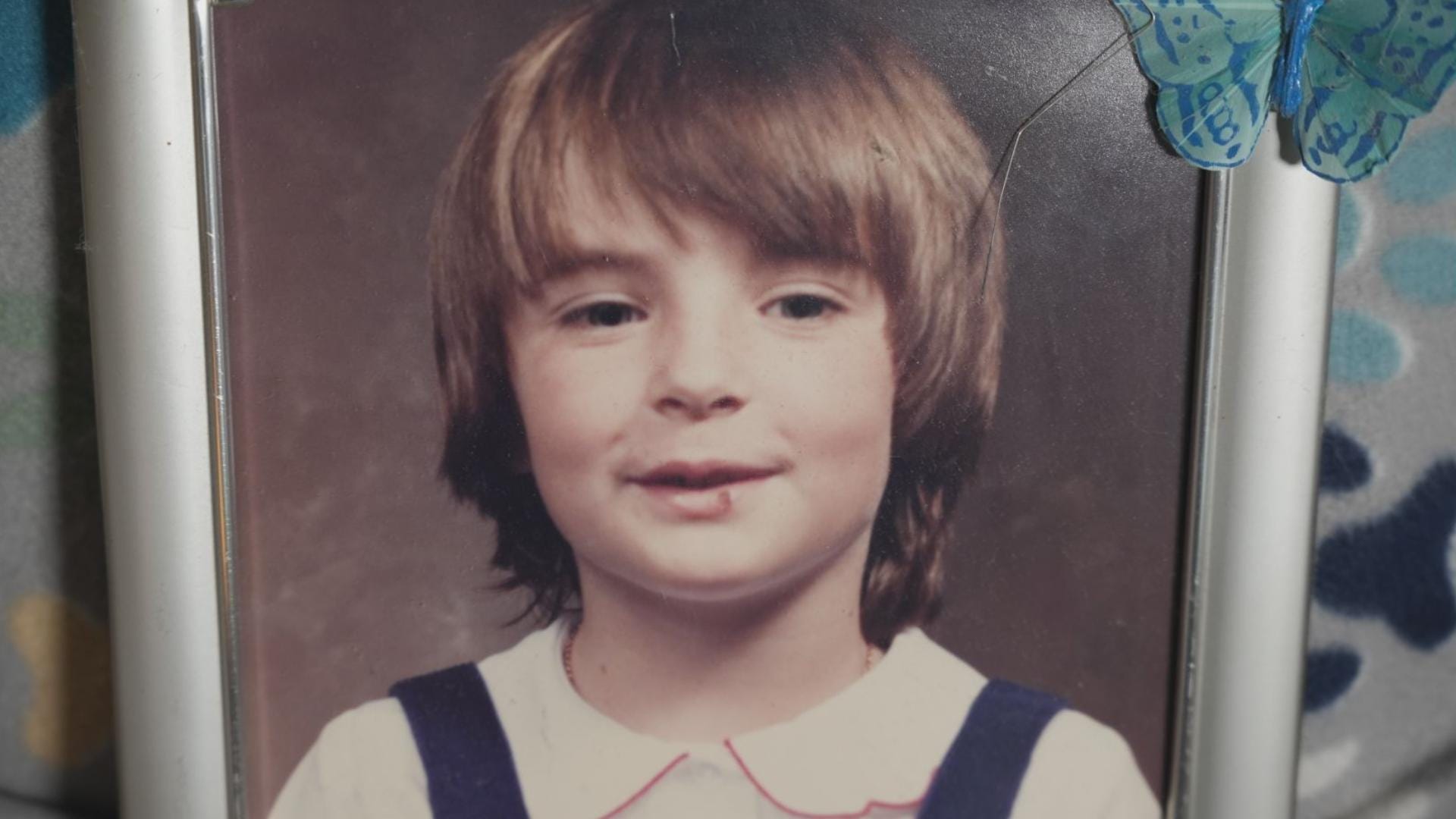
Today, Dorothy still keeps the single kindergarten portrait of Shannon—the only school picture ever taken of her daughter. Alongside it sit age-progressed composites prepared by forensic artists at the National Center for Missing & Exploited Children (NCMEC), depicting what Shannon might look like as a woman in her forties.
“So that maybe, if she was to walk up to my door, I might have an idea,” Dorothy said.
For Dorothy, Shannon’s presence endures in smaller, quieter ways.
“Butterflies are my thing with her. When I see a butterfly, it kind of tells me that she is around me, and sometimes I see a lot of butterflies.”
Former reporter Kandi Killin still keeps her yellowed newspaper clippings from October 1986. “It was a small child and nothing ever came to light. It’s a total mystery, and you can’t let go of things that you can’t figure out. That’s human nature,” Killin said. “She just disappeared, and it’s one of the saddest things I’ve ever had to cover.”
Forty years later, Dorothy Sherrill refuses to surrender hope that the truth will surface.
“This is not just something I can move on with,” Dorothy said. “Just keep her in your thoughts and prayers, and me in your thoughts and prayers, that someday I may get the answer I need, just so I can have that closure.”
Have Information?
Even after forty years, a single memory, an overheard remark, or a piece of long-buried information could break the Shannon Sherrill case wide open.
Indiana State Police Criminal Information Hotline: 1-800-453-4756
ISP Missing Children Clearinghouse: 1-800-831-8953
Direct Tip Email: missingchildren@isp.in.gov
National Center for Missing & Exploited Children: 1-800-THE-LOST (1-800-843-5678) / Case # NCMC601815