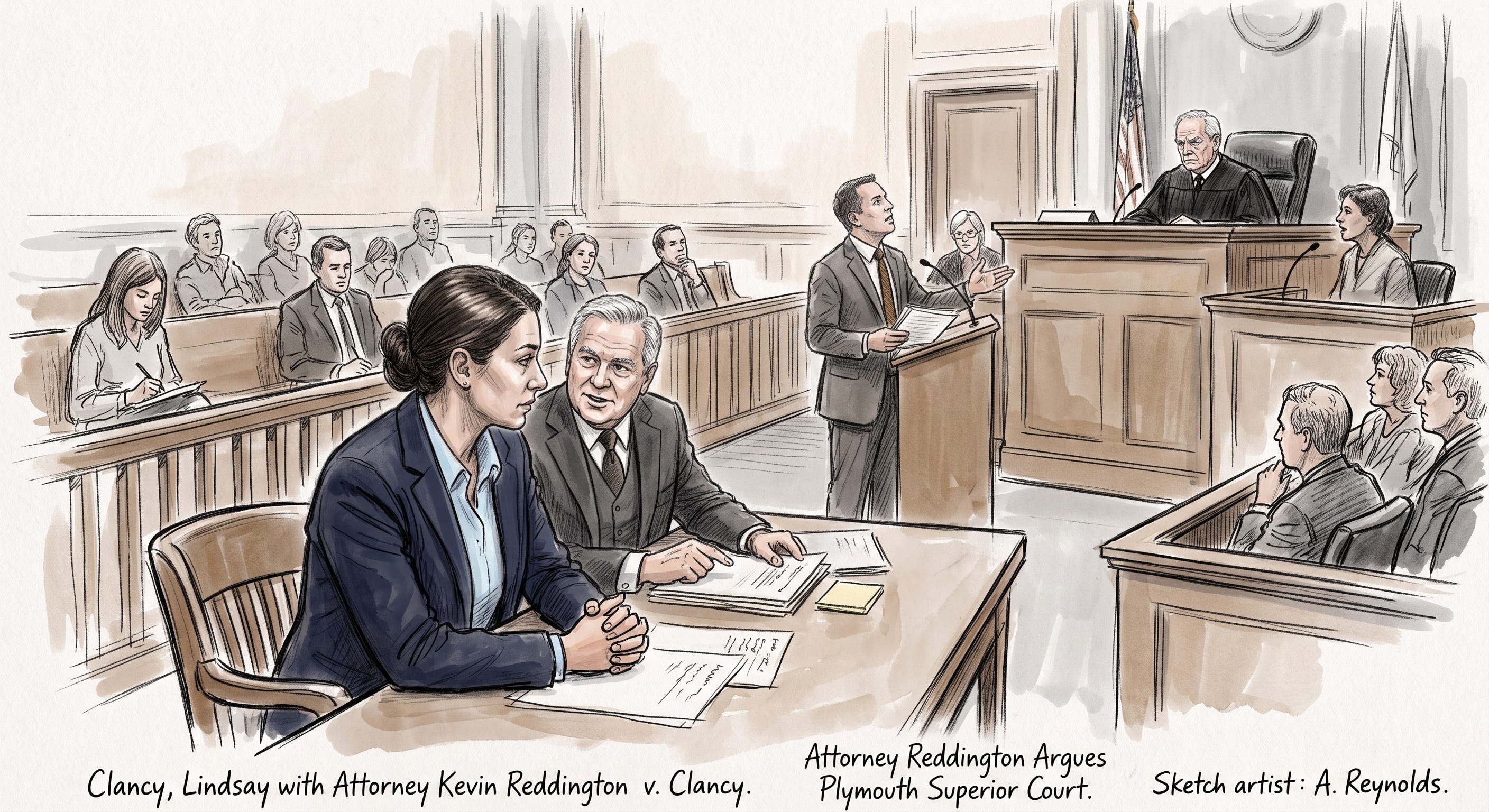
The legal and cultural aftermath of Massachusetts v. Lindsay Clancy has entered an unprecedented chapter of constitutional warfare and public scrutiny. In the wake of a grueling trial culminating in an 11–1 hung jury and a September 4 mistrial, defense attorney Kevin Reddington escalated the battle from the courtroom floor to the appellate record. In explosive post-trial motions filed before Plymouth Superior Court, Reddington launched an aggressive demand to formally investigate the lone holdout juror who blocked Clancy’s acquittal on grounds of postpartum psychosis and lack of criminal responsibility.
Simultaneously, an extraordinary public reckoning unfolded on national television. Patrick Clancy—whose three young children were strangled in the family’s Duxbury home on January 24, 2023—sat down with CBS’s 60 Minutes. The broadcast, intended to explore perinatal mental health, grief, and forgiveness, instead ignited widespread public unease. Viewers and analysts watched Patrick speak about the annihilation of his family with a measured, intellectualized detachment—an apparent emotional flatline that became an inescapable talking point in one of the most polarizing maternal filicide cases in modern legal history.
The 11–1 Rupture: Reddington’s Motion Against Juror Michael Desronvil
Inside the Plymouth Superior Court deliberation room, the jury was asked to resolve a fundamental question: Did Lindsay Clancy deliberately execute her three children—five-year-old Cora, three-year-old Dawson, and eight-month-old Callan—or was she held captive by acute postpartum psychosis, commanded by auditory delusions that completely dismantled her capacity to appreciate the wrongfulness of her actions?
After forty hours of deliberation stretched over seven days, eleven jurors concluded that the Commonwealth had failed to prove criminal responsibility beyond a reasonable doubt. They were prepared to render a verdict of not guilty by reason of lack of criminal responsibility.
One juror refused.
Juror Michael Desronvil remained unyielding in his conviction that Clancy was guilty of murder. Following the declaration of a mistrial, Reddington moved aggressively, filing formal motions seeking an immediate judicial inquiry into Desronvil’s conduct alongside a demand to dismiss the indictment altogether on double-jeopardy grounds.
Allegations of Juror Misconduct and Constitutional Breach
Reddington’s motions allege that Desronvil did not merely disagree with his peers on the weight of the evidence; the defense contends he violated his sworn oath as an impartial juror. The motions petition Judge William Sullivan to order:
Cellular Data Subpoenas: Complete records of all phone calls, text messages, and data transmission made or received by Desronvil between 8:00 AM and 4:30 PM across each day of jury deliberations. Unauthorized phone access during active deliberations represents a strict violation of Massachusetts court rules.
Questionnaire and Voir Dire Integrity: A thorough examination into the truthfulness of Desronvil’s answers on the pre-trial juror questionnaire and his subsequent responses during individualized voir dire questioning.
Refusal to Follow the Law: Scrutiny into complaints raised during deliberations by the jury foreperson, who sent notes to Judge Sullivan stating that a juror was outright refusing to apply the legal standards governing reasonable doubt and Massachusetts’ burden of proof.
Reddington argued that when multiple reports emerged indicating a juror was superimposing personal beliefs over statutory jury instructions, the court had an affirmative duty to conduct an evidentiary inquiry or seat an alternate juror rather than declaring a mistrial.
The Holdout’s Defense
Desronvil, retaining legal counsel of his own through attorney Edward Paltzik, quickly pushed back in public statements. Desronvil maintained that he had “no doubts” regarding Clancy’s guilt, arguing that her internet searches, the timeline of sending Patrick out for takeout and pediatric medication, and the physical evidence proved deliberate premeditation. He alleged that the eleven other jurors bullied and repeatedly interrupted him whenever he attempted to point out holes in the psychiatric defense.
For Reddington, however, the deadlock was not a legitimate disagreement among peers; it was a structural breakdown of the jury system that improperly subjected a severely ill defendant to the threat of a retrial.
The Disconnect on 60 Minutes: Patrick Clancy’s Television Appearance
While Reddington litigated the integrity of the jury room, Patrick Clancy took to national television, sitting with correspondent Ross Douthat on 60 Minutes. It was billed as his first comprehensive television interview since the mistrial. What transpired across the screen, however, left many viewers grappling with an unsettling cognitive dissonance.
Throughout the broadcast, Patrick sat beside his new wife, Dr. Rachel Danis—a Manhattan fertility specialist whom he met in early 2024 and married in April 2026. Rather than displaying raw, viscerally felt agony, Patrick’s presentation was characterized by clinical calm, monotonic vocal cadences, and an absence of typical grief reactions when recounting the death of his children.
Timeline of Key Events
Jan 24, 2023 ── Cora, Dawson, and Callan killed in Duxbury home.
Jan 28, 2023 ── Patrick Clancy posts public statement granting Lindsay total forgiveness.
Jan 2024     ── Patrick meets Dr. Rachel Danis at a NYC run club.
Apr 2026     ── Patrick Clancy and Rachel Danis marry in New York.
Sep 04, 2026 ── Judge declares mistrial after 11–1 jury deadlock.
Sep 20, 2026 ── Patrick Clancy appears on CBS's "60 Minutes."
Sep 21, 2026 ── Kevin Reddington files motions to investigate holdout juror Desronvil.
Analytical Neutrality Over Paternal Grief
The dissonance was most pronounced during moments that would typically elicit emotional collapse:
The Discovery in the Basement: Patrick recounted coming home from an errand to find Lindsay injured in the yard, before descending to the basement where he found his three children. When speaking of holding out hope that baby Callan would survive—recalling his internal plea, “Just give me one kid, and I would raise him as best I could”—his delivery remained flat, steady, and devoid of tears, shaking, or vocal cracking.
The Rationalization of Forgiveness: Within days of the killings, Patrick had publicly forgiven Lindsay, a move that stunned the local community. On 60 Minutes, he defended that stance with pragmatic, self-protective reasoning: “I also felt that if I didn’t get there, I would be eaten up inside forever”. Rather than describing a messy, agonized spiritual battle, he framed forgiveness as a functional survival strategy.
Clinical Framing of Lindsay’s Illness: When describing Lindsay’s deterioration in late 2022, Patrick spoke less like a devastated husband and more like an outside observer reviewing medical records. He described her insomnia, outpatient care, and medication regimens with detached, analytical efficiency, noting that “mental illness has this ability to be tragically deceptive”.
The Contrast: Stoicism vs. Hidden Trauma
Patrick’s controlled exterior has long been an engine for online speculation. During the trial, internet sleuths pointed to his dry-eyed testimony as evidence of coldness or culpability—theories he and Danis pushed back on during the broadcast, calling them a “huge distraction from what really matters here, which is perinatal mental health”.
During the interview, Patrick revealed an acute bodily reaction that never translated to tears: on the second day of his trial testimony, he suffered a debilitating panic attack behind closed doors that required him to be removed from the courthouse by ambulance.
Yet on camera, that profound psychological turmoil was hidden beneath a curated wall of intellectualization. Even while detailing memorial touchstones built for Cora, Dawson, and Callan at a community playground, his reflections sounded reflective and measured, as though recounting a tragedy that had befallen someone else in another lifetime.
The Legal Horizon: September 29 and the Fight Over Retrial
The clash between Kevin Reddington’s procedural crusade and the Commonwealth’s determination to retry Lindsay Clancy centers on fundamental questions of justice, trauma, and legal sanity.
Deliberation Conduct
Alleges holdout used a cellphone and refused to follow statutory instructions on reasonable doubt.
Juror Desronvil asserts he weighed all physical evidence and acted within his legal rights to reject lack of criminal responsibility.
Jury Dismissal
The court erred by declaring a mistrial instead of seating an alternate to address juror misconduct.
Deadlock was genuine; mistrial was required after jurors confirmed unanimity was impossible.
Case Resolution
Demands immediate dismissal of indictments based on double jeopardy principles.
Maintains murder charges; preparing options for a full retrial.
Lindsay Clancy remains confined to a psychiatric facility, paralyzed from her suicide attempt and medicated under continuous clinical observation. Should Judge Sullivan deny Reddington’s motions to dismiss the charges and investigate Desronvil, Plymouth County prosecutors will face the daunting task of impaneling a second jury in a case saturated by national media coverage, polarizing medical testimony, and widespread online scrutiny.
With a crucial hearing set for September 29 at Plymouth Superior Court, the case tests the boundaries of the American jury system: how courts manage the clash between medical realities and punitive criminal statutes, and whether a single juror’s refusal can force a paralyzed, mentally broken mother back into the legal arena.