

KFC Murders Solved After 42 Years: Suspect Identified
The KFC Murders have been solved after 42 years.

The KFC Murders: After 42 Years, Final Suspect Identified in Texas Cold Case
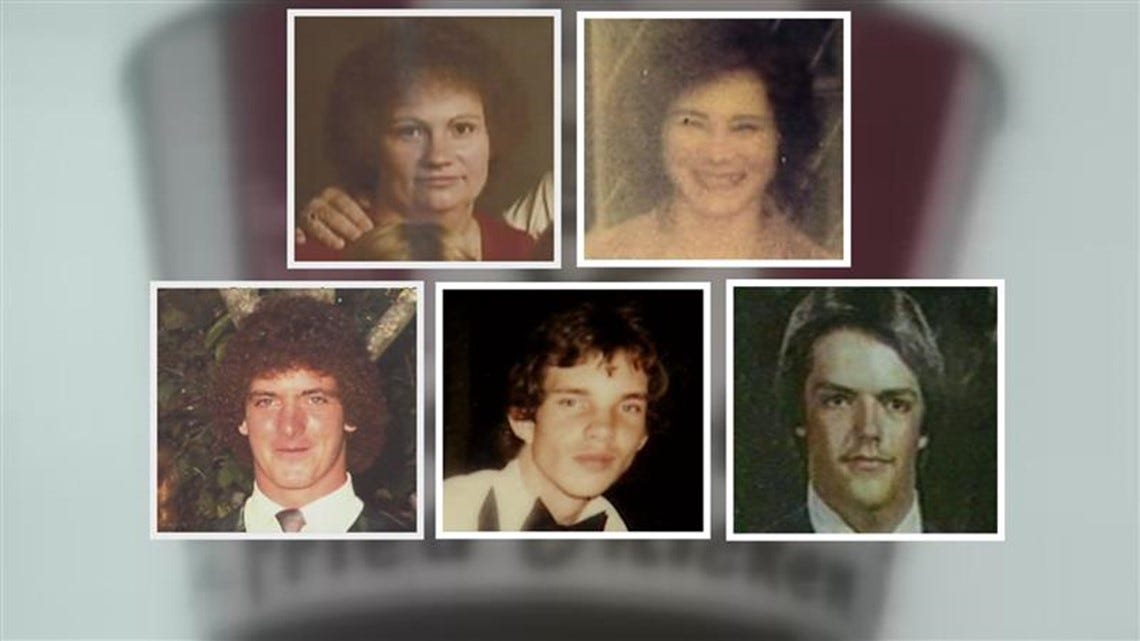
September 23, 1983, started like any other Friday night at the Kentucky Fried Chicken restaurant in Kilgore, Texas. Manager Mary Tyler, 37, was working alongside employees Opie Hughes, 39, and 20-year-old Joey Johnson. Off-duty employee David Maxwell, 20, had stopped by with his 19-year-old friend Monty Landers to visit Johnson. None of them could have known that within hours, they would become victims of one of the most horrific crimes in Texas history—a case that would haunt investigators and the East Texas community for more than four decades.
The Crime That Shocked East Texas
Sometime around 11 p.m., armed robbers entered the KFC restaurant. The five victims were abducted, forced from the restaurant, and driven to a remote oil lease location in rural Rusk County. There, in what investigators described as an “execution-style” killing, each victim was shot in the back of the head. Opie Hughes was found a short distance from the others—she had also been sexually assaulted before being murdered.
The bodies were discovered the following morning by an oil field worker. About $2,000 had been stolen from the restaurant. The brutal nature of the crime and the seemingly random selection of victims sent shockwaves through the tight-knit East Texas community.
Early Investigation and False Leads
The investigation initially focused on several suspects, including James Earl Mankins Jr., whose arrest was based on a torn fingernail found on one of the victims. However, DNA testing later proved the fingernail wasn’t his, and charges were dropped. The case went cold for years, becoming one of Texas’s most notorious unsolved mysteries.
“Every armchair detective and every criminal looking for a break would have claimed to have already solved it,” investigators later recalled about the frustrating early years of the investigation.
DNA Breakthrough: Two Suspects Convicted
The case heated up again in the early 2000s when advances in DNA technology allowed investigators to re-examine evidence from the crime scene. Blood found in the KFC restaurant led to two cousins: Romeo Pinkerton and Darnell Hartsfield.
Both men had been considered suspects within the first week of the investigation but weren’t arrested until 2005. Pinkerton pleaded guilty in 2007 and received five life sentences. Hartsfield was convicted in 2008 and also sentenced to life in prison. However, during their trials, prosecutors revealed that DNA evidence from Opie Hughes’ clothing didn’t match either man—indicating a third perpetrator was still at large.
The Long Search for the Third Suspect
For nearly two more decades, investigators continued searching for the final suspect. The unidentified DNA profile haunted the case, representing an unfinished chapter in the pursuit of justice for the five victims.
The breakthrough finally came in 2023 when the Texas Rangers reopened the case under the federal Sexual Assault Kit Initiative (SAKI), a program designed to help solve cold cases through advanced DNA testing. In July 2024, DNA from Hughes’ clothing was sent to Bode Technologies for genealogical testing—a technique that has revolutionized cold case investigations nationwide.
Modern Technology Solves 42-Year-Old Mystery
By May 2025, the genealogical analysis had narrowed the search to three brothers in East Texas: Larry, Billy, and Devan Riggs. In November 2025, investigators received confirmation that Devan Riggs was the source of the DNA evidence found on Hughes’ clothing.
Riggs, who died in October 2010, had an extensive criminal history both in East Texas and California. Seven weeks after the KFC murders, he had been arrested for attempting to murder his own brother in neighboring Shelby County. That investigation led to the discovery of numerous stolen items, including multiple vans and a .357 handgun—the same type of weapon believed to have been used in the KFC murders.
Case Closed, But Questions Remain
With Riggs’ identification, investigators finally closed the book on this 42-year-old cold case. However, the resolution brings mixed emotions to the victims’ families and the community.
“I think there were probably a lot of people who thought this was never going to happen, that there were never going to be final answers about what happened,” said Jo Lee Ferguson, a Longview News-Journal reporter who covered the case for over 30 years.
For the families of the victims—Opie Hughes, Mary Tyler, Joey Johnson, David Maxwell, and Monty Landers—the identification of Devan Riggs provides closure, but no courtroom justice. Riggs escaped prosecution by dying more than a decade before his crimes were fully exposed.
The KFC murders case stands as a testament to both the persistence of investigators and the power of modern forensic technology. It also serves as a reminder that even the coldest cases can still be solved, bringing long-awaited answers to grieving families and communities haunted by unspeakable violence.
As East Texas moves forward from this dark chapter, the five victims are remembered not just as names in a notorious case file, but as real people whose lives were tragically cut short on that September night in 1983—people who finally received the justice they deserved, even if it came 42 years too late.