


On a humid summer day in late June 1999, a woman driving along a rural road in St. Charles County, Missouri, noticed something unusual in a cornfield. What she had stumbled upon would become one of the most perplexing cold cases in modern American criminal history: the death of Ricky McCormick, a man whose life was largely invisible until his death produced a mystery that has resisted decades of scrutiny.
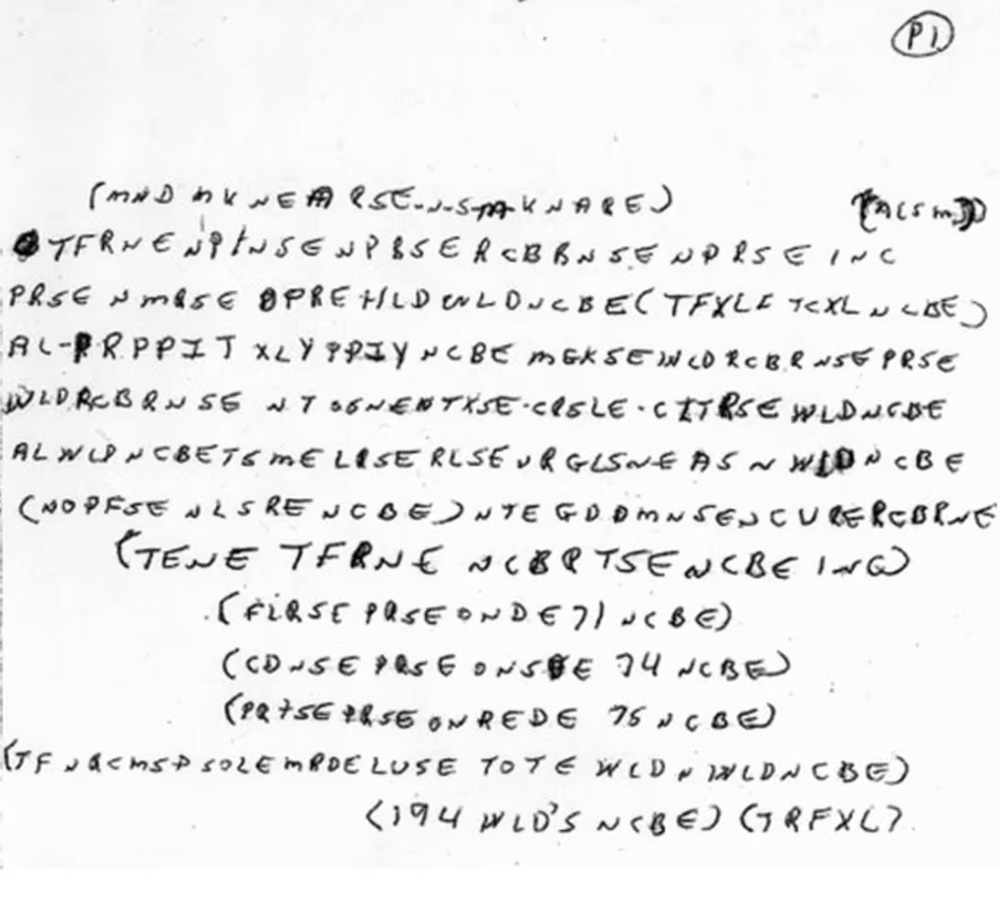
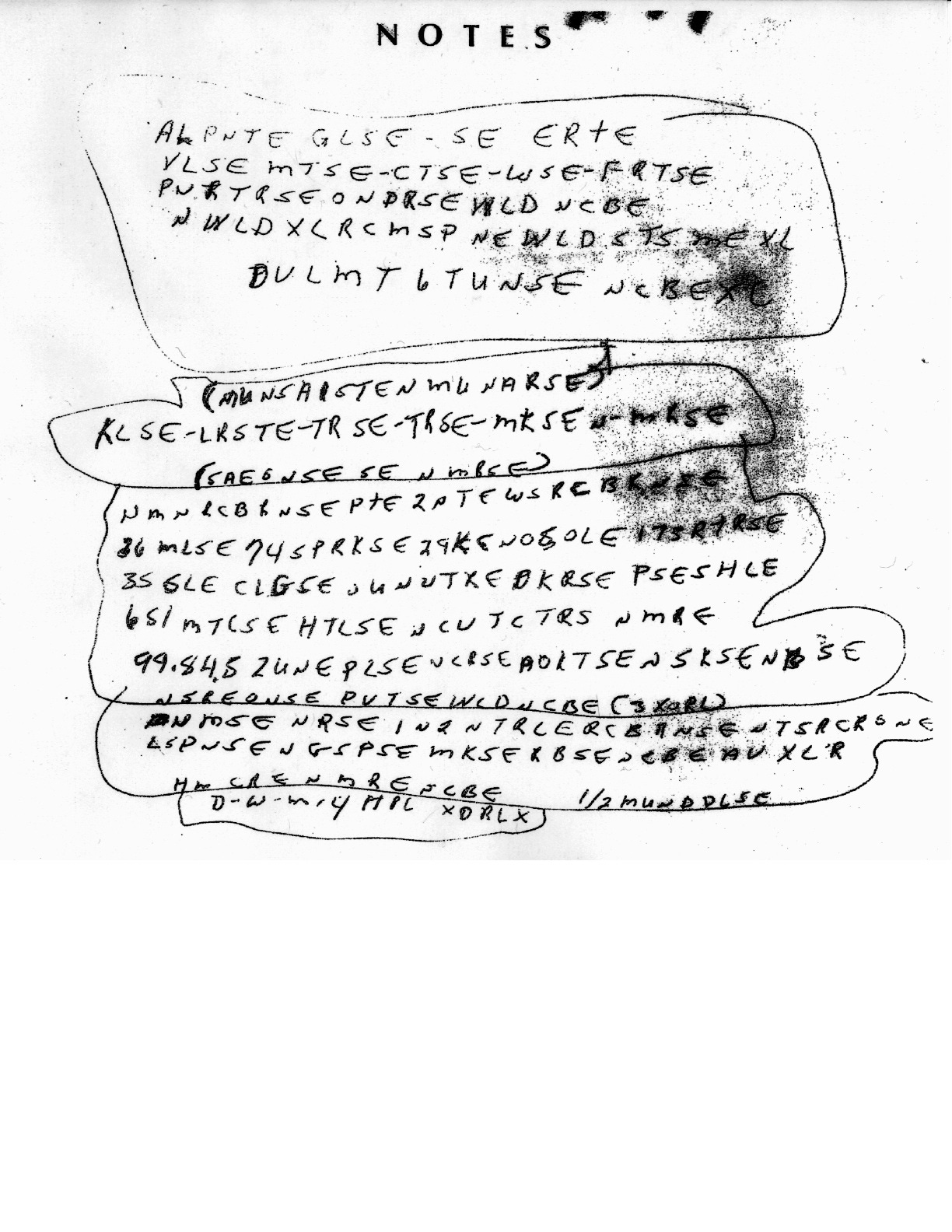
At the center of the case are two small pieces of paper. On them is a strange jumble of letters, numbers, and symbols that no one, not even the FBI’s elite cryptanalysts, has ever been able to decode.
More than 25 years later, the case remains unsolved. The cipher remains unread. Ricky McCormick’s final hours remain a mystery.
A Body in the Field
Ricky McCormick was 41 years old when his body was discovered on June 30, 1999, in a remote field near West Alton, Missouri. He had last been seen alive roughly five days earlier.
There were immediate anomalies.
McCormick did not own a car. The field where he was found was miles away from his usual surroundings and not accessible by public transportation. His body was already decomposing, suggesting it had been left there for some time. No one had reported him missing.
Even more troubling, investigators could not determine the cause of death. While authorities suspected foul play, they lacked the forensic evidence to prove it.
It was a case that might have quietly faded into obscurity, another unsolved death in a rural jurisdiction, if not for what was found in his pockets.
The Notes
Inside McCormick’s pants were two handwritten notes. At first glance, they appeared to be nonsense, columns of capital letters, numbers, parentheses, and occasional symbols.
To investigators, they looked deliberate.
The notes were quickly sent to the FBI’s Cryptanalysis and Racketeering Records Unit, one of the most sophisticated codebreaking teams in the world.
They could not crack it.
Neither could the American Cryptogram Association.
Years later, the FBI publicly admitted defeat and released the notes, asking civilians for help in deciphering them. This was a rare move that underscored how baffling the case had become.
To this day, the cipher remains unsolved.
Who Was Ricky McCormick?
Understanding the victim is often key to understanding the crime. In McCormick’s case, his life raises as many questions as it answers.
He was a high school dropout who struggled with chronic health issues, including heart and lung problems. He lived intermittently with his elderly mother and survived largely on disability payments.
His past included a criminal conviction and time in prison. He had fathered several children but was not married.
Those who knew him described a man on the margins, socially isolated, intellectually limited, and often adrift. Some accounts suggest he had difficulty reading and writing.
This detail would later become crucial.
If McCormick struggled with basic literacy, how could he have written a complex, encrypted message?
The Literacy Paradox
One of the most contentious aspects of the case lies in whether McCormick himself authored the notes.
Family members have been adamant that he could barely write his own name. They described his writing as little more than scribbles, casting serious doubt on the idea that he created a structured cipher.
Investigators believe otherwise.
According to the FBI, McCormick had been writing in similar coded formats since childhood. This suggests the possibility that the notes were not a sophisticated cipher in the traditional sense, but rather a personal system, perhaps a mnemonic shorthand or idiosyncratic code only he understood.
This divergence in interpretation has led to competing theories.
The personal code theory holds that McCormick created the notes himself, possibly as reminders or instructions.
The courier theory suggests that McCormick was carrying a message for someone else and did not understand its contents.
The second theory is particularly compelling given his possible connections to individuals involved in criminal activity, including drug trafficking. If true, the notes may not describe his own thoughts but someone else’s instructions.
The Final Days
McCormick’s last known movements suggest a man in distress.
In the days leading up to his death, he visited multiple hospitals complaining of chest pain and breathing problems. He was last seen around June 27, 1999.
Then he vanished.
There were no confirmed sightings. No witnesses placed him in the rural area where his body was found. There was no explanation for how he traveled there.
Investigators believe the notes may have been written within three days of his death. If so, they could contain a timeline of his final movements or instructions that led him to the place where he died.
Without decoding them, that possibility remains locked away.
The Cipher Itself
The notes are visually striking and deeply frustrating.
They consist of strings like clusters of letters, numbers interspersed with parentheses, and occasional underlining or formatting variations.
Experts have noted that the structure does not clearly align with known classical ciphers such as substitution or transposition systems.
Some have suggested it may be a field code or shorthand used in illicit operations. Others believe it could represent addresses, directions, or transactions. Another possibility is that it is not a cipher at all, but a personal mnemonic system.
Despite decades of analysis, no theory has produced a convincing full translation.
Even modern computational methods and crowdsourced cryptanalysis efforts have failed to yield a definitive answer.
The FBI’s Unusual Appeal
In 2011, more than a decade after McCormick’s death, the FBI took an extraordinary step and released the notes to the public.
The agency stated that cracking the code could reveal McCormick’s movements before his death and potentially identify his killer.
The response was overwhelming.
Amateur codebreakers, professional cryptographers, and curious civilians sent in theories.
None solved the case.
The sheer volume of interest highlighted the mystery’s unique grip. This was a murder investigation stalled not by lack of evidence, but by the inability to interpret the evidence that exists.
Competing Theories
Over the years, several hypotheses have emerged.
Some investigators point to a drug-related homicide. McCormick’s possible ties to criminal networks raise the possibility that he was killed as part of a dispute. In that scenario, the notes could represent transactions, contacts, or instructions.
Others consider misadventure or natural death. Given his health issues, it is possible he died of natural causes and was later moved. The remote location of the body complicates that explanation.
There is also the idea that the notes are a red herring. Some analysts argue they may be unrelated to his death, an odd but coincidental detail that has distracted investigators.
A more unsettling possibility is that the notes are fundamentally undecipherable. If they represent a personal and inconsistent system, they may have died with him.
A Case Defined by Absence
What makes the Ricky McCormick case so enduring is not just what is known, but what is missing.
There is no confirmed cause of death. There are no identified suspects. There is no clear motive. There is no readable message.
Perhaps most strikingly, there is no definitive narrative.
Instead, the case exists in a kind of investigative limbo, suspended between possibilities.
Why It Still Matters
Cold cases often fade from public consciousness. This one has not.
Part of the reason is the cipher, a tangible mystery that invites participation. It transforms the case from a passive narrative into an active puzzle.
There is also something more human at stake.
Ricky McCormick was, by most accounts, a marginalized individual, someone who lived on the fringes of society and whose disappearance initially went unnoticed.
The coded notes gave his case visibility. They ensured he would not be forgotten.
At the same time, they have obscured him, turning his life into a riddle.
The Unfinished Sentence
If the notes are ever decoded, they may answer fundamental questions.
They could reveal where McCormick was going, who he met, and why he ended up in that field.
They could also reveal something less dramatic, ordinary details that still complete the story.
Until then, the case remains open.
A man died under mysterious circumstances. Two pages of writing may explain why. Despite the efforts of some of the world’s best minds, those pages remain silent.
In the history of unsolved crimes, Ricky McCormick’s case stands as a rare convergence of homicide and cryptography. It is a reminder that sometimes the barrier to justice is not the absence of clues, but the inability to understand them.
Somewhere, perhaps, the answer has been sitting in plain sight all along, waiting for someone to read it correctly.
Anyone with information related to the death of Ricky McCormick, no matter how minor it may seem, is encouraged to come forward. The case remains open, and investigators have stated that even small details could prove significant. Tips can be submitted to the Federal Bureau of Investigation through your local FBI field office or via their online tip portal. You may also contact the St. Charles County Police Department, which originally handled the case.