

How Violence Learns to Call Itself Discipline
When force gets renamed

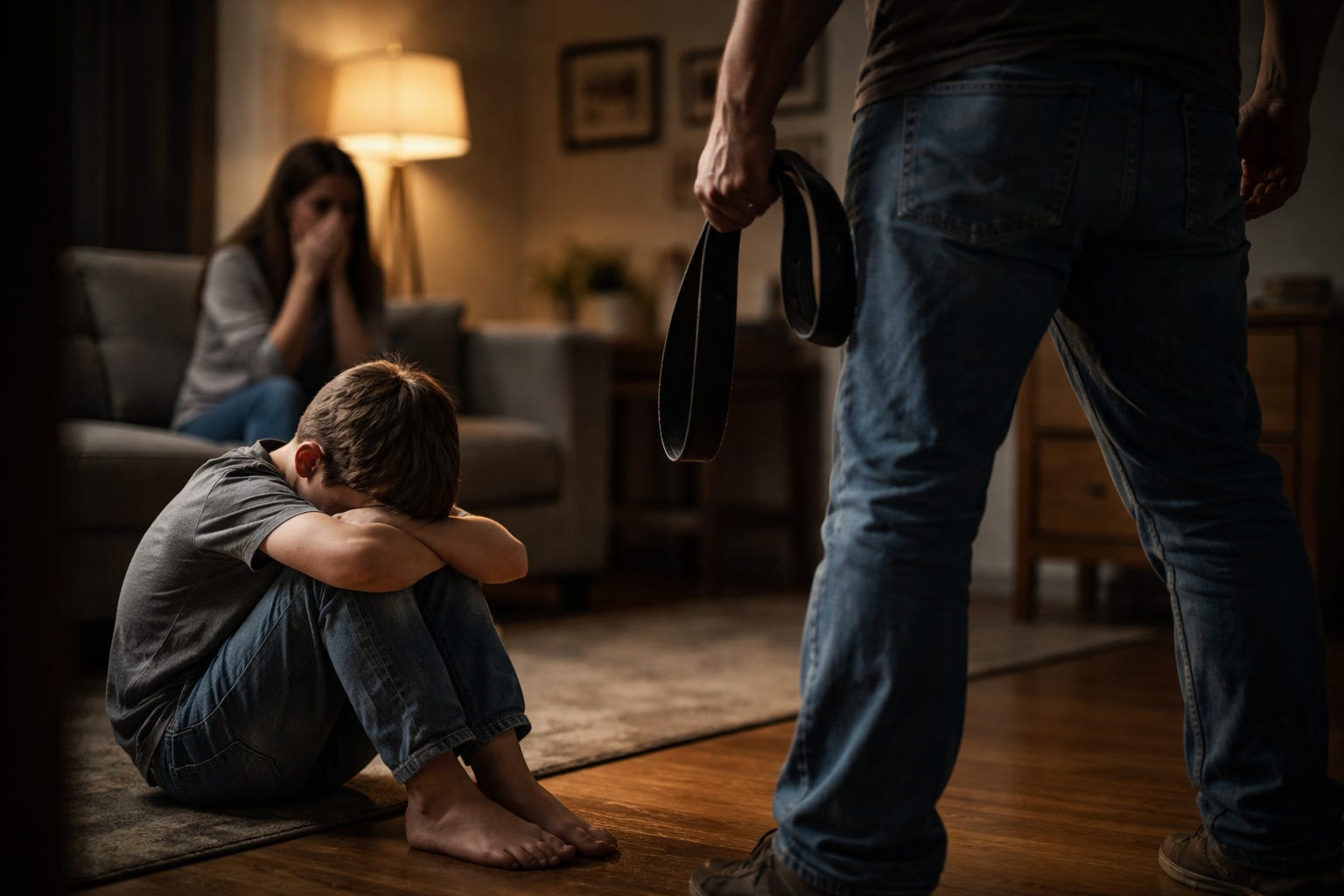
Children do not enter violent homes with language sturdy enough to challenge the language already in power. They arrive dependent, attached, still forming, and vulnerable to whatever definitions the adults place over the room. That gives the controlling adult an advantage people still fail to describe with enough precision. The adult does not only control the household. The adult often gets first control over what the household will call harm.
Language is powerful:
A slap becomes correction.
A shove becomes getting a child’s attention.
Humiliation becomes teaching.
Forced silence becomes respect.
Fear becomes structure.
Public degradation becomes a lesson the child supposedly needed.
The child is not only being hurt. The child is being trained in how to file the hurt, how to explain it, how to minimize it, and eventually how to defend it.
This is one of the reasons family violence survives so well inside ordinary language. People still like to imagine abuse as something unmistakable while it is happening, as if the child naturally knows the difference between guidance and domination. Development does not work like that.
Children borrow reality from the adults around them long before they can independently audit the terms. If the household keeps repeating that pain is instruction and terror is firmness, the child may register danger in the nervous system while still lacking a clean internal sentence for what is being done.
That split reaches farther than many people want to admit. It can shape memory, loyalty, self-blame, silence, partner choice, religious submission, workplace tolerance, and later confusion about what authority is allowed to do. A child can grow up with the body carrying alarm while the mind still uses the household’s original language for the acts that created it.
Real discipline exists. Children do need correction, routine, limits, adult authority, and consequence. But actual discipline has boundaries you can identify without much drama. It is proportionate. It relates to conduct the child can recognize. It has a behavioral purpose. It ends when the teaching function ends. It does not slide into the adult’s emotional release. It does not require the child to study the room for danger instead of understanding the lesson. It does not depend on psychological submission as proof that order has been restored.
When force is being sold as discipline, certain features turn up again and again:
the response is larger than the conduct
the rule changes with the adult’s mood
shame gets added for control value
submission becomes more important than learning
the adult’s authority becomes the real thing being defended
That last part usually gets blurred on purpose.
Violent adults inside families often sound deeply invested in standards, order, gratitude, work ethic, respect, and consequences.
Some are polished.
Some are admired.
Some are religious.
Some are described by outsiders as strict but fair, old school, disciplined, serious, traditional, or no-nonsense.
Public credibility does not clear the home record. In some cases it makes the lie harder to challenge because the family has already been trained to accept the adult’s version and outsiders arrive predisposed to believe it.
In coercive homes, force rarely presents itself as appetite. It usually presents itself as necessity. The adult was provoked. The child was out of line. The family was falling apart. Respect had to be restored. Somebody had to be the grown-up. Somebody had to teach consequences. Once that structure is in place, the violence gets wrapped in moral language before anyone outside the home asks what happened. The conduct receives social cover in advance.
The nervous system does not care what the offender called it.
A child living under threat adapts like a child living under threat. Startle responses sharpen. Attention shifts toward footsteps, door sounds, engine noises, facial changes, object placement, tone changes, pacing, and the pressure in a room right before impact. Children in these homes often become extremely accurate about small signals because accuracy has survival value. Later people romanticize that as being mature for their age, very observant, unusually wise, or an old soul. A more defensible description is that the child learned threat management early because the home made it necessary.
That adaptation can look useful from the outside. Sometimes it is useful, but usefulness and health are not the same thing.
There is another injury that can last even longer.
When violence keeps getting renamed as discipline, the child absorbs distorted definitions of care, correction, love, and authority.
The child may begin to believe that love is allowed to terrify.
The child may accept that humiliation is part of being taught.
The child may assume that unpredictability is normal in serious relationships.
The child may treat shame as a routine price of belonging.
Years later that person may enter coercive jobs, marriages, churches, institutions, or social circles and fail to identify danger quickly because the labels were corrupted early.
This also helps explain why many adults still defend violent parents long after the behavior could have been named more accurately. They are not always protecting the parent alone. They are often protecting the language system that made childhood survivable. Once a person admits that what was called discipline was in fact intimidation, degradation, or terror, several linked beliefs may collapse at once. Family identity may collapse. Loyalty may collapse. Moral order may collapse. Childhood memory may need to be reorganized.
That is not a small psychological task.
Sibling conflict around childhood history often grows out of the same problem. People say they were raised in the same house as if that settles the matter. It does not. Children do not occupy the same role inside a violent family.
One may be targeted harder.
One may be protected because of usefulness, gender, timing, temperament, resemblance, or alliance.
One may become the appeaser.
One may become the designated problem.
One may escape some direct impact by aligning with the controlling adult.
Years later the least damaged sibling may continue repeating the household version because it still costs less than confronting the fuller account.
Violent adults prefer the word discipline for a practical reason as well. It creates moral cover before an outsider ever arrives. If a teacher notices bruising, if police are called, if a partner begins asking questions, the frame is already in place. The child says, “I got in trouble.” The spouse says, “He is strict.” The friend says, “They run a tight house.” Language gets there first. Evidence then has to fight through a false frame already installed.
Disclosure often stalls right there.
Silence does not always come from absent memory. Sometimes it comes from contaminated vocabulary. The body carries the alarm while the mouth still describes the childhood as normal, disciplined, tough, traditional, or deserved. That split can persist for decades.
None of this means every strict parent is abusive. The record would not support the claim that every child from a violent home develops in the same way. But children raised where force is moralized can carry damaged definitions of authority, correction, and permission long after childhood ends.
I’ll take up the wider inheritance in my next article, When Criminal Thinking Raises Children, on how offender logic becomes family culture long before the law ever names it.
Sources
American Psychiatric Association. (2022). Diagnostic and statistical manual of mental disorders (5th ed., text rev.). American Psychiatric Association Publishing.
Bandura, A. (1977). Social learning theory. Prentice-Hall.
Bowlby, J. (1988). A secure base: Parent-child attachment and healthy human development. Basic Books.
Dutton, D. G. (2006). The abusive personality: Violence and control in intimate relationships (2nd ed.). Guilford Press.
Herman, J. L. (2022). Trauma and recovery: The aftermath of violence from domestic abuse to political terror (Rev. ed.). Basic Books.
Perry, B. D., & Szalavitz, M. (2006). The boy who was raised as a dog: And other stories from a child psychiatrist’s notebook. Basic Books.
Straus, M. A., Douglas, E. M., & Medeiros, R. A. (2014). The primordial violence: Spanking children, psychological development, violence, and crime. Routledge.
van der Kolk, B. A. (2014). The body keeps the score: Brain, mind, and body in the healing of trauma. Viking.