


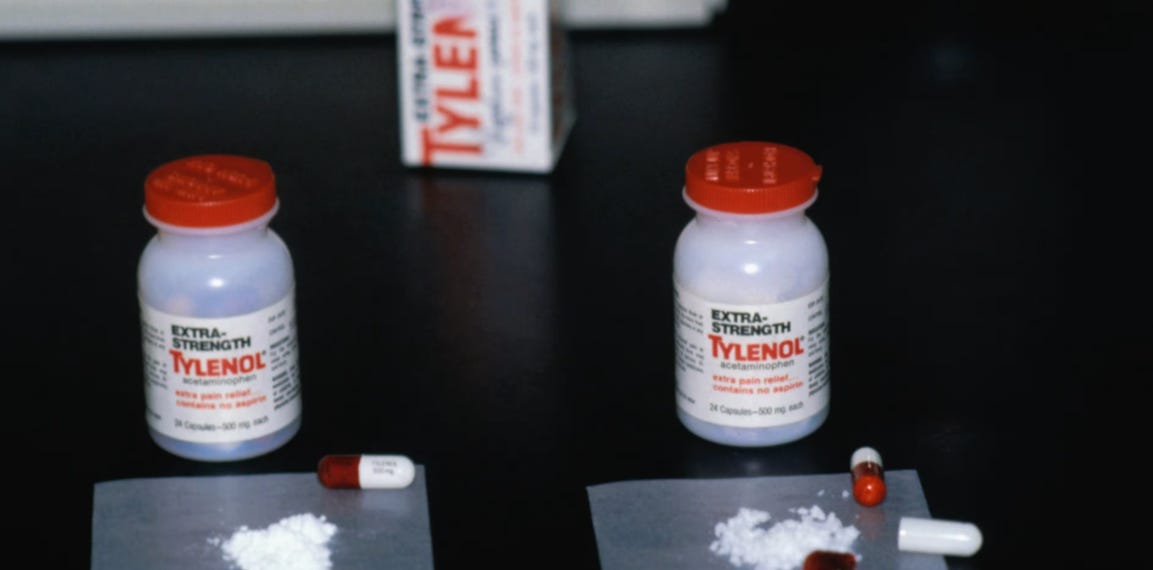
In late September 1982, a 12-year-old girl in a Chicago suburb woke up with what seemed like an ordinary illness. Her parents gave her Extra-Strength Tylenol, the most trusted over-the-counter painkiller in America at the time. Within hours, she was dead.
She would not be the last.
Over the next several days, six more people across the Chicago metropolitan area collapsed suddenly after taking Tylenol capsules. They lived in different neighborhoods and led entirely separate lives. Yet they all shared one fatal link. Each had ingested cyanide-laced pills.
What followed was one of the most chilling crimes in American history, not just for its brutality, but for its seemingly random nature. More than forty years later, the Tylenol murders remain unsolved. The killer(s) vanished into the anonymity of modern consumer life, leaving behind a case that still frustrates investigators, haunts victims’ families, and raises enduring questions about the limits of forensic science.
This is the story of how seven deaths reshaped an industry and why, despite decades of scrutiny, the truth remains elusive.
The Crime That Could Have Happened to Anyone
The facts, at first, seemed impossible.
Autopsies revealed potassium cyanide, a fast-acting poison, inside the victims’ bodies. Investigators quickly traced the source to Tylenol capsules purchased from local stores.
The implications were terrifying.
Unlike targeted killings, these deaths were indiscriminate. The killer had not stalked victims. Instead, they weaponized a consumer product, one found in medicine cabinets across the country. Authorities concluded that the tampering occurred after the bottles reached store shelves. Someone had opened packages, laced capsules with cyanide, and returned them for unsuspecting buyers.
It was a new form of murder. It was impersonal, scalable, and nearly impossible to predict.
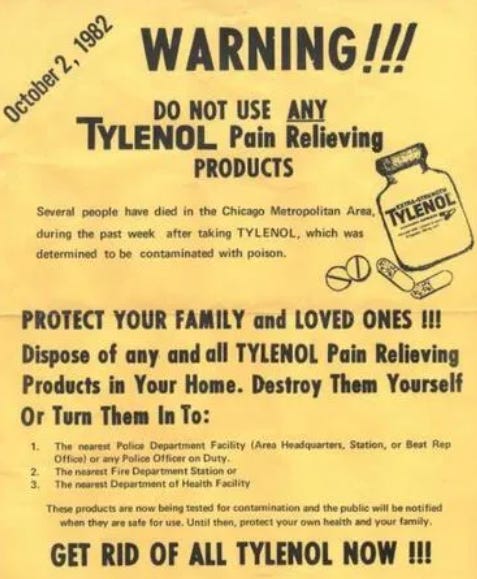
Panic spread nationwide. Hospitals issued warnings. Pharmacies pulled stock. Johnson and Johnson initiated a massive recall of approximately 31 million bottles, worth more than 100 million dollars. The United States had never seen anything like it.
A Massive Investigation With No Resolution
Law enforcement mobilized at an unprecedented scale. Local police, the FBI, and federal agencies coordinated an investigation that stretched across states and industries.
From the outset, the case suffered from a fundamental disadvantage. There was no single crime scene.
The poisoning likely occurred in multiple retail locations. The contaminated bottles came from different manufacturing plants, ruling out a singular point of origin in production.
This left investigators with a daunting scenario. A perpetrator moved through ordinary public spaces such as drugstores and supermarkets, blending in, altering products, and disappearing without detection.
Despite extensive efforts, including surveillance operations and public appeals, the investigation yielded little concrete evidence. In one widely publicized tactic, the FBI released the address and gravesite of the youngest victim, hoping the killer might visit. The site was monitored continuously. The killer never appeared.
The absence of a clear suspect, combined with minimal forensic evidence, would define the case for decades.
The Prime Suspect Who Was Not Charged
No name is more closely tied to the Tylenol murders than James William Lewis.
Lewis entered the investigation after sending an extortion letter to Johnson and Johnson demanding one million dollars to stop the killing. The letter contained details not yet public, immediately placing him under suspicion.
Authorities launched a nationwide manhunt and arrested him in New York.
At first glance, Lewis seemed like a viable suspect. He had a criminal history, an apparent familiarity with poisons, and he demonstrated knowledge of how the murders could have been carried out.
But the case against him unraveled under scrutiny.
There was no physical evidence linking Lewis to the poisoned bottles. There were no fingerprints, no DNA, and no eyewitnesses placing him in Chicago at the critical time.
He admitted to writing the extortion letter but claimed he was not involved in the killings.
Prosecutors ultimately charged him only with extortion. He served more than a decade in prison but was never tried for murder.
Even within law enforcement, opinions remain divided. Some investigators believed Lewis was responsible, but could not prove it. Others concluded he was a manipulator exploiting a tragedy he did not commit.
When Lewis died in 2023, he took whatever knowledge he had, whether guilt or opportunism, with him.
Other Suspects and Dead Ends
Lewis was not the only person scrutinized.
Another figure, a dock worker named Roger Arnold, attracted attention after allegedly discussing poisoning people and possessing cyanide. Investigators searched his home and examined his behavior, but ultimately found insufficient evidence to charge him.
There were also leads involving individuals connected to distribution facilities and those with access to chemicals. Again, nothing conclusive emerged.
Each suspect highlighted the same investigative dilemma. Opportunity was widespread, but proof was nonexistent.
Competing Theories About Where the Crime Happened
At the heart of the mystery lies a fundamental question. Where did the poisoning occur?
The dominant theory among investigators is that the killer tampered with bottles after they reached store shelves. This explains the geographic clustering of deaths and the presence of contaminated bottles in retail locations.
It also aligns with the randomness of the victims.
However, the theory has weaknesses. It requires the perpetrator to move undetected across multiple stores, open sealed products, and return them without being seen.
An alternative theory suggests contamination earlier in the supply chain.
In recent years, renewed attention has focused on the possibility that the tampering occurred before the products reached stores. Some analyses and documentaries have raised questions about cyanide presence in facilities connected to production and later incidents involving tampered Tylenol, even after safety seals were introduced.
If this were true, it would imply a far more complex scenario and potentially broader responsibility.
This theory remains speculative. No definitive evidence has emerged to support it.
Why the Case Remains Unsolved
More than four decades later, the Tylenol murders endure as a case study in investigative limitations.
One major factor is the lack of forensic evidence. In 1982, forensic science was far less advanced than today. DNA analysis was not yet available, and evidence collection standards were inconsistent. By the time modern techniques emerged, much of the original material had degraded or been exhausted. Even later testing, including DNA comparisons with suspects, failed to produce matches.
Another factor is the absence of a clear crime scene. Unlike traditional homicides, there was no centralized location to analyze. The crime effectively spanned an entire retail network, making reconstruction extraordinarily difficult.
The randomness of the victims also played a role. The killer did not target specific individuals, eliminating one of the most powerful investigative tools, victimology. Without a pattern of relationships or motives, the case lacked direction.
The massive public panic that followed may have further complicated the investigation. Thousands of tips poured in, along with copycat incidents, forcing authorities to sift through an overwhelming volume of information.
It is also possible that this was a single-offender event. If the perpetrator acted once and never repeated the crime, there would be no behavioral pattern to track. Unlike serial offenders, this individual may have left no trail before or after the murders.
The Legacy: A Safer (but More Suspicious) America
While the murders remain unsolved, their impact is undeniable.
The crisis led directly to the introduction of tamper-evident packaging. Foil seals, shrink bands, and blister packs became standard across industries. Federal laws criminalizing product tampering soon followed.
In a grim sense, the killer succeeded in permanently altering consumer behavior.
Even today, many Americans instinctively check seals before using medicine, a habit born from the fear of 1982.
The Lingering Question
Who did it?
The answer may still exist, buried in evidence lockers, obscured by time, or held by someone who has never come forward.
What makes the Tylenol murders so enduring is not just their brutality, but their methodology. The killer exploited trust. Trust in brands, in packaging, and in the invisible systems that underpin everyday life.
That trust, once broken, has never been fully restored.
Epilogue: A Crime Without Closure
For the families of the victims, the case is not history. It is unfinished.
There has been no arrest, no trial, and no definitive answer.
Only a question that has lingered for more than forty years now.
How does someone commit one of the most consequential mass murders in American history and simply disappear?
Until that question is answered, the Tylenol murders will remain what they have always been. A cold case is defined not just by what happened, but by what never did.
Have Information?
The Tylenol murders remain an open investigation. Anyone with credible information, no matter how minor it may seem, is encouraged to contact the Federal Bureau of Investigation or their local law enforcement agency. Tips can be submitted to the FBI at tips.fbi.gov or by calling 1-800-CALL-FBI (1-800-225-5324).
Even decades later, new information could prove critical in bringing resolution to the case.
Sources: This article draws upon reporting and archival material from contemporary news coverage and later investigative analyses, including summaries and historical documentation of the Chicago Tylenol murders from publicly available records such as PBS NewsHour reporting on James William Lewis and the investigation, EBSCO research summaries on pharmaceutical-related crimes, and retrospective features examining the case’s impact on consumer safety and federal regulation. Additional context is informed by modern documentary coverage and long-form journalism revisiting the evidence, investigative theories, and unresolved questions surrounding the case.