


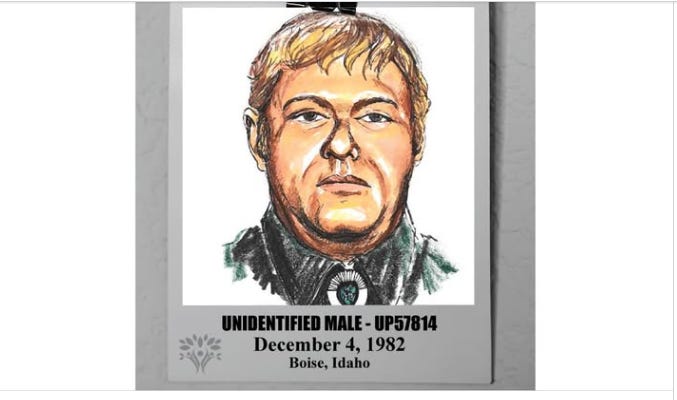
On a frigid Saturday afternoon on December 4, 1982, inside Sacred Heart Catholic Church in Boise, Idaho, a parishioner arriving for 6:00 PM Mass noticed a well-dressed man slumped across a pew’s kneeler. At first glance, he appeared to be lost in deep prayer. When church ushers and a registered nurse approached to check on him, they found him rigid and cold.
He had not died of natural causes. Within weeks, toxicology confirmed the man had swallowed a lethal dose of potassium cyanide. In his pocket lay an envelope with $1,900 in cash and a typed note signing his name as “Wm. L. Toomey.” Yet that name was a phantom—a decoy stolen from a living traveling salesman who had never set foot in Idaho.
For over four decades, the decedent remained one of the Northwest’s most famous unidentified dead: Boise’s “Unknown Wanderer.” Now, with the Ada County Sheriff’s Office leveraging advanced forensic genetic genealogy to finally uncover his true identity, authorities are scrutinizing a long-whispered theory: could this anonymous cyanide suicide in Idaho be the key to cracking the infamous 1982 Chicago Tylenol murders?
The Discovery at Sacred Heart
Witnesses recalled seeing the man enter Sacred Heart Catholic Church around 4:00 PM on December 4, seeking out the confessional. Finding it occupied, he walked toward the back pews. Two hours later, he was dead.
The scene bore the hallmarks of a man carrying out a meticulous, predetermined exit plan:
The Physical Evidence: The decedent stood 6 feet tall, weighed roughly 175 pounds, and was estimated to be between 35 and 45 years old. He was well-groomed with an athletic build, styled sandy-blond hair, and a deep sun-tan that sharply contrasted with an Idaho winter.
Southwestern Attire: He wore a green long-sleeved shirt, blue jeans, cowboy boots, a turquoise-and-silver bolo tie, a Seiko wristwatch, and an ornate belt buckle handcrafted by a New Mexico artisan inset with a 100-peso Mexican coin.
Systematic Anonymity: His leather wallet held only $53 in cash. The wear patterns inside the leather showed clear indentations where driver’s licenses, credit cards, and photos had once resided, but each card had been systematically stripped away.
The Typewritten Note: Inside his shirt pocket, investigators found a brown envelope holding $1,900 in crisp currency alongside an index-card note typed on an unknown machine:
“In the event of my death, the enclosed currency should give more than adequate compensation for my funeral or disposal (preferred to be cremated) expenditures. What is leftover, please take this as a contribution to this church. God will see to your honesty in this. — Wm. L. Toomey”
Detectives quickly confirmed the real William L. Toomey was alive, resided in another state, and had lost his ID or business cards months prior. Furthermore, “Toomey” was widely recognized across Catholic circles as the brand name of R.J. Toomey Co., a premier manufacturer of clerical collars and priest vestments—a detail detectives found difficult to dismiss as mere coincidence.
Coroner Erwin Sonnenberg soon determined the cause of death: the man had swallowed a capsule of industrial-grade potassium cyanide, dying within seconds on the kneeler. On December 28, 1982, over 200 parishioners gathered at Sacred Heart to lay the “Unknown Wanderer” to rest in a donated plot at Dry Creek Cemetery.
Autumn of Terror: The Chicago Poisonings
To grasp why an anonymous suicide in an Idaho church shook federal investigators, one has to rewind nine weeks earlier to the autumn of 1982.
Between September 29 and October 1, 1982, seven people in the Chicago metropolitan area died suddenly and violently after taking Extra-Strength Tylenol:
Mary Kellerman, a 12-year-old schoolgirl in Elk Grove Village, died after taking a capsule for a cold.
Adam Janus, 27, died of sudden cardiopulmonary collapse in Arlington Heights. Hours later, his grief-stricken brother Stanley Janus (25) and sister-in-law Theresa Janus (20) took capsules from the same bottle in the family home and died in the hospital.
Mary McFarland (31), Paula Prince (35, a United Airlines flight attendant), and Mary Reiner (27, who had given birth just days earlier) all collapsed and died within hours of purchasing tamper-compromised bottles from area drugstores.
Investigators determined an unknown killer had taken retail bottles off shelves at local stores, laced the capsules with 65 milligrams of potassium cyanide (over three times a lethal dose), and placed the bottles back on store shelves for unsuspecting shoppers.
The attacks triggered widespread panic, led Johnson & Johnson to recall 31 million bottles, prompted the FDA to mandate modern tamper-evident packaging, and inspired Congress to pass the federal “Anti-Tampering Act.” Yet, despite a massive federal dragnet involving over 100 FBI agents and the Chicago Police Department, the perpetrator vanished without a trace.
The Parallels: Why Detectives Suspected a Tylenol Link
When news of the Boise suicide reached federal investigators in late December 1982, the case immediately drew scrutiny. Several striking threads tied the Unknown Wanderer directly to the profile of the Chicago poisoner.
1. The Rarity of the Lethal Agent
In 1982, potassium cyanide was not a common street poison or household substance. Sourcing it required access to industrial chemical suppliers, electroplating facilities, mining supply distributors, or university laboratories. Finding someone in late 1982 who possessed, measured, and swallowed encapsulated potassium cyanide—the identical weapon used in Chicago just two months earlier—instantly separated him from typical suicide cases.
2. The Timeline of Evasion
The Chicago poisonings occurred at the end of September. The subsequent FBI manhunt was one of the largest in American history, dominating evening news broadcasts nationwide. Forensic psychologists profiling the Tylenol killer theorized that the culprit, likely overwhelmed by the unintended national scale of the panic and the closing federal dragnet, would experience acute post-offense paranoia, severe decompensation, and likely flee across state lines. The Wanderer arrived in Boise in early December—deep in the western interior—carrying cash, avoiding hotels under his real name, and severing ties with his past.
3. Southwestern Supply Vectors
The Wanderer’s deep tan, turquoise bolo tie, boots, and New Mexico artisan buckle placed him squarely in the American Southwest (Texas, Arizona, or New Mexico). During the Tylenol task force’s initial mapping, one of Johnson & Johnson’s two central distribution and manufacturing nodes for the compromised lots was located in Round Rock, Texas. Investigators spent years chasing theories of whether the tampering originated at a southwestern distribution facility or was carried out by a transient actor moving along interstate corridors between Texas, the Midwest, and the West.
4. Psychological Motive and Sanctuary
The choice of Sacred Heart Catholic Church carried deep psychological weight. The Wanderer sought out confession before dying. Denied immediate absolution because the booth was occupied, he chose to consume the fatal capsule while kneeling before the altar. Criminal profilers have noted that taking his own life inside a holy sanctuary, accompanied by a plea for the church’s prayers and leaving funds for his burial, suggests an individual consumed by immense, unbearable guilt—seeking spiritual forgiveness while ensuring his temporal identity was erased so his family would never bear the shame of his crimes.
Alternative Suspects: The Decades-Long Hunt
While the Boise Unknown Wanderer emerged as a compelling figure, the Tylenol investigation pursued multiple alternative suspects over four decades:
James William Lewis: The most prominent suspect in the case, Lewis sent a typewritten letter to Johnson & Johnson demanding $1 million to “stop the killings.” While the FBI raided his residence, found books on toxicology, and proved he wrote the extortion demand, they could never place him in Chicago when the tampered bottles were placed on shelves; records indicated he and his wife were in New York City. Lewis served 12 years for extortion and consistently denied committing the murders until his death in July 2023. In 2010, his DNA was tested and did not match biological material recovered from the tainted bottles.
Roger Arnold: A dock worker at a Jewel-Osco warehouse in Melrose Park, Arnold was reported to police by a local bar owner after bragging about possessing white powder and discussing poisoning people. Investigators searched his home and discovered a handbook on poisons and firearms, but cleared him after testing showed his materials did not match the specific chemical profile of the Chicago cyanide. Arnold later suffered a nervous breakdown and fatally shot an innocent man he mistakenly believed had turned him in.
The “Unabomber” Ted Kaczynski: In 2011, the FBI requested a DNA sample from Kaczynski, noting that his early bombings (1978–1980) occurred in the Chicago suburbs and that his parents owned a home in Lombard, Illinois, which he visited in the autumn of 1982. Kaczynski vigorously denied ever owning potassium cyanide, and tests showed no conclusive link to the Tylenol evidence.
None of these high-profile suspects yielded physical forensic evidence tying them directly to the tamper points.
Forensic Breakthrough and the Road Ahead
The Ada County Sheriff’s Office kept the Unknown Wanderer file active for over forty years, preserving tissue samples and evidence from the 1982 autopsy. In recent years, investigators partnered with forensic genetic genealogists, extracting degraded DNA from the decades-old remains to assemble a comprehensive genealogical profile.
By building complex family trees from public genetic databases, researchers successfully tracked the lineage back to his surviving relatives, definitively unlocking the true name of the man who died in Sacred Heart’s pews.
With a confirmed name, date of birth, and paper trail, investigators can now construct a forensic timeline of the Wanderer’s movements throughout the late summer and autumn of 1982. Crucially, law enforcement can compare his genetic profile against partial DNA and latent fingerprint evidence recovered from the tampered Chicago Tylenol packaging.
Whether the Unknown Wanderer was the elusive Chicago poisoner seeking final absolution in an Idaho church pew, or simply a deeply troubled man whose tragic suicide was caught up in the coincidence of a terrifying era, solving his identity closes one of the Pacific Northwest’s greatest cold cases—and brings detectives one step closer to resolving the mystery that changed America.
For background on the decades-long mystery behind this case, watch the Boise Unknown Wanderer Investigation.
This video details the original discovery and decades of investigation into the unidentified man at Sacred Heart Catholic Church.